

Turkey’s anti-PKK operation begins in Iraq

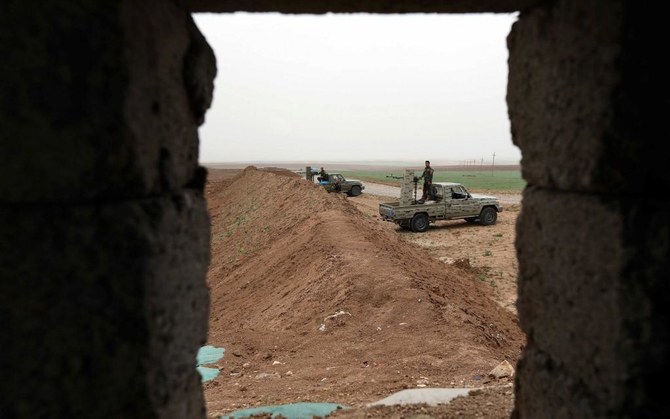
Kurdish fighters hold a position in Faysh Khabur, which lies in Iraq’s Kurdish autonomous region near the three-way border between Iraq, Syria and Turkey in this March 29, 2018 photo. (AFP)
Updated 28 May 2019
Follow

Turkey’s anti-PKK operation begins in Iraq

  • Ankara aims to ‘neutralize terrorists and destroy their shelters’

ANKARA: Turkey launched a military operation against the Kurdistan Workers’ Party (PKK) in northern Iraq on Monday.

Operation Claw, in the Hakurk region along the Turkish and Iranian borders, was conducted by commandos with air and artillery support.

The aim is to “neutralize terrorists and destroy their shelters,” said Turkey’s Defense Ministry. 

PKK militants mainly enter Turkey through Hakurk, and usually launch offensives during spring and summer.

More than 40,000 people have been killed during the group’s decades-long insurgency against the Turkish state. The PKK is listed as a terrorist group by Turkey, the US and the EU.

Iraqi Prime Minister Adel Abdel Mahdi recently visited Ankara and, at a joint press conference with Turkish President Recep Tayyip Erdogan, promised further security cooperation.

Mete Sohtaoglu, an Istanbul-based Middle East expert, told Arab News: “This cross-border ground and air operation has support from Baghdad.”

Sohtaoglu said “time will tell” what Tehran’s reaction is to the Turkish operation. “Another aim of the operation is to cut links between the PKK and its Syrian affiliates,” he added.

The PKK’s jailed leader Abdullah Ocalan recently urged the Kurdish-led Syrian Democratic Forces (SDF) to “consider Turkish sensitivities in Syria, with constitutional assurances given within the framework of Syria’s territorial integrity.” Ankara says the SDF is affiliated with the PKK.

Bilgay Duman, coordinator of Iraq studies at the Ankara-based think-tank ORSAM, said Operation Claw is significant in that it was launched on the same day that Iraqi President Barham Salih was in Turkey for a working visit.

The Iraqi government “can’t become very active against the PKK as it doesn’t have any administrative efficiency in the northern territories, but it’s aware of all of Ankara’s sensitivities and concerns,” he told Arab News.

Duman said he expects Turkey to target specific infrastructure, logistical bases and key PKK figures with Baghdad’s support.

“The PKK’s presence in urban areas (in Iraq) like Sinjar and Mahmour is a serious problem to tackle as well,” he added.


Israel defense minister vows to stay in Gaza, establish outposts

Updated 23 December 2025
Follow

Israel defense minister vows to stay in Gaza, establish outposts

  • His remarks, reported across Israeli media, come as a fragile US-brokered ceasefire between Israel and Hamas holds in Gaza

JERUSALEM: Defense Minister Israel Katz on Tuesday vowed Israel will remain in Gaza and pledged to establish outposts in the north of the Palestinian territory, according to a video of a speech published by Israeli media.
His remarks, reported across Israeli media, come as a fragile US-brokered ceasefire between Israel and Hamas holds in Gaza.
Mediators are pressing for the implementation of the next phases of the truce, which would involve an Israeli withdrawal from the territory.
Speaking at an event in the Israeli settlement of Beit El in the occupied West Bank, Katz said: “We are deep inside Gaza, and we will never leave Gaza — there will be no such thing.”
“We are there to protect, to prevent what happened (from happening again),” he added, according to a video published by Israeli news site Ynet.
Katz also vowed to establish outposts in the north of Gaza in place of settlements that had been evacuated during Israel’s unilateral disengagement from the territory in 2005.
“When the time comes, God willing, we will establish in northern Gaza, Nahal outposts in place of the communities that were uprooted,” Katz said, referring to military-agricultural settlements set up by Israeli soldiers.
“We will do this in the right way and at the appropriate time.”
Katz’s remarks were slammed by former minister and chief of staff Gadi Eisenkot, who accused the government of “acting against the broad national consensus, during a critical period for Israel’s national security.”
“While the government votes with one hand in favor of the Trump plan, with the other hand it sells fables about isolated settlement nuclei in the (Gaza) Strip,” he wrote on X, referring to the Gaza peace plan brokered by US President Donald Trump.
The next phases of Trump’s plan would involve an Israeli withdrawal from Gaza, the establishment of an interim authority to govern the territory in place of Hamas and the deployment of an international stabilization force.
It also envisages the demilitarization of Gaza, including the disarmament of Hamas, which the group has refused.
On Thursday, several Israelis entered the Gaza Strip in defiance of army orders and held a symbolic flag-raising ceremony to call for the reoccupation and resettlement of the Palestinian territory.