

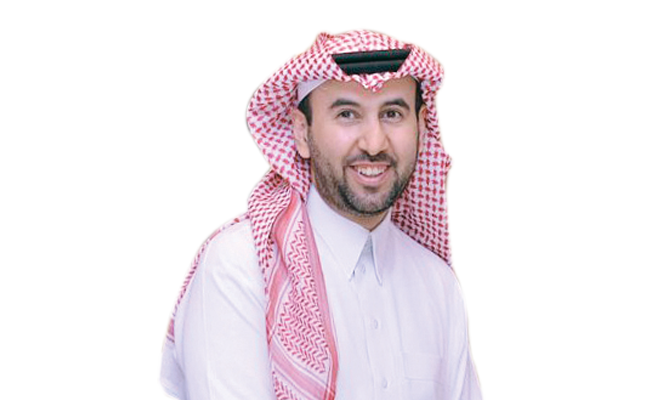
Saad bin Muhareb Al-Muhareb, executive head of the Saudi Publishing and Distribution House

Saad bin Muhareb Al-Muhareb
Updated 27 May 2019
Follow

Saad bin Muhareb Al-Muhareb, executive head of the Saudi Publishing and Distribution House

Saad bin Muhareb Al-Muhareb was recently appointed executive head of the Saudi Publishing and Distribution House by the Minister of Culture Prince Badr bin Abdullah bin Mohammed.

The prince previously announced the establishment of the Saudi Publishing and Distribution House, which is aimed at publishing, marketing and distributing Saudi books in Arab countries.

Saudi Arabia also aims to remove the barriers that previously existed between the Saudi author and the public, while the ministry is keen to support Saudi innovators in all creative fields and through all possible support tracks.

Al-Muhareb is a prominent Saudi author, journalist and academic. He has worked as a lecturer at media and communication college at Al-Imam Muhammad Ibn Saud Islamic University in Riyadh since 2013.

Al-Muhareb also worked as a journalist for various publications in Saudi Arabia, including Asharq Al-Awsat, Al-Eqtisadiah, Alarabiya.net, Elaph and Albilad.

He was also director of the Riyadh International Book Fair in 2016.

Al-Muhareb was editor in chief of SMS (Short Message Service) at Middle East Broadcasting Center (MBC) between 2007 and 2009.

He also served as a public relations officer at the Communications and Information Technology Commission (CITC) between 2003 and 2004.

Al-Muhareb holds a bachelor’s degree in journalism and public relations from Al-Imam Muhammad Ibn Saud Islamic University in Riyadh. He also earned a master’s degree in mass communication and media studies from King Saud University in Riyadh.

He has published four books focused on Saudi media, journalism, Saudi society and literature.


Pakistan, Saudi Arabia explore joint investment push in high-growth regions

Updated 29 min 10 sec ago
Follow

Pakistan, Saudi Arabia explore joint investment push in high-growth regions

  • Both sides discuss combining Pakistan’s production capacity with Saudi capital and regional market access
  • Government says Saudi side expressed interest in corporate farming in Pakistan, particularly in rice sector

KARACHI: Pakistan and Saudi Arabia are looking to jointly tap high-growth regional markets and align production and capital strengths, according to an official statement on Wednesday, following talks between Commerce Minister Jam Kamal Khan and Saudi Investment Assistant Minister Ibrahim Al-Mubarak in the Kingdom.

The two countries have long maintained close bilateral ties that have evolved into a multidimensional strategic partnership.

In October last year, the two countries launched an Economic Cooperation Framework aimed at shifting relations beyond aid toward sustainable trade, investment and development links. The framework followed the signing of a joint security agreement a month earlier, under which aggression against one would be treated as an attack on both.

“A key focus of the discussion was the joint exploration of regional markets, particularly Central Asia, Africa, and ASEAN, identified as high-growth regions offering significant opportunities for collaboration,” according to a statement circulated by Pakistan’s commerce ministry after the meeting.

“The two sides agreed that Pakistan and Saudi Arabia, by leveraging their respective strengths, can position themselves as complementary partners — combining Pakistan’s production capabilities with Saudi Arabia’s capital strength, market access, and regional connectivity,” it added.

The Saudi side expressed interest in corporate farming in Pakistan, particularly in the rice sector, with discussions covering mechanization, storage and logistics to enable consistent, long-term exports under structured arrangements.

Talks also covered broader cooperation in agriculture and food security, including rice, fodder, meat and other agri-products, with the potential involvement of Saudi financing institutions in supporting export-linked agricultural and infrastructure projects.

Corporate farming and mechanization were discussed as long-term solutions to productivity challenges in crops such as cotton, where declining yields and high manual input costs have hurt competitiveness, the statement said.

Human resource development emerged as another area of focus, with both sides noting shortages in mid-tier skills such as nurses, caregivers, technicians and hospitality staff.

The Saudi side expressed openness to replicating vocational “train-to-deploy” models in Pakistan that link training programs directly with overseas employment opportunities.

The meeting also examined opportunities in building materials, pharmaceuticals, sports goods, footwear and light manufacturing, with both sides agreeing to pursue sector-specific workshops and business-to-business engagements to translate policy alignment into tangible trade and investment flows.