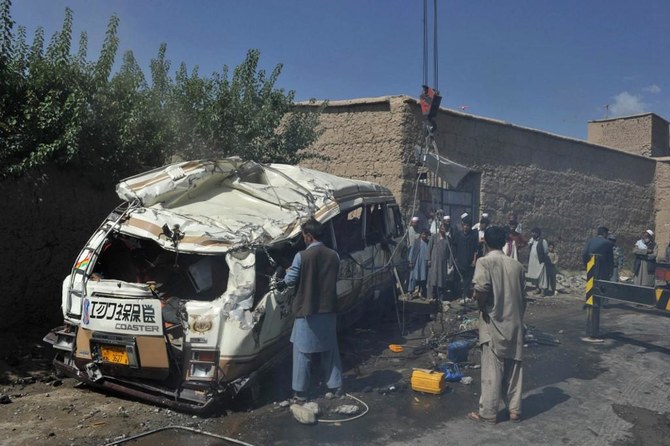
Afghan officials: 10 wounded in Kabul minibus bombing

Taliban militants often conduct attacks and bombings in Kabul. (File/AFP)
Updated 27 May 2019
Follow

Afghan officials: 10 wounded in Kabul minibus bombing

  • An Afghan official says all the wounded are ministry workers
  • Gunmen killed a religious scholar in Kabul yesterday

KABUL: Afghan officials say 10 people were wounded when a sticky bomb attached to a minibus carrying government workers detonated in the capital of Kabul.
Police spokesman Ferdus Faramarz says one of the wounded is in critical condition.
Arab Haidari, from the religious affairs ministry, says all the wounded are ministry’s employees who were on their way to work when the explosion took place on Monday morning.
No group immediately claimed responsibility for the attack but both the Taliban and Daesh militants regularly stage attacks in Kabul.
The bombing comes a day after gunmen shot and killed a prominent religious scholar, Mawlavi Shabir Ahmad Kamawi, in Kabul. Last week, a mosque bombing killed another religious scholar during the Friday prayers sermon, also in Kabul.


Poland slow to counter Russia’s ‘existential threat’: general

Updated 4 sec ago
Follow

Poland slow to counter Russia’s ‘existential threat’: general

  • The general highlighted a low “pace of technical modernization,” compared to increases in the army’s size
  • Kukula said the Polish army should reach 500,000 soldiers by 2039

WARSAW: Russia poses an “existential threat” to Poland and its military is lagging, the country’s armed forces chief warned senior officials on Wednesday.
Poland, the largest country on NATO’s eastern flank and a neighbor of Russia, Belarus, and Ukraine, is the western alliance’s largest spender in relative terms.
This year, the country is allocating 4.8 percent of its GDP to defense, just shy of the alliance’s five percent target to be met by 2035.
However, that record defense spending was not enough to “make up for nearly three decades of chronic underfunding of the armed forces,” General Wieslaw Kukula, chief of the general staff, argued at the meeting, which included top officers, the defense minister and Poland’s president.
The general highlighted a low “pace of technical modernization,” compared to increases in the army’s size.
Kukula said the Polish army should reach 500,000 soldiers by 2039, compared with around 210,000 at present.
As a result of a lack of updates, some new Polish units “are not achieving combat readiness,” due to insufficient equipment, rather than a personnel shortage, the general argued.
Meanwhile, he added, “the Russian Federation remains an existential threat to Poland.”
Russia “is constantly reorganizing its forces, drawing on the lessons from its aggression in Ukraine, and building up the capacity for a conventional conflict with NATO countries,” he stressed.
Poland is to receive 43.7 billion euros ($51,5 billion) in loans under the European Union’s Security Action For Europe (SAFE) scheme, designed to strengthen Europe’s defensive capabilities.
Warsaw plans to use these funds to boost domestic arms production.
The Polish government claims that Poland will be able to access SAFE finance even if President Karol Nawrocki — backed by Poland’s conservative-nationalist opposition — vetos a law setting out domestic arrangements for its implementation.
Law and Justice (PiS) — the main opposition party — argues that SAFE could become a new tool for Brussels to place undue pressure on Poland, thanks to a planned mechanism for monitoring the funds, which they claim risks undermining Polish sovereignty.