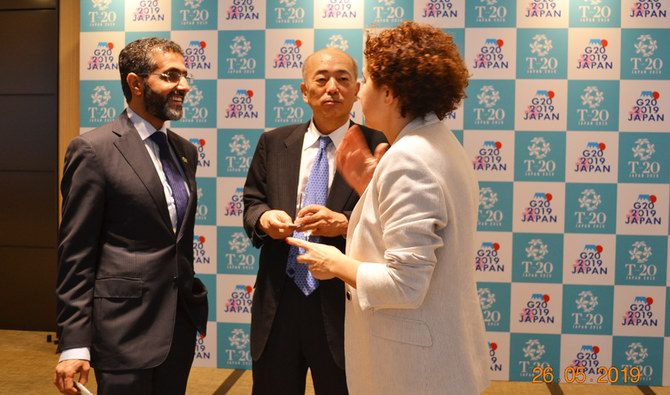
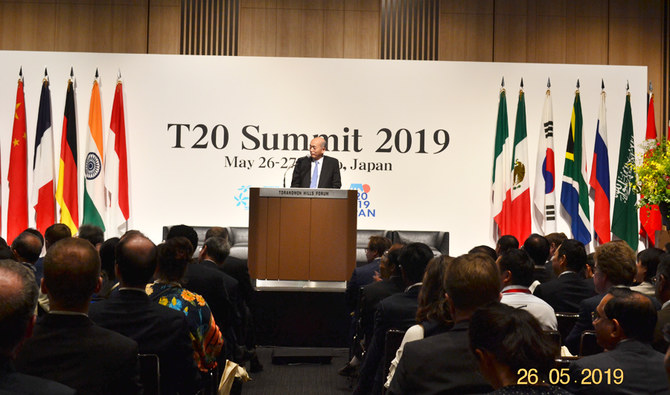
TOKYO: The world’s leading think tanks gathered for the G-20’s Think20 (T20) Japan Summit on Sunday in Tokyo, ahead of the upcoming G-20 Osaka Summit next month.
In the opening address, the president of the Japan Institute of International Affairs (JIIA), Kenichiro Sasae, spoke of the importance of technological advances, governance and multilateralism.
“Technology is a tool,” he told assembled delegates. “We need two guiding symbols to harness modern technology to continue to pull economic growth. Technology has a wade-ranging impact, not only on business but also on privacy, protection.”
The T20 Summit comes amidst the backdrop of a four-day visit to the Japanese capital by US President Donald Trump.
Of the main topics discussed in closed sessions were finding innovative ways to fill economic infrastructure gaps, the US-China trade crisis, how to promote entrepreneurial ecosystems and climate change.
The host country has the privilege of selecting task forces specifically for the T20. Under the theme “Seeking a Sustainable, Inclusive and Resilient Society,” Japan’s T20 recommendations were based on theoretical and empirical analysis, and consist of 10 separate task forces.
They include sustainable development, climate change and environment, cooperation with Africa, Global governance and Future Politics.
Heading the Saudi T20 delegation, Dr. Fahad Al-Turki spoke to Arab News and told of the delegations’ various roles and expectations for the summit.
“We’re working with the Argentines, the Japanese and the Italians to ensure continuity on policy recommendations that will go to the G-20,” he said.
Five Saudi think tanks are being represented at the summit.
“The purpose is to have a collective effort from Saudi Arabia to represent the Kingdom at the T20. The first day went great, we talked with the authors of many of the policy briefs about our views and our recommendations,” he added.
Dr. Hossa Al-Mutairi told Arab News Saudi participation was essential, in anticipation to the 2020 G-20 Riyadh Summit.
“We participated last year as observers (at the 2018 summit in Buenos Aires), we went to learn from the Argentines, attended their sessions to understand the process of organizing T20 as well as how to select the task forces, but mainly to maintain a network with T20 members,” she said.
“One of the presentations that we had was on climate change, as Saudi Arabia cares about climate change, but we also care about economic stability. There is a connection between economics, environment and energy, you can’t separate them and we look into all energy sources.”

Saudi researchers join T20 summit in Japan
- Ways to fill economic infrastructure gaps, the US-China trade crisis analyzed
- Five Saudi think tanks are being represented at the summit
Saudi Arabia led green building performance regionally in 2025: Report
- Saudi Arabia achieved the highest regional score of 76.31 points and certified more than 1.03 million sq. meters of sustainable building space
- Results reflect measurable efficiency gains across 6,662 projects completed since 2010, marking a new regional benchmark for measurable sustainability progress
RIYADH: Saudi Arabia led the region in sustainable building performance and environmental impact in 2025, according to the Saaf index developed by the Saudi Green Building Forum.
Saudi Arabia achieved the highest regional score of 76.31 points and certified more than 1.03 million sq. meters of sustainable building space, the Saudi Press Agency reported on Wednesday.
These results reflect measurable efficiency gains across 6,662 projects completed since 2010, marking a new regional benchmark for measurable sustainability progress and institutional excellence.
The achievement underscores Saudi Arabia’s growing influence in advancing sustainable construction across the Middle East and supports the Kingdom’s Vision 2030 objectives for cleaner growth, resource efficiency and climate resilience through data‑driven environmental performance.
Faisal Al‑Fadl, secretary‑general of SGBF, said that 2025 represented a major turning point toward a measurable, institutional sustainability strategy that united policy, technology and practice.
He added that the approach extended beyond renewable energy, clean water and eco‑friendly materials to embed sustainability in economic planning and public development programs, made possible through integrated efforts with regional governments and public institutions.
The Saaf index provides a specialized regional framework for measuring efficiency and resilience through the Sufficiency and Resilience Composite Index, or SCI, enabling precise performance assessments.
Findings show that the sector has evolved into a cohesive strategy integrating project delivery, professional capacity building, market innovation and climate action.
According to the SGBF review, Saudi Arabia’s achievements reflect its ability to combine quality implementation, institutional maturity and scale.
Environmentally, green building projects achieved an estimated 62,800 tonnes of carbon‑equivalent annual reduction and earned 29 professional recognitions, reinforcing growing international acknowledgment of Saudi leadership in sustainability.
The data also underscore SGBF’s role as a professional partner in advancing methodologies, applications and impact measurement within non‑governmental frameworks that link policy and practical execution.
More than 7,300 professionals across 22 Arab countries engaged with the Saaf platform in 2025, alongside numerous business‑driven initiatives expanding the region’s sustainable‑development footprint.
Al‑Fadl said that the period from 2025 to 2026 would act as a bridge toward Vision 2030, strengthening a model in which sustainable buildings were managed by impact, measured through indicators and implemented via lasting partnerships.
SGBF serves as the Kingdom’s leading platform for advancing sustainable construction and green design. It unites experts, innovators and practitioners dedicated to building environmentally responsible and high‑performance structures.
Through continuous education, certification and collaboration, SGBF drives the transformation of Saudi Arabia’s building sector — minimizing environmental impact, promoting resource efficiency and improving overall quality of life for communities nationwide.


