

Iran will defend itself against any aggression: foreign minister

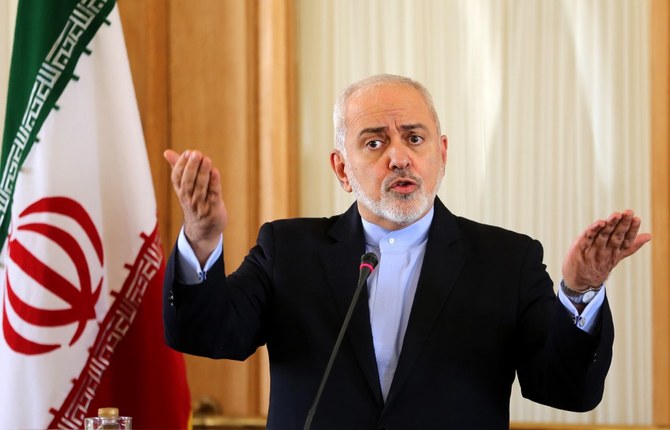
Zarif said they hope to have balanced relations with their gulf neighbors. (File/AFP)
Updated 27 May 2019
Follow

Iran will defend itself against any aggression: foreign minister

  • Iraq said they will act as an intermediary between US and Iran
  • Iran said they proposed to sign a non-aggression pact with Gulf countries

BAGHDAD: Iranian will defend itself against any military or economic aggression, Foreign Minister Mohammad Javad Zarif said on Sunday, calling on European states to do more to preserve a nuclear agreement his country signed.

Speaking in a news conference in Baghdad with his Iraqi counterpart Mohammed Al-Hakim, Zarif said his country wanted to build balanced relations with its Gulf Arab neighbors and that it had proposed signing a non-aggression pact with them.

“We will defend against any war efforts against Iran, whether it be an economic war or a military one, and we will face these efforts with strength,” he said.

Meanwhile,  Iranian Deputy Foreign Minister Abbas Araqchi arrived on Sunday in Oman and discussed "regional developments" with Yousuf bin Alawi bin Abdullah, the sultanate’s minister responsible for foreign affairs, the state-run Oman News Agency reported.
Bin Alawi said earlier this week that his country is trying "with other parties" to calm tensions between the United States and Iran.

Strains have increased between Iran and the United States, which is a firm backer of Tehran’s regional rival Saudi Arabia, after this month’s attack on oil tankers in the Gulf region that Washington has blamed on Iran.

Tehran has distanced itself from the bombings, but the United States has sent an aircraft carrier and an extra 1,500 troops to the Gulf, sparking concerns about the risks of conflict in a volatile region.

Iraq stands with Iran and is willing to act as an intermediary between its neighbor and the United States, Hakim said, adding that Baghdad does not believe an “economic blockade” is fruitful, a reference to US sanctions.

“We are saying very clearly and honestly that we oppose the unilateral actions taken by the United States. We stand with the Islamic Republic of Iran in its position,” said Hakim. The United States and Iran are Iraq’s two main allies.

Washington has been seeking to tighten sanctions against Iran, as relations worsen under President Donald Trump, who last year pulled out of a nuclear agreement his predecessor Barack Obama had signed with Iran alongside other world powers in 2015.

In Tehran, President Hassan Rouhani floated the idea of holding a referendum over Iran’s nuclear program, Iranian media reported.

A referendum over the controversial nuclear program could give Iran’s leaders space to maneuver and a chance to resolve the standoff with the United States.

Top Iranian leaders have said they are not seeking war with the United States and officials speaking to Reuters from Tehran said last week that despite the sharpened rhetoric with Washington, authorities are trying to avoid an open conflict.

“Article 59 of the Constitution (referendum) is a deadlock breaker ... and could be a problem-solver at any junction,” the semi-official news agency ILNA quoted Rouhani as saying late on Saturday.

Rouhani said that, when he was a top nuclear negotiator in 2004, he had proposed holding a referendum on the nuclear issue to Supreme Leader Ayatollah Ali Khamenei.

Iran has only held three referendums since its 1979 Islamic revolution — to approve the setting up of an Islamic Republic and then to approve and amend the constitution.

Washington says it has built up the US military presence in the region, accusing Tehran of threats to US troops and interests. Tehran has described US moves as “psychological warfare” and a “political game”.

Separately, a deputy commander of Iran’s elite Revolutionary Guards said the US military presence in the Middle East was at its “weakest in history” despite the talk of a build-up.


Family of Palestinian-American shot dead by Israeli settler demand accountability

Updated 5 sec ago
Follow

Family of Palestinian-American shot dead by Israeli settler demand accountability

  • Relatives say Abu Siyam was among about 30 residents from the village of Mukhmas who confronted armed settlers attempting to steal goats from the community

LONDON: The family of a 19-year-old Palestinian-American man reportedly shot dead by an Israeli settler in the occupied West Bank have demanded accountability, amid mounting scrutiny over a surge in settler violence and a lack of prosecutions.

Nasrallah Abu Siyam, a US citizen born in Philadelphia, was killed near the city of Ramallah on Wednesday, becoming at least the sixth American citizen to die in incidents involving Israeli settlers or soldiers in the territory in the past two years.

Relatives say Abu Siyam was among about 30 residents from the village of Mukhmas who confronted armed settlers attempting to steal goats from the community. Witnesses said that stones were thrown by both sides before settlers opened fire, wounding at least three villagers.

Abu Siyam was struck and later died of his injuries.

Abdulhamid Siyam, the victim’s cousin, said the killing reflected a wider pattern of impunity.

“A young man of 19 shot and killed in cold blood, and no responsibility,” he told the BBC. “Impunity completely.”

The US State Department said that it was aware of the death of a US citizen and was “carefully monitoring the situation,” while the Trump administration said that it stood ready to provide consular assistance.

The Israeli embassy in Washington said the incident was under review and that an operational inquiry “must be completed as soon as possible.”

A spokesperson for the Israeli Defense Forces said troops were deployed to the scene and used “riot dispersal means to restore order,” adding that no IDF gunfire was reported.

The military confirmed that the incident remained under review and said that a continued presence would be maintained in the area to prevent further unrest.

Palestinians and human rights organizations say such reviews rarely lead to criminal accountability, arguing that Israeli authorities routinely fail to prosecute settlers accused of violence.

A US embassy spokesperson later said that Washington “condemns this violence,” as international concern continues to grow over conditions in the occupied West Bank.

Palestinians and human rights groups say Israeli authorities routinely fail to investigate or prosecute settlers accused of violence against civilians.

Those concerns were echoed this week by the UN, which warned that Israel’s actions in the occupied West Bank may amount to ethnic cleansing.

A UN human rights office report on Thursday said that Israeli settlement expansion, settler attacks and military operations have increasingly displaced Palestinian communities, with dozens of villages reportedly emptied since the start of the Gaza war.

The report also criticized Israeli military tactics in the northern West Bank, saying that they resembled warfare and led to mass displacement, while noting abuses by Palestinian security forces, including the use of unnecessary lethal force and the intimidation of critics.

Neither Israel’s foreign ministry nor the Palestinian Authority has commented on the findings.