
NEW DELHI: Indian Prime Minister Narendra Modi’s landslide victory in the country’s general elections has met with mixed feelings over the future of the economy.
The premier has been re-elected with an overwhelming majority of 305 out of 545 seats in the Lok Sabha (lower house of India’s Parliament). With its alliance partner, the ruling Bharatiya Janata Party (BJP) now holds a commanding position.
The dramatic election win has sparked both hope and apprehension in India over the government’s plans for dealing with a slowing economy and growing unemployment, and the prospects for millions of Muslims living there.
Recent data leaked from the government-owned National Sample Survey Organization (NSSO) revealed that the rate of unemployment was running at its highest level for 45 years. Industrial production was also shown to have dipped, with the automobile sector seeing a downward trend in the last two quarters.
“My time, energy and life are dedicated to the nation and I will leave no stone unturned to take the country to a prosperous path,” said Modi on Thursday evening in his victory speech in New Delhi.
However, Prof. Arun Kumar of New Delhi-based Jawaharlal Nehru University (JNU), said: “The government should first admit that there is a huge problem of unemployment in the country and it should release the data to address it.”
Kumar told Arab News: “Now the elections are over, and people have reposed faith in the government, the Modi regime should come clean on the figure of unemployment and the actual GDP data, and only then would it be able to address the issue honestly.
“The big challenges the government faces are in the unorganized sector which got badly hit by the demonetization of currency in 2016 and the roll out of a new tax regime called GST (general sales tax). These unorganized sectors were the main job providers in small towns and rural areas.”
Prof. Sanjay Srivastava, of New Delhi-based think tank the Institute of Economic Growth, said: “The government will have to address the unemployment and farm crisis in an urgent manner to bring the economy on track.”
“To address youth unemployment, the government will have to streamline the skill development program very effectively to generate jobs. Besides that, the rural sector today is under great stress and the government’s first priority should be to address farmer suicides and their decreasing incomes.”
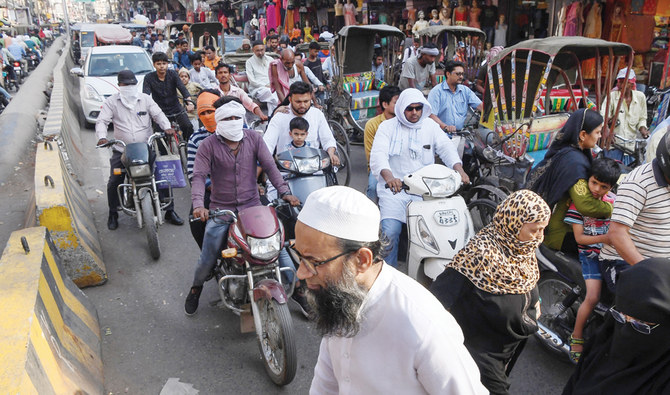
On the political front, one of the biggest challenges for Modi will be to calm the fears of 130 million Muslims in India who have been on the receiving end of political and social marginalization ever since his regime came to power in 2014. The Hindu nationalist party does not have any Muslims among its list of victorious candidates.
During his victory speech, Modi said that “no party can fool people in the name of secularism. Now secularism no longer becomes an election issue.”
Political analyst and former editor of English daily The Tribune, Harish Khare, said: “The 2019 verdict has a chilling message that the minorities’ votes do not count. The Muslims have been told to remain stranded in their own islands of resentments and grievances. They will have to reconcile themselves to a majoritarian polity.”
Prof. Afroz Alam, of Maulana Azad National Urdu University, said: “India cannot afford to cut off its largest minority from the wider political society. If it does so it cannot afford a sustainable growth. It’s time Muslims started looking at the larger picture. They should now look for greater representation in state and central-level jobs,” Alam told Arab News.
People in Kashmir are also apprehensive about their fate. In the last five years the central government has taken a tough approach to dissent in the valley, leading to higher casualties.
A suicide attack earlier this year on a convoy of paramilitary forces that claimed more than 50 lives, almost resulted in all-out war with Pakistan.
Data released by the Ministry of Home Affairs showed that between 2014 and 2018, there had been a 93 percent rise in the number of security personnel killed in terrorist incidents in Jammu and Kashmir, and a 176 percent increase in terrorist incidents in the state.
“Kashmir has no hopes,” said Prof. Sheikh Showkat of the University of Kashmir.
“Kashmir bled in the previous tenure and it may bleed again unless good sense prevails, and they engage both Kashmiris and Pakistan in dialogue.”
Politician Shah Faesal said: “Narendra Modi might go for a measured reciprocation of (Pakistani Prime Minister) Imran Khan’s offer to work together. If it happens, Kashmir will benefit from that.
“We badly need some respite from the cycle of violence. A change in the policy of the central government can make that possible immediately,” added Faesal, who resigned from the Indian administrative service last year to form a new political party.