KARACHI: A bomb at a mosque in the Pakistani city of Quetta on Friday killed at least three people, hospital officials said, in the fifth blast in the southwestern Balochistan province in the last month.
Security forces have been on high alert during the holy month of Ramadan, with extra security set up at major sites around the country following a string of deadly assaults.
Dr. Waseem Baig, a spokesperson at the Quetta Civil Hospital, told Arab News three people had been killed and at least twenty wounded in a blast that took place inside a mosque in the Pashtunabad area of Quetta during Friday congregation prayers.
“Of twenty, the condition of three is critical whereas everyone else is stable,” Baig said, adding that doctors were present at the emergency ward to provide immediate treatment to wounded worshippers.
Balochistan Chief Minister Jam Kamal Khan condemned the blast and called for an investigation.
“The terrorists attacking innocent people on a holy day [Friday] of the holy month [of Ramadan] deserve severe punishment,” he said in a handout issued by his office.
Bomb disposal officials said the blast, which no militant group has as yet claimed, was caused by around two kilograms of explosives placed near the mehrab, the place inside a mosque where the prayer leader stands during congregation.
There have been a string of attacks in the last month in the resource-rich but underdeveloped province of Balochistan whose Gwadar port city is the crown jewel of China’s $62 billion investment in Belt and Road Initiative projects in Pakistan.
On May 9, an improvised bomb rigged to a motorcycle and apparently targeting a police vehicle exploded near a mosque in Quetta, killing at least four policemen and wounding 11.
On the same day, a tribal elder and two others were killed in a blast in the province’s Qilla Abdullah area, and the following day on May 10, two coal miners and three paramilitary soldiers were killed in a blast in Khost.
On May 11, three gunmen dressed as military officers raided the five-star Pearl Continental Hotel in Gwadar, killing three hotel security guards, an employee and a navy soldier in the ensuing gunbattle.
On April 12, a suicide bomb ripped through an outdoor fruit and vegetable market in Quetta, killing at least 18 people, half of them ethnic Hazaras. Six days later, unidentified gunmen killed 14 people, most of them personnel of the Pakistan army, after pulling them from several passenger buses on Balochistan’s southern Makran coast.
Separatist groups have for decades fought a low-level insurgency against the government in the province, complaining that Balochistan’s gas and mineral resources are unfairly exploited by richer provinces, with little reward for the people of Pakistan’s poorest province. The groups also oppose Chinese projects in the area.
“Another nefarious act by evil forces in Quetta,” State Minister for States and Frontier Regions Shehryar Afridi said in a Twitter post after Friday’s attack. “Our resilience will not be shaken by such coward acts ever.”


Three killed in blast inside mosque in Pakistani city of Quetta
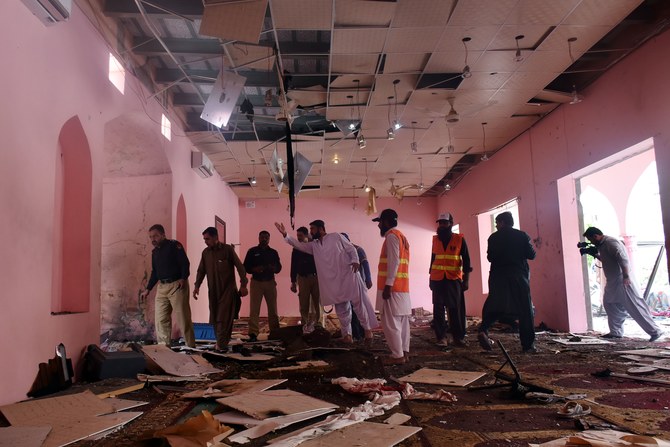
Three killed in blast inside mosque in Pakistani city of Quetta

- Hospital officials say 20 wounded, being treated at Civil Hospital Quetta
- This is the fifth attack in the southwestern Balochistan province in the last month

Pakistan raises fuel prices by Rs55 per liter as Middle East conflict drives oil surge
- Government says adequate fuel stocks in place despite global energy shock
- Oil prices jump from about $78 to over $106 per barrel amid regional conflict
ISLAMABAD: Pakistan on Friday increased petrol and diesel prices by Rs55 ($0.20) per liter each as escalating conflict in the Middle East sent global oil prices sharply higher and disrupted energy supply routes, officials said.
Global oil markets have been rattled since coordinated strikes by the United States and Israel against Iran began last week, triggering retaliatory attacks across the region, raising fears of disruption to key energy shipping routes and pushing petroleum prices sharply upward.
The price adjustment in Pakistan was announced after a joint press conference by Finance Minister Muhammad Aurangzeb, Deputy Prime Minister and Foreign Minister Ishaq Dar and Petroleum Minister Ali Pervaiz Malik, who said the government was monitoring international energy markets and domestic supply conditions amid the crisis.
“So, the decision we have made by changing the levy a little bit is that we are going ahead with increasing the price of both fuels, petrol and diesel, by Rs55 ($0.20),” Malik told reporters.
“And as soon as this matter settles, we will revise the prices downward with the same speed and take steps on how to increase people’s income and purchasing power.”
He said Pakistan entered the crisis with “comfortable energy reserves” due to earlier planning but rising global prices had forced the government to adjust domestic fuel rates to maintain supply continuity.
He said international petrol prices had climbed from roughly $78 per barrel on March 1 to around $106.8 per barrel, while diesel prices had risen to about $150 per barrel.
Malik added that the government had taken steps to minimize the burden on consumers, noting diesel plays a critical role in agriculture, transportation and public mobility.
Malik also warned that authorities would take strict action against anyone attempting to hoard fuel or manipulate supply for profiteering.
The minister said Pakistan was working with international partners to secure additional energy supplies, including arrangements with Saudi Aramco and the use of Pakistan National Shipping Corporation vessels to transport crude oil imports.
Finance Minister Aurangzeb said a high-level government committee formed by Prime Minister Shehbaz Sharif had been meeting daily to review developments in global petroleum markets and their potential impact on Pakistan’s economy.
“Pakistan currently maintains adequate energy stocks and macroeconomic stability,” Aurangzeb said, adding that the government’s response was based on preparedness rather than panic.
He said the committee, which includes senior ministers, the governor of the State Bank of Pakistan and other officials, was assessing short-, medium- and long-term implications of the crisis for inflation, foreign exchange reserves and broader economic indicators.
Deputy PM Dar said the regional conflict had significantly disrupted global energy markets, with international petroleum prices rising by as much as 50–70 percent in recent days.
The deputy prime minister added that Pakistan was also engaged in diplomatic efforts aimed at de-escalating tensions and restoring stability in the region.
Petroleum prices will now be reviewed more frequently, potentially on a weekly basis, and any reduction in global oil prices would be passed on to consumers.
Pakistan, which relies heavily on imported fuel to meet its energy needs, is particularly vulnerable to global oil price shocks that can quickly feed into inflation and pressure the country’s external accounts.


