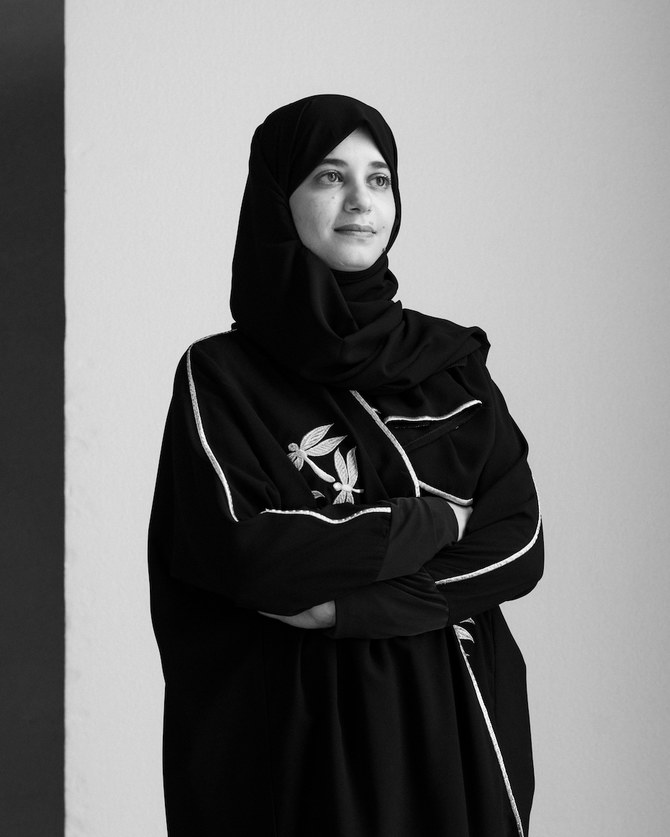


VENICE: The Al-Baha-born, Jeddah-based land artist and arts professor Zahrah Al-Ghamdi has an unwavering passion for creating arresting, large-scale installations composed of natural materials — sand, clay, rocks, leather and the like. Explaining her love of shaping these organic substances, Al-Ghamdi once said: “It’s important for me to smell the sand and feel it with my own hands, because those senses of touch and smell allow my work a synergy, and if I don’t get that synergy, I can’t work.”
This month saw perhaps the most significant accomplishment of Al-Ghamdi’s career to date. The artist was chosen to inaugurate Saudi Arabia’s pavilion at the 2019 edition of the Venice Biennale —the art world’s largest public event and oldest contemporary art show — through an immersive solo exhibition entitled “After Illusion.”
Al-Ghamdi was jointly selected to represent the Kingdom by the recently developed Saudi Ministry of Culture and the Misk Art Institute, a homegrown arts foundation that aims to strengthen artistic activity within the Kingdom.
“To be honest, when I used to read about the Venice Biennale and its unique concept, I felt so far away from that world — it was like a dream,” Al Ghamdi tells Arab News. “In recent years, I’ve worked really hard and always hoped to achieve more through each work I would present. So when I received the call from the Misk Art Institute to participate at the biennale, it was like a dream I never thought I’d dream. I was elated but simultaneously felt a great deal of responsibility, as I am not representing (just) myself, but my country and all its artists.”
Through her debut participation at the biennale, which is open to the public until November 24, Al-Ghamdi joins a canon of female artists putting on solo exhibitions and taking the lead in representing their countries to the world, including Larissa Sansour for Denmark, Laure Prouvost for France, Cathy Wilkes for Great Britain, Nujoom Al-Ghanem for the UAE and Naiza Khan for Pakistan.
In a dimly lit, almost celestial setting, “After Illusion” takes the viewer through a thoughtfully designed constellation of 52,000 manually manipulated leather spheres — or ‘creatures’ as Al-Ghamdi likes to call them — cascading down white drop curtains, while others are scattered on the ground. Adding intimacy to the overall experience, an audio recording of Al-Ghamdi working in her atelier plays within the pavilion’s interior.
As with most of Al-Ghamdi’s works, the exhibition not only reflects an element of Saudi Arabia’s history and evolving identity, but also the artist’s own history, acting as an expressive form of self-portrait.
“One of the things that I liked about Al-Ghamdi’s work is that she makes her work by hand,” says pavilion curator and fellow Saudi artist Eiman Elgibreen. “This is something we are missing lately in the art scene — everyone is doing manufactured, plastic-y things. I was always interested (in the fact) that she works with something very traditional but transforms it into something really contemporary and new. The leather material used here reminds her of her grandfather herding, but now no one herds. And so she took the leather and transformed it, which I thought would go very well with our concept. Just imagine these creatures having a new life and then trying to settle in Venice, reassuring people that it’s not wrong to transform and change, because eventually you’ll reach a new reality that way.”
Al-Ghamdi, too, has undergone transformation in her life and career, evolving her artistic vision by exploring themes of memory and loss, exhibiting works in Dubai’s AlSerkal Avenue and London’s British Museum, among others, and participating in international residency programs and symposiums. It was Al-Ghamdi’s father — a teacher who enjoyed drawing — who first noticed her artistic abilities and encouraged her to pursue the arts.
After obtaining an undergraduate degree in Islamic Arts from Jeddah’s King Abdulaziz University, Al-Ghamdi traveled to England, where she gained Master’s and PhD degrees in Design and Visual Art. It was during her studies abroad that Al-Ghamdi’s artistic knowledge greatly expanded, and land art was her greatest influence.
Land art — which, in its modern sense, gained momentum during the 1970s — was practiced by pioneering Western artists including Robert Smithson, Andy Goldsworthy, Richard Long, and Walter De Maria. Resisting the commercialism of the art world and the confines of the gallery space, they turned instead to vast landscape settings for artistic expression — passionately sculpting into the ground or building massive installations using natural materials.
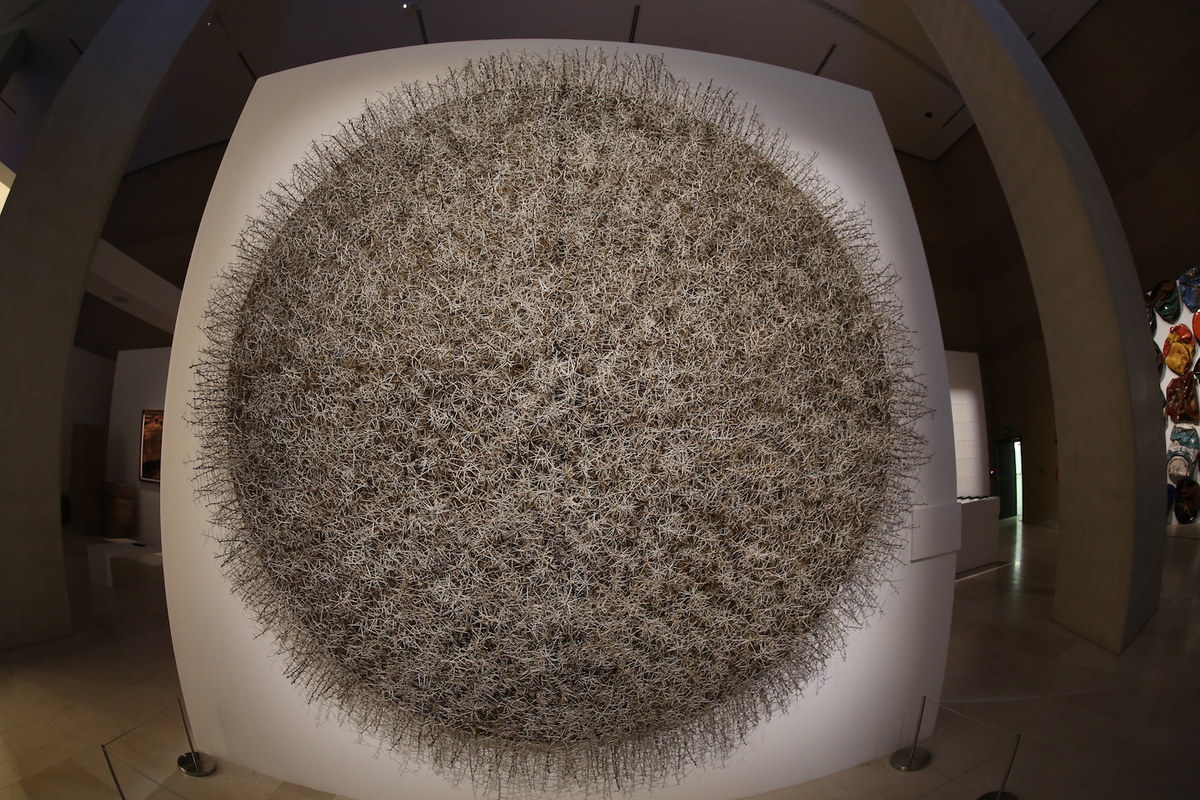
One of Al-Ghamdi's earlier works, 'What Lies Behind The Sun,' was constructed from thorns. (Supplied)
“In Saudi Arabia, the field of research was weak for me. But when I traveled abroad, I was introduced to a whole other world through the Internet and exhibitions,” Al-Ghamdi explains. “I was deeply influenced by land artists Smithson, Goldsworthy, and Long, and I was taken by their ability to use raw materials to express their feelings and attract the attention of viewers. They helped me see ‘nothing’ as something important, and that I could use raw materials to send a message. For instance, in a previous work I made, I placed tough thorns that were found in southern Saudi Arabia in a large circular shape. The thorns may indeed emit stories of pain, (but also), on the contrary, the notion of power and stability.”
Observing her experimental and thought-provoking oeuvre — from a carefully lined floor installation made of rubble to a layered gauze installation soaked in black paint — one may experience an unsettling sense of isolation, sadness, and vulnerability. A kind of destruction, almost.
“That is exactly how I want you to see my work. When I look at architecture, I do not necessarily see the beauty or happiness it exudes. My colleagues often ask me why I focus on the misery of architecture, but that’s what personally interests me — I need to see its truth. When I look at the old, abandoned buildings in the south of Saudi Arabia, they’re isolated and look unhappy to me, as they are surrounded by contradictory modern counterparts that do not attract me,” Al-Ghamdi says. “In my work, I am also trying to send a message to the viewer that the earth, which grants life and stability, suffers from the relentless actions of human beings through dryness, pollution, and war."