

Top Pakistani opposition leaders to meet as anti-government agitation on the cards

1 / 2
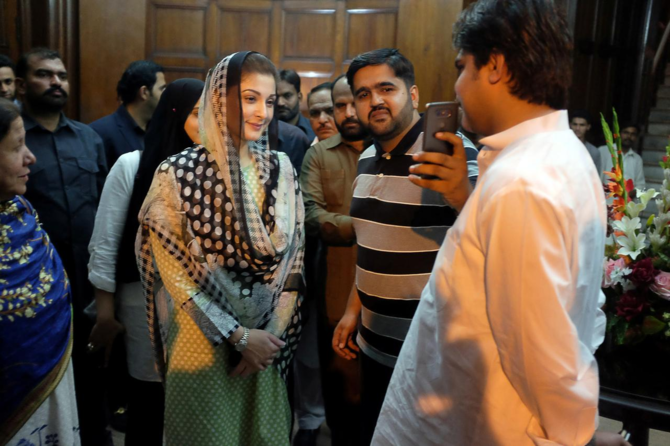
Maryam Nawaz, the daughter of Pakistan's former Prime Minister Nawaz Sharif, now jailed, takes a picture with a supporter at a rally in Lahore, Pakstan September 9, 2017. Picture taken September 9, 2017. (REUTERS / File)
2 / 2
Maryam Nawaz Sharif, daughter of Jailed former Prime Minister Nawaz Sharif’s is due to meet chairman of the Pakistan Peoples Party (PPP), Bilawal Bhutto Zardari, on Sunday. The opposition parties consider launching an anti-government agitation over a ballooning economic crisis, a senior leader of Sharif’s party said on Saturday. (AFP/File Photo)
Updated 19 May 2019
Follow

Top Pakistani opposition leaders to meet as anti-government agitation on the cards

  • Bilwal invited jailed Nawaz Sharif’s daughter, opposition party leaders to iftar meal on Sunday
  • Sharif’s PMLN party will meet on Monday to consider launching agitation against government of PM Khan

ISLAMABAD: Jailed former Pakistani Prime Minister Nawaz Sharif’s daughter, Maryam Nawaz Sharif, will have a rare meeting with the chairman of the Pakistan Peoples Party (PPP), Bilawal Bhutto Zardari, on Sunday as opposition parties consider launching an anti-government agitation over a ballooning economic crisis, a senior leader of Sharif’s party said on Saturday.

Bilawal invited Pakistan Muslim League-Nawaz (PMLN) vice president, Maryam Nawaz Sharif, and other opposition party leaders to an iftar meal on Sunday, which the PMLN’s media wing said in a Twitter post she had agreed to attend.

“Bilawal’s invitation to Maryam is significant and important because they are both leaders of the country’s major political parties,” Romina Khurshid Alam, a PML-N lawmaker and close Maryam aide, told Arab News. “Obviously when they meet, they will discuss the political situation, particularly the worsening economic situation, and its impact on the common man.”

Officials from the PMLN will also be meeting on Monday to plan an anti-government protest campaign following instructions from their jailed leader Nawaz Sharif to launch an agitation against the administration of Prime Minister Imran Khan.

Sharif is currently serving a seven-year sentence imposed last year for failing to disclose the source of income that allowed him to acquire the Al-Azizia Steel Mills in Saudi Arabia. He has appealed. He was let out of prison in March on medical bail but landed back in jail last week after the court refused to extend the bail period.

On Thursday, Sharif met his daughter and other family members and party leaders at Lahore’s Kot Lakhpat Jail and, according to local media reports, instructed them to plan an anti-government protest movement after Eid Al-Fitr, the religious festival that marks the end of the holy month of Ramadan. Economic deterioration, high inflation and unemployment will be the main pillars of the agitation, media said.

“PMLN has summoned a party meeting on Monday,” senior PMLN leader Pervaiz Rashid told Arab News. “The purpose of this call [to protest] is to highlight people’s hardships,” he added, saying he would share details of what the party was planning once Monday’s meeting had taken place.

Inflation at its highest in more than five years has shocked many Pakistanis who voted for PM Khan and his promise to eradicate poverty, create jobs and build an Islamic welfare state.

Bilalwal’s party has also recently hinted that it would launch a street protest against the government after Eid.

Special Assistant to the Prime Minister on Information and Broadcasting, Dr. Firdous Ashiq Awan, has said the PMLN had no justification for launching a movement against the economy, accusing the party of stunting growth during its five-year term from 2013-2018.

“After leading the funeral of the economy, they now want to extract more oil from the people,” she said in a tweet on Friday. In another post, she said: “After wrecking the economy, with what face are they talking about going to the people?”


Pakistan says defense pact with Saudi Arabia elevated brotherly ties to ‘new heights’

Updated 25 February 2026
Follow

Pakistan says defense pact with Saudi Arabia elevated brotherly ties to ‘new heights’

  • Pakistan, Saudi Arabia signed strategic defense pact last year pledging aggression against one will be treated as attack on both
  • Deputy PM Ishaq Dar says enduring bonds with Islamic and Arab nations form vital pillar of Pakistan’s foreign policy 

ISLAMABAD: Deputy Prime Minister Ishaq Dar said on Wednesday that Pakistan’s defense pact with Saudi Arabia elevated its brotherly ties with the Kingdom to “new heights,” stressing that close ties with Arab and Islamic nations form a key pillar of Islamabad’s foreign policy. 

Pakistan and Saudi Arabia signed a Strategic Mutual Defense Agreement on Sept. 17 last year, pledging that aggression against one country would be treated as an attack on both, enhancing joint deterrence and formalizing decades of military and security cooperation.

Both nations agreed in October 2025 to launch an economic cooperation framework to strengthen trade and investment ties. 

“In the Middle East, our landmark Strategic Mutual Defense Agreement with Saudi Arabia has elevated our brotherly ties to new heights,” Dar said while speaking at the Pakistan Governance Forum 2026 event in Islamabad. 

The Pakistani deputy prime minister was speaking on the topic “Navigating International Relations Amidst Changing Geo-Politics.”

Dar noted that Pakistan has reinforced partnerships with other Middle Eastern nations such as the UAE, Qatar, Jordan, Oman, Egypt and Bahrain. He said these partnerships have yielded “concrete agreements” in investment, agriculture, infrastructure, and energy sectors. 

“Our enduring bonds with Islamic and Arab nations form a vital pillar of our foreign policy, and we will continue to expand our partnerships across Asia, Latin America, and Africa,” he said. 

Dar pointed out that the presidents of Kazakhstan, Uzbekistan and Kyrgyzstan have undertaken visits to Pakistan in recent months, reflecting Central Asian nations’ desire to boost cooperation with Islamabad.

On South Asia, the Pakistani deputy PM said Pakistan has successfully transformed its fraternal ties with Bangladesh into “a substantive partnership.”

“Similarly, the trilateral mechanism involving China, Pakistan, and Bangladesh has been launched with a view to expanding and deepening regional cooperation and synergy,” the Pakistani minister said. 

He said Islamabad has strengthened its “all-weather” partnership with China via the second phase of the multi-billion-dollar China-Pakistan Economic Corridor agreement and “unwavering support” from both sides for each other’s core interests. 

Dar said Pakistan had also reinvigorated its partnership with the US, advancing cooperation in trade, technology, investment, and regional stability. 

“This calibrated approach has enhanced our ability to navigate complexity with skill and confidence, ensuring that our national interests are served without compromising our core foreign policy principles,” he said.