UK Brexit compromise talks fail

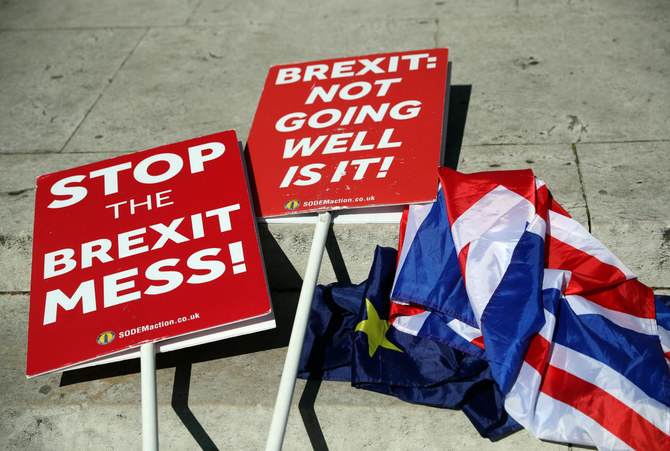
Anti-Brexit placards are seen on the floor outside the Houses of Parliament in London, Britain. (File/Reuters/Hannah McKay)
Updated 17 May 2019
Follow

UK Brexit compromise talks fail

  • Opposition Labour Party leader Jeremy Corbyn said the talks with Prime Minister Theresa May's Conservative government have "gone as far as they can"
  • The two sides have held weeks of negotiations to try to agree on terms for Brexit that can win support in Parliament

LONDON: Talks between Britain's government and opposition aimed at striking a compromise Brexit deal broke down without agreement Friday, plunging the country back into a morass of uncertainty over its departure from the European Union.
Opposition Labour Party leader Jeremy Corbyn said the talks with Prime Minister Theresa May's Conservative government have "gone as far as they can."
In a letter to May released by Labour, Corbyn said "we have been unable to bridge important policy gaps between us."
And with May set to announce within weeks that she plans to step down, Corbyn said the "increasing weakness and instability" of the government made striking a lasting agreement impossible.
The two sides have held weeks of negotiations to try to agree on terms for Brexit that can win support in Parliament. The talks began after lawmakers rejected May's divorce deal with the EU three times.
But the Conservatives and left-of-center Labour differ on how close an economic relationship to seek with the bloc after the UK leaves. Labour wants to stick close to EU rules in order to guarantee seamless trade, while the government wants a looser relationship that would leave Britain freer to strike new trade deals around the world.
Britain was due to leave the EU on March 29, but the bloc has extended the Brexit deadline until Oct. 31 amid the political impasse in the UK.
That deadlock has deepened this week with the breakdown of the cross-party talks and intensifying pressure on May from within the Conservative Party to quit.
Pro-Brexit Conservatives are furious that Britain hasn't yet left the EU, almost three years after voters backed Brexit in a referendum. Many blame May and want her replaced with a more staunchly pro-Brexit leader such as former Foreign Secretary Boris Johnson.
On Thursday, May agreed to set out a timetable for her departure early next month, raising the prospect that Britain will get a new prime minister before it leaves the EU.
Her resignation, when it comes, will trigger a party leadership contest in which any Conservative lawmaker can run. The winner will become party leader and prime minister without the need for a general election.
May plans to make a fourth attempt to get lawmakers' backing for Brexit terms by putting a withdrawal agreement bill to a vote during the week of June 3.
She says that if it passes, Britain could leave the EU in July, well before the October deadline set by the bloc.
But it's unclear how the government plans to persuade a majority of lawmakers to back May's EU divorce terms, since few legislators on either side of the Brexit divide seem prepared to change their positions.


EU leaders begin India visit ahead of ‘mother of all deals’ trade pact

Updated 3 sec ago
Follow

EU leaders begin India visit ahead of ‘mother of all deals’ trade pact

  • Antonio Luis Santos da Costa, Ursula von der Leyen are chief guests at Republic Day function
  • Access to EU market will help mitigate India’s loss of access to US following Trump’s tariffs

New Delhi: Europe’s top leaders have arrived in New Delhi to participate in Republic Day celebrations on Monday, ahead of a key EU-India Summit and the conclusion of a long-sought free trade agreement.

European Council President Antonio Luis Santos da Costa and European Commission President Ursula von der Leyen arrived in India over the weekend, invited as chief guests of the 77th Republic Day parade.

They will hold talks on Tuesday with Prime Minister Narendra Modi at the EU-India Summit, where they are expected to announce a comprehensive trade agreement after years of stalled negotiations.

Von der Leyen called it the “mother of all deals” at the World Economic Forum in Davos last week — a reference made earlier by India’s Commerce Minister Piyush Goyal — as it will create a market of 2 billion people.

“The India-EU FTA has been a long time coming as negotiations have been going on between the two for more than a decade. Some of the red lines that prevented the signing of the FTA continue to this date, but it seems that the trade negotiations have found a way around it,” said Anupam Manur, professor of economics at the Takshashila Institution.

“The main contentious issue remains the Indian government’s desire to protect the farmers and dairy producers from competition and the European Union’s strict climate-based rules and taxation. Despite this, both see enormous value in the trade deal.”

India already has free trade agreements with more than a dozen countries, including Australia, the UAE, and Japan.

The pact with the EU would be its third in less than a year, after it signed a multibillion CEPA (comprehensive economic partnership agreement) with the UK in July and another with Oman in December. A week after the Oman deal, New Delhi also concluded negotiations on a free trade agreement with New Zealand, as it races to secure strategic and trade ties with the rest of the world, after US President Donald Trump slapped it with 50 percent tariffs.

The EU is also facing tariff uncertainty. Earlier this month Trump threatened to impose new tariffs on several EU countries unless they supported his efforts to take over Greenland, which is an autonomous region of Denmark.

“The expediting factor in the trade deal is the unilateral and economically irrational trade decisions taken by their biggest trading partner, the United States,” Manur told Arab News.

Being subject to the highest tariff rates, India has been required to sign FTAs with other major economies. Access to the EU market would help mitigate the loss of access to the US.

The EU is India’s largest trading partner in goods, accounting for about $136 billion in the financial year 2024-25.

Before the tariffs, India enjoyed a $45 billion trade surplus with the US, exporting nearly $80 billion. To the EU’s 27 member states, it exports about $75 billion.

“This can be sizably increased after the FTA,” Manur said. “Purely in value terms, this would be the biggest FTA for India, surpassing the successful FTAs with the UK, Australia, Oman and the UAE.”