ISLAMABAD: Pakistani education minister Shafqat Mahmood said on Wednesday Pakistan would soon launch a new program that relied on technology, specifically on mobile phones and SMS texts, to increase female literacy in a country where one in three girls miss out on primary school.
Nearly 22.5 million of Pakistan’s estimated 50 million children are out of school, most of them girls, Human Rights Watch (HRW) said in a report last year, highlighting the problems of poverty, lack of federal investment and a shortage of government schools. At around the age of 14, only 13 percent girls are still in education, HRW said, attributing this mainly to a shortage in secondary schools for girls, as well sexual harassment, early marriage, gender discrimination and abusive teachers.
“Now we are looking at maybe the possibility of using technology,” Mahmood told Arab News in response to a question about the government’s plans to increase female literacy.
In figures released in July 2018, the Pakistan Telecommunication Authority said Pakistan had 151 million cellphone users, a demographic Mahmood wants to capitalize on to improve literacy rates.
He said his ministry was experimenting with various ideas and on Wednesday, he would be briefed about a project designed by telecommunications giant Mobilink Jazz to address the problem of illiteracy through mobile devices and text messaging.
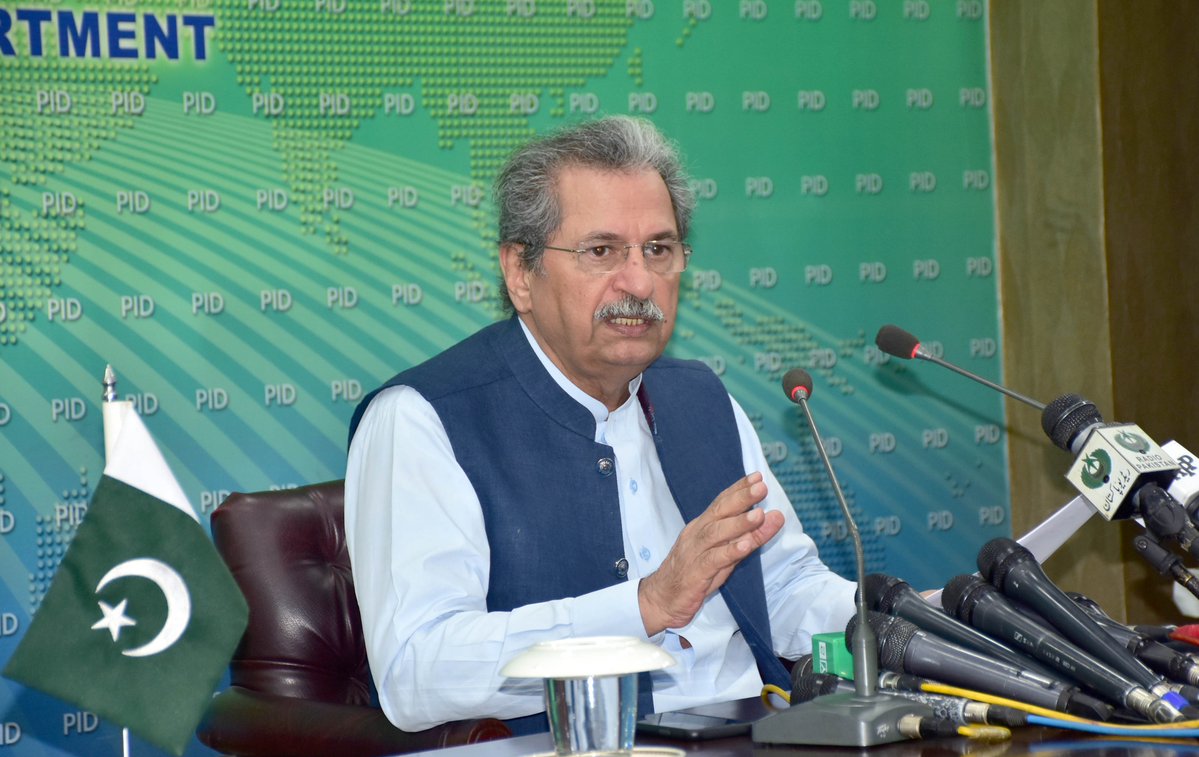
In this image from May 6, 2019, Pakistan's education minister, Shafqat Mahmood, can be seen addresssing a news conference in Islamabad. (PID)
“I am a little excited about this, I am trying to contain my excitement,” the minister said, speaking about the project which he said is yet to be named. “Because if we are able to use technology we will overcome many hurdles.”
He explained that the project being prepared by the government would take away the need for at least 2.1 million teachers and 700,000 literacy centers. Also, he said, while people, especially girls, couldn’t be forced to physically attend literacy centers and schools, even people who weren’t well-educated or from lower middle class backgrounds knew how to use mobile phones now.
Another problem, Mahmood said, was that many people in a conservative country like Pakistan did not want to send their daughters to school, especially if there were no schools near the home, and so getting an education using cell phones could be an answer to a cultural problem also.
The education minister said in rural areas, there were often no higher secondary schools near people’s homes “and therefore the girls have to travel long distances and the parents are not ready to do that.”
“If we can use technology,” the education minister said, “if people are sitting at home and getting some kind of methodology through which literacy is happening on their mobile devices, so you [government] distributes mobile devices and use them to create literacy.
“That’s a very interesting area [and] sort of where I am looking into,” the minister said. “It’s early days.”
Worldwide, more than 130 million girls are out of school, costing the global economy as much as $30 trillion, according to the World Bank.
Pakistani Taliban and allied Islamist militants, who regard girls education as anti-Islam, have been attacking thousands of schools for young women in northwestern and northern parts of Pakistan.
In 2012, the Pakistani Taliban shot and critically wounded Nobel prize winner Malala Yousafzai, known for her girls’ education advocacy in northern Swat valley.
Pakistan spent less than 2.8 percent of its GDP on education in 2017 — falling far short of the United Nations’ recommended 4 to 6 percent.
Before his election as prime minister in August, Imran Khan promised to “prioritize establishment and upgradation of girls’ schools and provide stipends to girls and women for continuing their education” in his party’s manifesto. Little has been done so far though the education minister said the government was planning many new initiatives.
Maha Arshad, an impact investment practitioner who has previously worked with Teach For Pakistan, outlined some of the causes of low female literacy rates in Pakistan. In many cases, she said, girls were helping their mothers take care of the rest of the children at home and families with limited resources preferred to send their boys to school over girls.
But Nadia Naviwala, a Global Fellow at the Woodrow Wilson Center, said it was a “huge myth” that Pakistani parents did not want to send their daughters to school.
“It is more of a supply problem,” she said. “The government schools are primarily staffed by men, the public sector teachers are mainly men which is why most parents do not want to send their girls to study at those schools.”
Education minister Mahmood agreed that the problem was one of supply which required the government “to build more schools, but also to re-think the schools we already have.”
“The reality is a child in school who has spent three years in a school here cannot read a sentence and that’s a majority of third graders,” Naviwala said. “It makes you think what is wrong with these schools? They’re not schools. Pakistan does not provide strong education to its children. There is not a dramatic difference between a child who attends school and one who doesn’t, not as dramatic as you would expect it to be.”