

Palestinian’s suspicious death in Turkey: ‘Those who did this to my brother are not human’

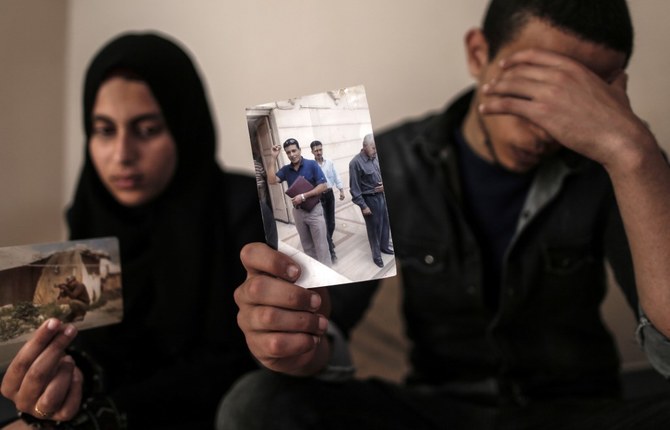
Zaki’s family does not believe he committed suicide in prison. (AFP/File)
Updated 17 May 2019
Follow

Palestinian’s suspicious death in Turkey: ‘Those who did this to my brother are not human’

  • Brother of deceased said Turkish authorities emptied the body of organs
  • Turkish medical report confirms the presence of injuries on the body

DUBAI: Those who defiled the body of his brother are not human, lamented the sibling of a Palestinian who died while in Turkish custody for allegations of espionage.

Those who committed this are not human, Zakariya Mubarak told Al-Arabiya in a live interview.

“The tongue was not inside the body, it was stuffed with cotton,” he said.

Worse, it is now impossible to reinvestigate the stated reasons for Zaki’s death, as the cadaver’s current state makes it hard to perform autopsy again.

“I was just told that it is impossible to rerun the autopsy, as there is nothing inside the body, it was completely emptied,” Zakariya explained.

Turkish authorities have claimed that Zaki died in custody after committing suicide on April 28, but his family believes he died of torture in Turkish prisons. He was earlier detained along with another Palestinian on charges of espionage.

Zakariya told Al-Arabiya that he was shocked when he first saw the body of his brother, as the injuries Zaki suffered made him even unsure if it was him.

“Until his two daughters came and recognized him by the special markings on his body,” he added.

Zakariya described his brother as a trusting person who was betrayed by the same people he trusted.

“Zaki had great trust in the Islamic system in Turkey,” he said.

The man said his brother believed that Turkish president Recep Tayyip Erdogan was supportive of Palestinians, which encouraged him to enter Turkey with his Palestinian passport.

“He could have entered with the Bulgarian refugee document, it could have protected him from what he went through,” he explained.

Zakariya said his brother was betrayed because he was Palestinian, “as if the Palestinian blood is cheap.”

He said the Palestinian embassy has not provided much help or support, he had to move the body to Egypt on his own.

“We are very grateful to Egypt for providing the moral support, however, what they can do is limited,” Zakariya said.

A physical examination is the solution the deceased’s family decided to follow, as an autopsy would not reveal the cause of death due to the body’s state.

“I am sure we will win in the international courts,” Zakariya said.

Zakariya also claimed the Turkish medical report contradicts itself, and confirms the presence of injuries and wound marks on the body.


Iraq majority bloc backs Nouri al-Maliki as next PM: statement

Updated 8 sec ago
Follow

Iraq majority bloc backs Nouri al-Maliki as next PM: statement

  • The Coordination Framework said that it “decided, by majority vote, to nominate” Al-Maliki for the position
  • The statement spoke of Al-Maliki’s “political and administrative experience and his record in running the state“

BAGHDAD: Iraq’s main Shiite alliance, which holds a parliamentary majority, endorsed on Saturday former prime minister and powerbroker Nouri Al-Maliki as the country’s next premier.
The Coordination Framework, an alliance of Shiite factions with varying links to Iran, said in a statement that it “decided, by majority vote, to nominate” Al-Maliki for the position “as the candidate of the largest parliamentary bloc.”
The statement spoke of Al-Maliki’s “political and administrative experience and his record in running the state.”
A shrewd politician, Al-Maliki, 75, has long been a central figure in Iraq’s politics and its only two-term prime minister (2006-2014) since the US invasion of 2003, which ended decades of rule by the autocratic Sunni president Saddam Hussein.
Since the invasion and by convention in Iraq, a Shiite Muslim holds the powerful post of prime minister, a Sunni is parliament speaker, and the largely ceremonial presidency goes to a Kurd. After Iraq’s November general election, the Coordination Framework, which includes Al-Maliki, formed the majority bloc.
Soon after, it held heated talks to choose the next prime minister, along with other discussions with Sunni and Kurdish parties regarding other posts.
Iraq’s parliament chose a speaker last month and should convene next to elect a new president, who will then appoint a prime minister to replace the incumbent Mohammed Shia Al-Sudani.
Al-Maliki, leader of the State of Law Coalition, remains influential in Iraqi politics despite his controversial past, including widespread accusations of corruption, stoking sectarian tensions, and failing to stop the Daesh group.