

Saudi economic reforms ‘yielding positive results,’ says IMF

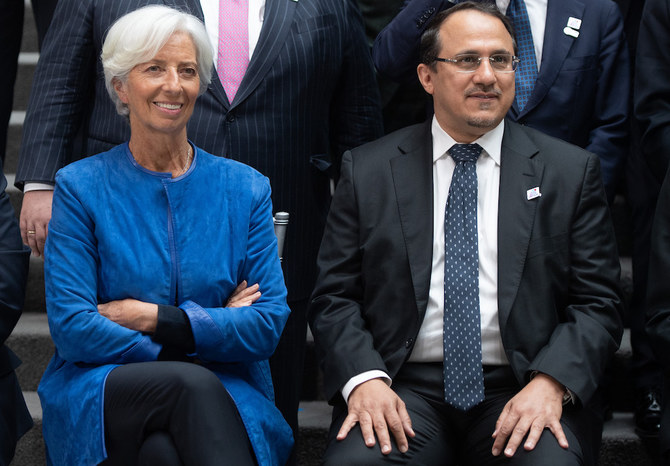
IMF Managing Director Christine Lagarde sits alongside Ahmed Alkholifey, Governor of the Saudi Arabian Monetary Authority (SAMA), during the G20 Finance Ministers and Central Bank Governors Meeting in Washington, DC. (File/AFP)
Updated 16 May 2019
Follow

Saudi economic reforms ‘yielding positive results,’ says IMF

  • Non-oil sector expected to grow at a faster rate this year
  • Fiscal deficit seen rising to 7 percent of GDP in 2019

LONDON: Economic reforms underway in Saudi Arabia have started to yield “positive results,” the IMF said on Wednesday — although the fund cautioned that challenges, notably the level of government spending, remain.
The International Monetary Fund (IMF) issued its preliminary findings on the Kingdom’s economy following an official staff visit to the country, prior to the preparation of a final report.
It found that reforms under the Vision 2030 program — the ambitious plan to diversify Saudi Arabia’s economy set out three years ago — were paying off. 
“Reforms to the capital markets, legal framework, and business environment are progressing well,” the IMF said. 
“Non-oil growth has picked-up, female labor force participation and employment have increased.”
Other factors the IMF cited include the “successful introduction” of value-added tax (VAT), energy price reforms, and an increase in fiscal transparency.
But several challenges remain, the IMF cautioned. 

“Government spending has risen, supporting growth but raising medium-term fiscal vulnerabilities to lower oil prices. Fiscal consolidation is needed to reduce these vulnerabilities. More generally the economic footprint of the public sector is still large,” it said.
The IMF said unemployment among Saudi nationals remains high.
“To deliver a diversified, productive and competitive economy, reforms need to make Saudi nationals more competitive for private sector jobs, raise foreign direct investment, and increase the availability of finance for young and growing companies,” it said.
The fund said Saudi Arabia’s non-oil sector is expected to grow at a faster rate this year, at 2.9 percent.
Yet the IMF said it expects Saudi Arabia’s fiscal deficit — the difference between government spending and revenues — to rise to 7 percent of GDP in 2019, from 5.9 percent last year.
It urged fiscal consolidation to reduce the impact of “medium-term” vulnerabilities. 
“If oil prices are lower than assumed in the government’s budget plan, the country would face large fiscal deficits unless spending was reduced,” it said.
The fund said the government should consider lowering its wage bill and increasing the VAT rate. 
“A reduction in the government wage bill, a more measured increase in capital spending, and the better targeting of social benefits will all yield fiscal savings. The introduction of the VAT has been very successful, and consideration should be given to raising the rate from 5 percent, which is low by global standards, in consultation with other GCC countries,” it said.


Diriyah Co. partners with Midad to develop Four Seasons hotel in Diriyah 

Updated 07 January 2026
Follow

Diriyah Co. partners with Midad to develop Four Seasons hotel in Diriyah 

RIYADH: Saudi Arabia’s sovereign wealth fund-backed developer, Diriyah Co., has signed a joint development agreement with Midad Real Estate Investment and Development Co. to construct the Four Seasons Diriyah Hotel and private residences. 

The partnership will strengthen collaboration between the two companies through the development of the luxury Four Seasons Diriyah, which will feature 159 rooms, alongside private Four Seasons residences, spanning approximately 235,000 sq. meters within Diriyah’s master plan. 

The project’s total value is projected at SR3.1 billion (approximately $827 million), encompassing both land acquisition and construction expenses. 

Midad is one of the Kingdom’s leading real estate developers, expanding its portfolio of high-end projects and maintaining numerous strategic partnerships with prominent global brands, reinforcing its reputation as a trusted name in luxury residential and hospitality development across Saudi Arabia. 

This partnership marks the first major collaboration between Diriyah Co. and Midad, supporting Diriyah’s plans to develop 40 luxury hotels across its two main projects: the 14-sq.-km Diriyah Project and the 62-sq.-km Wadi Safar Project, a premium destination that blends lifestyle, culture, and entertainment. 

Commenting on the agreement, Minister of Tourism and Secretary-General of Diriyah Co., Ahmad Al-Khatib, said: “The Kingdom continues to set new standards in developing tourism destinations, with Diriyah at the forefront.” 

He added that such partnerships enhance the world-class experiences Saudi Arabia offers and strengthen the Kingdom’s position as a leading destination in this sector. 

Diriyah Co. CEO Jerry Inzerillo commented that the Four Seasons Diriyah Hotel and Residences will be one of the Kingdom’s largest luxury hotels. 

“We are proud to announce this joint development with Midad, one of Saudi Arabia’s top real estate developers. This agreement reflects our ongoing commitment to enabling Saudi partners to contribute to Diriyah’s transformative journey and confirms Midad’s confidence in the opportunities the project presents,” Inzerillo added. 

Midad CEO Abdelilah bin Mohammed Al-Aiban said: “This project is a pivotal milestone for our company, allowing us to bring the Four Seasons experience to one of the Kingdom’s most prominent heritage destinations.” 

He added: “We are excited to deliver a project that embodies design excellence, world-class service, and sustainable value, while contributing meaningfully to Saudi Arabia’s tourism, cultural, and economic ambitions.” 

The collaboration comes amid rapid progress on the SR236 billion Diriyah project, which has awarded construction contracts worth more than SR101.25 billion to date. 

Diriyah is expected to contribute approximately SR70 billion directly to the Kingdom’s gross domestic product, create more than 180,000 jobs, accommodate 100,000 residents, and host around 50 million annual visitors. 

The development will feature contemporary office spaces accommodating tens of thousands of professionals across technology, media, arts, and education, complemented by museums, retail destinations, a university, an opera house, and the Diriyah Arena.  

It will also offer a diverse selection of restaurants and cafes, alongside nearly 40 world-class resorts and hotels distributed across its two primary master plans.