

Saudi economic reforms ‘yielding positive results,’ says IMF

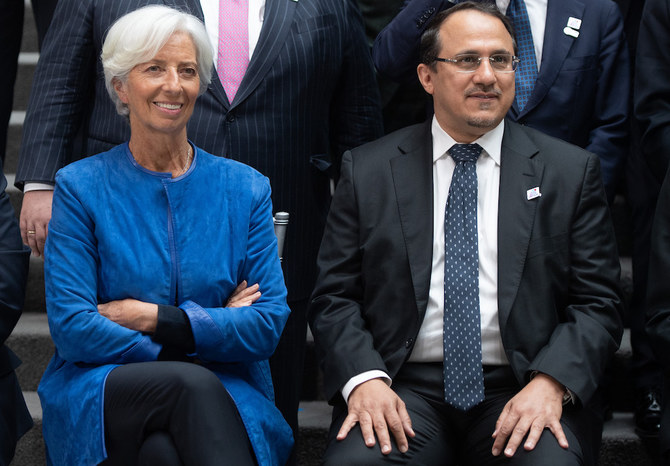
IMF Managing Director Christine Lagarde sits alongside Ahmed Alkholifey, Governor of the Saudi Arabian Monetary Authority (SAMA), during the G20 Finance Ministers and Central Bank Governors Meeting in Washington, DC. (File/AFP)
Updated 16 May 2019
Follow

Saudi economic reforms ‘yielding positive results,’ says IMF

  • Non-oil sector expected to grow at a faster rate this year
  • Fiscal deficit seen rising to 7 percent of GDP in 2019

LONDON: Economic reforms underway in Saudi Arabia have started to yield “positive results,” the IMF said on Wednesday — although the fund cautioned that challenges, notably the level of government spending, remain.
The International Monetary Fund (IMF) issued its preliminary findings on the Kingdom’s economy following an official staff visit to the country, prior to the preparation of a final report.
It found that reforms under the Vision 2030 program — the ambitious plan to diversify Saudi Arabia’s economy set out three years ago — were paying off. 
“Reforms to the capital markets, legal framework, and business environment are progressing well,” the IMF said. 
“Non-oil growth has picked-up, female labor force participation and employment have increased.”
Other factors the IMF cited include the “successful introduction” of value-added tax (VAT), energy price reforms, and an increase in fiscal transparency.
But several challenges remain, the IMF cautioned. 

“Government spending has risen, supporting growth but raising medium-term fiscal vulnerabilities to lower oil prices. Fiscal consolidation is needed to reduce these vulnerabilities. More generally the economic footprint of the public sector is still large,” it said.
The IMF said unemployment among Saudi nationals remains high.
“To deliver a diversified, productive and competitive economy, reforms need to make Saudi nationals more competitive for private sector jobs, raise foreign direct investment, and increase the availability of finance for young and growing companies,” it said.
The fund said Saudi Arabia’s non-oil sector is expected to grow at a faster rate this year, at 2.9 percent.
Yet the IMF said it expects Saudi Arabia’s fiscal deficit — the difference between government spending and revenues — to rise to 7 percent of GDP in 2019, from 5.9 percent last year.
It urged fiscal consolidation to reduce the impact of “medium-term” vulnerabilities. 
“If oil prices are lower than assumed in the government’s budget plan, the country would face large fiscal deficits unless spending was reduced,” it said.
The fund said the government should consider lowering its wage bill and increasing the VAT rate. 
“A reduction in the government wage bill, a more measured increase in capital spending, and the better targeting of social benefits will all yield fiscal savings. The introduction of the VAT has been very successful, and consideration should be given to raising the rate from 5 percent, which is low by global standards, in consultation with other GCC countries,” it said.


Saudi stock market opens its doors to foreign investors

Updated 06 January 2026
Follow

Saudi stock market opens its doors to foreign investors

RIYADH: Foreigners will be able to invest directly in Saudi Arabia’s stock market from Feb. 1, the Kingdom’s Capital Market Authority has announced.

The CMA’s board has approved a regulatory change which will mean the capital market, across all its segments, will be accessible to investors from around the world for direct participation.

According to a statement, the approved amendments aim to expand and diversify the base of those permitted to invest in the Main Market, thereby supporting investment inflows and enhancing market liquidity.

International investors' ownership in the capital market exceeded SR590 billion ($157.32 billion) by the end of the third quarter of 2025, while international investments in the main market reached approximately SR519 billion during the same period — an annual rise of 4 percent.

“The approved amendments eliminated the concept of the Qualified Foreign Investor in the Main Market, thereby allowing all categories of foreign investors to access the market without the need to meet qualification requirements,” said the CMA, adding: “It also eliminated the regulatory framework governing swap agreements, which were used as an option to enable non-resident foreign investors to obtain economic benefits only from listed securities, and the allowance of direct investment in shares listed on the Main Market.”

In July, the CMA approved measures to simplify the procedures for opening and operating investment accounts for certain categories of investors. These included natural foreign investors residing in one of the Gulf Cooperation Council countries, as well as those who had previously resided in the Kingdom or in any GCC country. 

This step represented an interim phase leading up to the decision announced today, with the aim of increasing confidence among participants in the Main Market and supporting the local economy.

Saudi Arabia, which ‌is more than halfway ‍through an economic plan ‍to reduce its dependence on oil, ‍has been trying to attract foreign investors, including by establishing exchange-traded funds with Asian partners in Japan and Hong Kong.