

UAE slams Iranian aggression but calls for calm amid oil tanker attack investigation

1 / 2
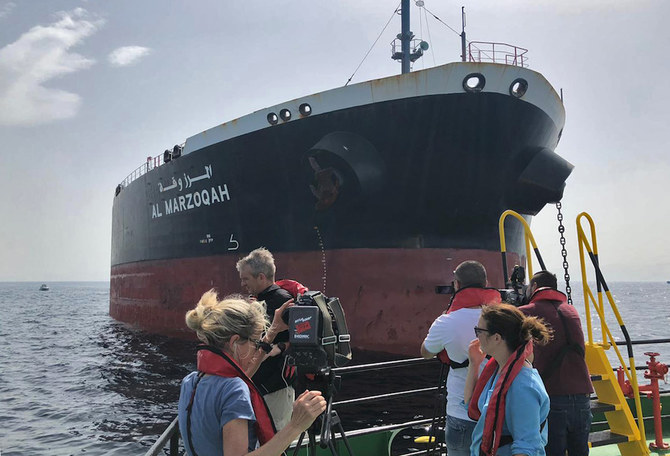
Saudi oil tanker Al-Marzoqah, one of the four tankers damaged in sabotage attacks. (AFP)
2 / 2
UAE Navy boats next to Al Marzoqah Saudi Arabia tanker are seen off the Port of Fujairah, UAE May 13, 2019. (Reuters)
Updated 16 May 2019
Follow

UAE slams Iranian aggression but calls for calm amid oil tanker attack investigation

  • Minister of State for Foreign Affairs Anwar Gargash says investigation underway
  • Too early to say who is responsible but Iranian behavior central to regional problems

DUBAI: The UAE is “very committed to de-escalation” after the sabotage of four oil tankers off the coast of Fujairah on Sunday, a senior minister said Wednesday.

An investigation is underway and due to be completed within days, Minister of State for Foreign Affairs Anwar Gargash said, refusing to state who was responsible. But speaking in Dubai, he added that “Iranian behavior” was at the center of regional problems.

Though declining to name a suspect in the sabotage, Gargash says “Iranian behavior” is at the center of regional problems.
“We need to emphasize caution and good judgment. It is easy to throw accusations but it is a difficult situation, there are serious issues and among them is Iranian behavior,” he said. “We have been bullied by Iran, we have seen aggressive Iranian action in the region.”

He added that the UAE has handed a letter to the security council on the sabotage of the oil tankers. 

Gargash also talked about the threat from Iran-backed Houthis in Yemen, where the UAE is part of a coalition supporting the government against the militants.

On Tuesday, drones attacked two pumping stations on a pipeline running between the country’s east and west coasts.

“We will also retaliate and retaliate hard when we see the Houthis hit civilian targets within Saudi Arabia,” Gargash said.

His comments come as tensions escalate in the region, with the US deploying an aircraft carrier and B-52 bombers in response to Iran-related threats. The US and other European countries on Wednesday announced they were scaling back their presence in Iraq where powerful Iran-backed armed groups hold sway.

Ratcheting up the rhetoric, the commander of Iran's Islamic Revolutionary Guard Corps, Major Gen.Hossein Salami, said on Wednesday they were "on the cusp of a full-scale confrontation with the enemy."


Israeli police kill Bedouin man during raid in southern Israel, local official says

Updated 58 min 48 sec ago
Follow

Israeli police kill Bedouin man during raid in southern Israel, local official says

  • The shooting of 36-year-old Muhammed Hussein Tarabin threatened to worsen the already strained relations between the Israeli government and the country’s Bedouin minority

TEL AVIV: Israeli police shot and killed a Bedouin Arab man during an overnight raid in his village in southern Israel, according to media reports and a local official.
The shooting of 36-year-old Muhammed Hussein Tarabin threatened to worsen the already strained relations between the Israeli government and the country’s Bedouin minority.
Israeli police have been conducting a large-scale operation in the village of Tarabin for the past week in what they describe as a crackdown on local crime.
Talal Alkernawi, the mayor of the nearby town of Rahat, confirmed the man’s death.
Israeli police said they opened fire on a man who had “endangered” forces during an arrest raid.
The Israeli news site Haaretz cited relatives as saying Tarabin, whose family name shares the name of the village, was in his home.
In a video statement, Tarabin’s 11-year-old son, Hussein, said that men in uniform came to their house at night. He heard shots and saw his father’s body lying on the ground.
Israel’s far-right National Security Minister Itamar Ben-Gvir, who oversees the police force, expressed support for the police. “Anyone who endangers our police officers and fighters must be neutralized,” he posted on X.
Prime Minister Benjamin Netanyahu said Sunday that the country would do everything to prevent the Negev desert in southern Israel from becoming the “wild south”. He congratulated Ben-Gvir on leading the initiative and said he would visit the region in the coming days.
Israel’s more than 200,000 Bedouin are the poorest members of the country’s Arab minority, which also includes Christian and Muslim urban communities. Israel’s Arab population makes up roughly 20 percent of the country’s 10 million people. While they are citizens with the right to vote, they often suffer discrimination and tend to identify with Palestinians in the occupied West Bank and the Gaza Strip.
The Bedouin sector has grappled with crime and poverty, and about one-third of its members live in villages that the Israeli government considers illegal. Israel says it is trying to bring order to a lawless area, but Bedouin leaders accuse the government of neglect, trying to destroy their way of life or pushing to relocate them to less desirable areas.
Residents say police have made around two dozen arrests in the village of Tarabin over the past week. Nati Yefet, a spokesman for the regional council of unrecognized villages in the area, said most have been quickly released.
“They’re looking for people, crime-related things, but they didn’t find anything,” Yefet said. He accused Ben-Gvir of intensifying the raids in the run-up to elections expected later this year.
Marwan Abu Frieh, of the Arab rights group Adalah, said Israel has stepped up house demolitions in recent years, leaving thousands of residents without shelter and worsening the plight of communities often denied basic services.