

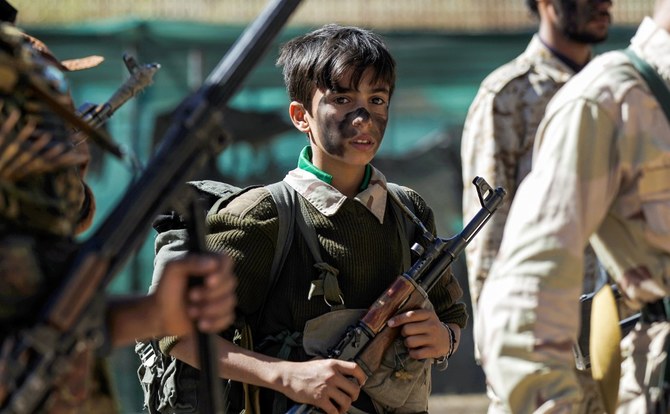

DUBAI: Houthi militants in Yemen would give child soldiers keys, telling them that it was for “entering paradise” when they died, UK tabloid the Mirror reported.
“They told us the key was for us to enter paradise if we were killed,” a child told government-backed soldiers, according to the British news site.
The Houthis, backed by Iran and led by Abdul Malik Al-Houthi, have long used children as soldiers in the now four-year long civil war. Al-Houthi was highlighted as a preacher of hate in Arab News’ special series targeting figures who incited hate and fear across all religions and nationalities.
In December 2018, a senior Houthi military official acknowledged to Associated Press that the militia had inducted 18,000 child soldiers into their army since the beginning of the war in 2014.
Children as young as 10 have been found fighting on the front lines of the conflict in Yemen. Those who try to flee are recaptured and forced to continue fighting, a former child soldier told the Yemeni Coalition to Monitor Human Rights Violations.
Samah Hadid, deputy director of Amnesty International’s Beirut regional office, said that Houthi forces were “taking children away from their parents and their homes, stripping them of their childhood to put them in the line of fire where they could die.”
Ahmed Jesar, one of the children who was kidnapped and taken at the mere age of 13, told the Mirror of his story.
“I was studying in school when the men arrived at the classroom,” he said adding that, “They told me to get up and took me away – I was very frightened. They gave me a gun and gave me a week’s training. But then we got caught up in a gunfight.”
“My friend, who was the same age as me, was killed. I saw his body on the ground. I was only 13. I should have been playing with my friends and learning at school, not watching people being killed. I was taken to hospital because I had been injured. I knew I had to get away and managed to escape when no one was looking,” he continued.
Another boy, 12-year-old Abdul Haziz, told the tabloid: “My uncle was forced to take me to join them. They gave me a gun. But then my uncle was killed in a missile attack. They took me aside and said, ‘You must get revenge for the death of your uncle’. They gave me the drug qat [a stimulant] and then another drug. I didn’t know what it was. I eventually managed to escape.”
According Yemen’s Ministry of Human Rights, the Iran-backed Houthi militants have recruited more than 10,000 children between the years 2015 and 2018.


