Lavrov and Pompeo urge closer US-Russia ties, still disagree over Iran nuclear deal

1 / 3
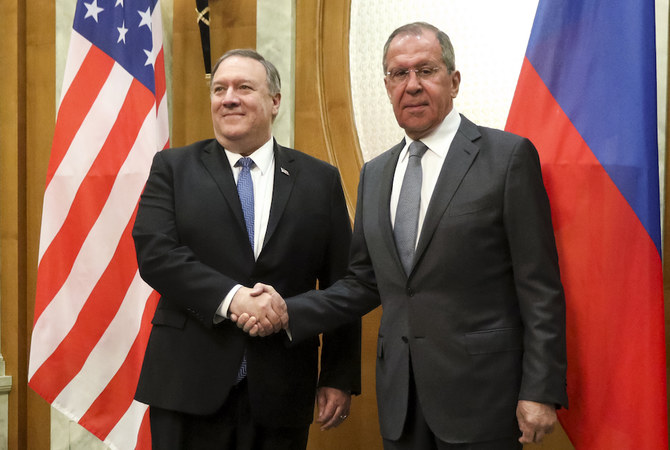
US Secretary of State Mike Pompeo (L) and Russian Foreign Minister Sergey Lavrov pose for a photo prior to their talks in the Black Sea resort city of Sochi, southern Russia, Tuesday, May 14, 2019. (Russian Foreign Ministry Press Service via AP)
2 / 3
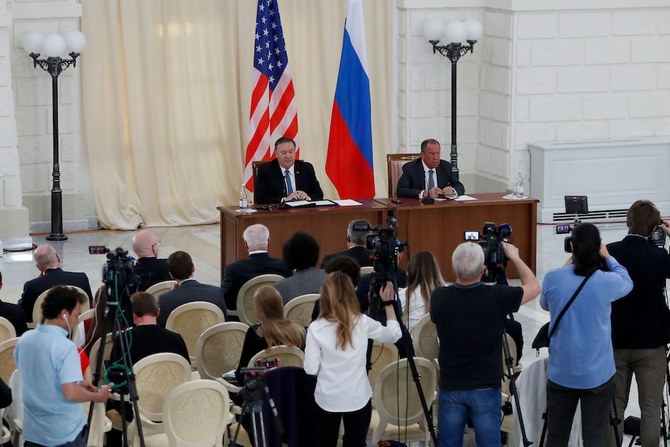
US Secretary of State Mike Pompeo and Russian Foreign Minister Sergey Lavrov attend a joint news conference after their talks in the Black Sea resort city of Sochi, Russia May 14, 2019. (Reuters)
3 / 3
Russian Foreign Minister Sergei Lavrov and US Secretary of State Mike Pompeo hold a joint press conference following their talks in Sochi on May 14, 2019. (AFP)
Updated 15 May 2019
Follow

Lavrov and Pompeo urge closer US-Russia ties, still disagree over Iran nuclear deal

SOCHI: Russia and the United States voiced hope for better ties Tuesday as President Vladimir Putin welcomed Secretary of State Mike Pompeo but tensions were laid bare in a clash over election meddling.
In a late-night encounter in Putin's forested dacha in the Black Sea resort of Sochi, Pompeo became the highest-ranking American to meet the Russian leader in 10 months.
"I would very much like your visit to Russia to benefit Russia-US relations and promote their development," Putin told Pompeo as he took a seat across from him in a sleek conference room, saying that they should "fully restore" relations.
Putin praised a two-year investigation by US special counsel Robert Mueller, despite its findings that Russia meddled extensively in the 2016 election on behalf of then-candidate Donald Trump, especially by manipulating social media.
But the probe found that his campaign did not collude with Russia -- lifting one cloud that has hung over Trump since his unexpected victory.
"Despite the exotic nature of Mr Mueller's commission, on the whole he conducted quite an objective investigation and confirmed the absence of any collusion between the US administration and Russia," Putin said.
Pompeo, speaking earlier at a joint news conference with Foreign Minister Sergei Lavrov, acknowledged deep differences on election meddling -- and warned Russia to stay out of next year's vote.
"Interference in American elections is unacceptable. If Russia engaged in that in 2020, it would put our relationship in an even worse place than it has been," Pompeo said.
"I conveyed that there are things that Russia can do to demonstrate that these kinds of activities are a thing of the past. I hope that Russia takes advantage of those opportunities," he said.
Lavrov hit back against "those who are inflating this topic" and saying of collusion: "It's clear that such insinuations are absolute fiction."
"We want and we are ready to deal with cybersecurity issues along with our American partners, without any politicisation," he said.
Pompeo nonetheless also voiced hope for a better future with Russia.
He said that his mission came from Trump, who has persistently praised Putin -- a loathed figure for virtually all of the US political class.
Trump, he said, wants the United States and Russia "to do everything we can" to create a future that is "more successful" for both countries and the world as a whole.
"Some of our cooperation has been excellent -- on North Korea, on Afghanistan, we've done good work -- (and) counter-terrorism work -- together. These are things we can build upon," Pompeo said.
Pompeo was the highest-ranking American to see Putin since July when the Russian leader met in Helsinki with Trump -- who shocked the US establishment by seeming to take at face value Putin's denials of election interference.
Putin's aide Yuri Ushakov said the president and Pompeo discussed Iran, Syria, Afghanistan and the situation in North Korea, following leader Kim Jong Un's first visit to Russia last month.
However in the 90 minutes of closed-door talks they did not touch on the Ukraine crisis and only briefly discussed sanctions imposed by Washington over Russia's backing of separatist rebels in the country.
They equally did not touch on Michael Calvey, a prominent American investor who has been behind bars in Moscow since mid-February on controversial fraud charges, Ushakov said.


Bangladesh mourns Khaleda Zia, its first woman prime minister

Updated 30 December 2025
Follow

Bangladesh mourns Khaleda Zia, its first woman prime minister

  • Ousted ex-premier Sheikh Hasina, who imprisoned Zia in 2018, offers condolences on her death
  • Zia’s rivalry with Hasina, both multiple-term PMs, shaped Bangladeshi politics for a generation

DHAKA: Bangladesh declared three days of state mourning on Tuesday for Khaleda Zia, its first female prime minister and one of the key figures on the county’s political scene over the past four decades.

Zia entered public life as Bangladesh’s first lady when her husband, Ziaur Rahman, a 1971 Liberation War hero, became president in 1977.

Four years later, when her husband was assassinated, she took over the helm of his Bangladesh Nationalist Party and, following the 1982 military coup led by Hussain Muhammad Ershad, was at the forefront of the pro-democracy movement.

Arrested several times during protests against Ershad’s rule, she first rose to power following the victory of the BNP in the 1991 general election, becoming the second woman prime minister of a predominantly Muslim nation, after Pakistan’s Benazir Bhutto.

Zia also served as a prime minister of a short-lived government of 1996 and came to power again for a full five-year term in 2001.

She passed away at the age of 80 on Tuesday morning at a hospital in Dhaka after a long illness.

She was a “symbol of the democratic movement” and with her death “the nation has lost a great guardian,” Bangladesh’s interim leader Muhammad Yunus said in a condolence statement, as the government announced the mourning period.

“Khaleda Zia was the three-time prime minister of Bangladesh and the country’s first female prime minister. ... Her role against President Ershad, an army chief who assumed the presidency through a coup, also made her a significant figure in the country’s politics,” Prof. Amena Mohsin, a political scientist, told Arab News.

“She was a housewife when she came into politics. At that time, she just lost her husband, but it’s not that she began politics under the shadow of her husband, president Ziaur Rahman. She outgrew her husband and built her own position.”

For a generation, Bangladeshi politics was shaped by Zia’s rivalry with Sheikh Hasina, who has served as prime minister for four terms.

Both carried the legacy of the Liberation War — Zia through her husband, and Hasina through her father, Sheikh Mujibur Rahman, widely known as the “Father of the Nation,” who served as the country’s first president until his assassination in 1975.

During Hasina’s rule, Zia was convicted in corruption cases and imprisoned in 2018. From 2020, she was placed under house arrest and freed only last year, after a mass student-led uprising, known as the July Revolution, ousted Hasina, who fled to India.

In November, Hasina was sentenced to death in absentia for her deadly crackdown on student protesters and remains in self-exile.

Unlike Hasina, Zia never left Bangladesh.

“She never left the country and countrymen, and she said that Bangladesh was her only address. Ultimately, it proved true,” Mohsin said.

“Many people admire Khaleda Zia for her uncompromising stance in politics. It’s true that she was uncompromising.”

On the social media of Hasina’s Awami League party, the ousted leader also offered condolences to Zia’s family, saying that her death has caused an “irreparable loss to the current politics of Bangladesh” and the BNP leadership.

The party’s chairmanship was assumed by Zia’s eldest son, Tarique Rahman, who returned to Dhaka just last week after more than 17 years in exile.

He had been living in London since 2008, when he faced multiple convictions, including an alleged plot to assassinate Hasina. Bangladeshi courts acquitted him only recently, following Hasina’s removal from office, making his return legally possible.

He is currently a leading contender for prime minister in February’s general elections.

“We knew it for many years that Tarique Rahman would assume his current position at some point,” Mohsin said.

“He should uphold the spirit of the July Revolution of 2024, including the right to freedom of expression, a free and fair environment for democratic practices, and more.”