



KARACHI: For as long as he could remember, Bilawal Lashari had dreamt of becoming an army officer. So as soon as he graduated as an intermediary in 2017, he applied to take an entry test and undergo a medical examination.
Much to Lashari’s disappointment, a slight tilt in his leg led him to fail his physical and he had to accept that his dream of fighting for and protecting his homeland was not to be.
Two years later, however, he would lay down his life doing exactly that.
On Saturday, May 11, 2019, gunmen stormed the Pearl Continental Hotel in the port city of Gwadar in Balochistan province, killing four hotel employees and one Pakistan Navy soldier. Lashari was among those who perished, shot dead trying to block the attackers from entering the luxury hotel in which Chinese and other foreign guests often stay. He was 22.
Lashari had worked at Pearl Continental, popularly called the PC Hotel, for three and a half months and is survived by a wife and an eight-month-old son Hasnain.
“My son always wanted to be a soldier,” Lashari’s father Muhammad Yousuf told Arab News via telephone from his native village, Hajji Khan Lashari, in the southern Pakistani province of Sindh, adding that he became a guard after he was not selected in the army for medical reasons.
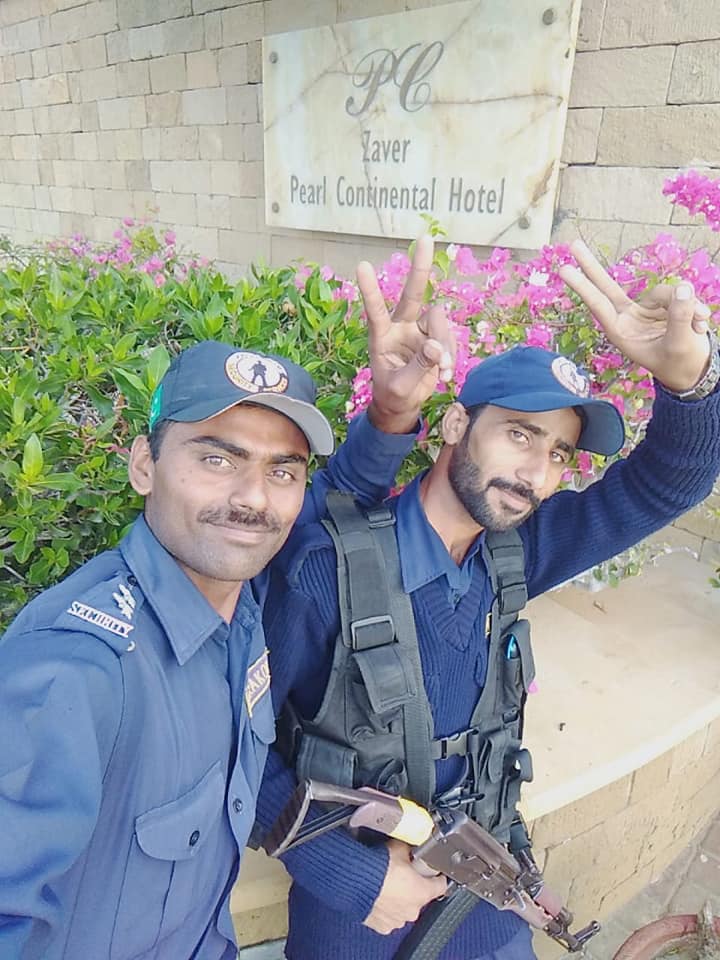
This undated selfie of Bilawal Lashari (right) and Zahoor Ahmed was taken by Ahmed at Pearl Continental Hotel Gwadar where they were employed as security guards and died in a militant attack on May 11, 2019 (Photo handout by family friend Khuda Bux Lashari)
“He could not become a soldier but he died doing what a soldier would do for his country,” Yousaf said, his voice cracking. “God chose to post him at a place where we would be faced with enemies.”
Yousaf grew silent and then added: “He was my eldest and most beloved child and you can’t imagine the pain I feel over losing him. But he has raised my head in pride. He took all the bullets straight to his chest.”
Gwadar, in the resource-rich but underdeveloped southwestern province of Baluchistan, is the crown jewel of China’s $62 billion investment in Belt and Road Initiative projects in Pakistan.
Separatist groups have for decades fought a low-level insurgency against the government in the province, claiming that Baluchistan’s gas and mineral resources are unfairly distributed by richer provinces. The groups also oppose Chinese projects in the area.
Saturday’s attack was claimed in a Twitter post by the Balochistan Liberation Army, a separatist group that has long operated in the area.
Yousuf said before Lashari became a guard, he worked for a while at the family’s two-acre farm. But water scarcity in the area and lack of prospects for farming soon pushed him to look for another job. His cousin Zahoor Ahmed, a security guard at the Pearl Continental Hotel, came to his rescue and got him a job at the hotel.
Both were killed in Saturday’s attack in which Ahmed’s brother was also wounded.
Ahmed’s father Kamal Khan described his son as someone who was always ready to help his family and friends and said he had aided many young men from the village in finding jobs. He had recently been promoted at his job at the PC Hotel in Karachi and was transferred to the Gwadar branch, Khan said. Throughout his time at the hotel, he had pushed for jobs there for many of his village mates.
“My one son, Zahoor Ahmed, laid his life for the country. Another, Rasheed Ahmed, is seriously wounded and now being treated in Karachi,” Khan said. “But their actions have lessened my pain.”
“I am proud of my son,” he said about Ahmed. “He sacrificed his life for the country and gave a message to the enemies that we Pakistanis are brave.”
On Sunday night, as the bodies of Lashari and Ahmed were brought to their hometown from Gwadar, thousands of people from nearby villages and towns thronged to the funeral prayers.
“We feel grief but not regret,” said Khuda Bux Lashari, a childhood friend of both men. “People are calling them heroes.”
Ahmed’s father said he would come back from Gwadar for a two-week visit every six months and the family had been expecting him home at the end of Ramadan, for Eid celebrations. This time, a special treat awaited him: he would meet his daughter Zoya, born three months ago in his absence, for the first time.
“She was going to meet her father on this Eid,” Khan said. “Though she will never see him now when she hears about his story, she will be proud.”


