ANKARA: Turkey’s military launched a major naval exercise on Monday at a time of rising tensions over its plans to explore for gas off the coast of Cyprus.
The exercises, featuring 131 vessels, 57 planes and 33 helicopters, began early on Monday, a Turkish defense ministry official confirmed to AFP.
They are due to last until May 25 and take place across the Mediterranean, Aegean and Black seas.
It follows Turkey’s announcement in May that it would carry out exploratory drilling off Cyprus up to September.
The European Union has said that will encroach on Cyprus’s exclusive economic zone, while the United States described the move as “highly provocative.”
The international community does not recognize the Turkish Republic of Northern Cyprus, proclaimed after troops occupied the top third of the island in 1974 in response to a coup sponsored by the Greek military junta.
The discovery of huge gas reserves in the Mediterranean has fueled a race to tap the underwater resources.
Turkey considers the area to be part of its continental shelf and granted exploration licenses to Turkish Petroleum in 2009 and 2012.
The internationally recognized Republic of Cyprus, which rules the rest of the island, has signed its own exploration deals with energy giants Eni, Total and ExxonMobil.
Speaking on Sunday, Defense Minister Hulusi Akar insisted Turkey would take all necessary measures to “protect its rights in the Mediterranean and Aegean Seas, and in Cyprus.”

Turkey starts naval exercise amid Cyprus gas dispute
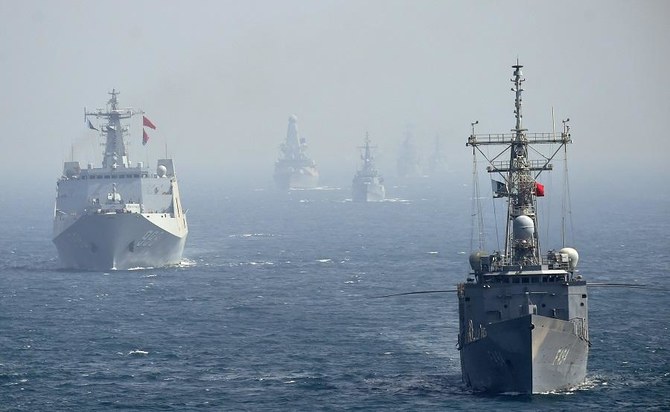
- The exercises, featuring 131 vessels, 57 planes and 33 helicopters, began early on Monday
- They are due to last until May 25 and take place across the Mediterranean, Aegean and Black seas
Hundreds flee to government-held areas in north Syria ahead of possible offensive
- Many of the civilians who fled used side roads to reach government-held areas
- Men, women and children arrived in cars and pickup trucks that were packed with bags of clothes
DEIR HAFER, Syria: Scores of people carrying their belongings arrived in government-held areas in northern Syria on Friday ahead a possible attack by Syrian troops on territory held by Kurdish-led fighters east of the city of Aleppo.
Many of the civilians who fled used side roads to reach government-held areas because the main highway was blocked with barriers at a checkpoint that previously was controlled by the Kurdish-led and US-backed Syrian Democratic Forces, Associated Press journalists observed.
The Syrian army said late Wednesday that civilians would be able to evacuate through the “humanitarian corridor” from 9 a.m. to 5 p.m. Thursday. The announcement appeared to signal plans for an offensive against the SDF in the area east of Aleppo.
There were limited exchanges of fire between the two sides.
Men, women and children arrived in cars and pickup trucks that were packed with bags of clothes, mattresses and other belongings. They were met by local officials who directed them to shelters.
In other areas, people crossed canals on small boats and crossed a heavily damaged pedestrian bridge to reach the side held by government forces.
The SDF closed the main highway but about 4,000 people were still able to reach government-held areas on other roads, Syrian state TV reported.
A US military convoy arrived in Deir Hafer in the early afternoon but it was not immediately clear whether those personnel will remain. The US has good relations with both sides and has urged calm.
Inside Deir Hafer, many shops were closed and people stayed home.
“When I saw people leaving I came here,” said Umm Talal, who arrived in the government-held area with her husband and children. She added that the road appeared safe and her husband plans to return to their home.
Abu Mohammed said he came from the town of Maskana after hearing the government had opened a safe corridor, “only to be surprised when we arrived at Deir Hafer and found it closed.”
SDF fighters were preventing people from crossing through Syria’s main east-west highway and forcing them to take a side road, he said.
The tensions in the Deir Hafer area come after several days of intense clashes last week in Aleppo, previously Syria’s largest city and commercial center, that ended with the evacuation of Kurdish fighters from three neighborhoods north of the city that were then taken over by government forces.
The fighting broke out as negotiations stalled between Damascus and the SDF over an agreement reached in March to integrate their forces and for the central government to take control of institutions including border crossings and oil fields in the northeast.
The US special envoy to Syria, Tom Barrack, posted on X Friday that Washington remains in close contact with all parties in Syria, “working around the clock to lower the temperature, prevent escalation, and return to integration talks between the Syrian government and the SDF.”
The SDF for years has been the main US partner in Syria in fighting against the Daesh group, but Turkiye considers the SDF a terrorist organization because of its association with Kurdish separatist insurgents in Turkiye.


