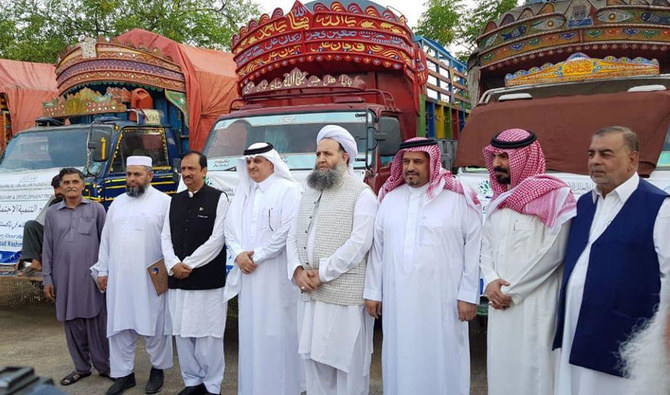
ISLAMABAD: The regional office of the Muslim World League (MWL) in Islamabad has inaugurated the annual “Iftar Saem” program, which provides meals for fasting Muslims, in Pakistan and the Kashmir region.
The program was launched in the presence of Pakistan’s Minister of Religious Affairs Noor-ul-Haq Qadri and Saudi Ambassador to Pakistan Nawaf bin Said Al-Malki. The program consists of 4,700 food baskets for the benefit of thousands of people across Pakistan, selected according to a field survey and prioritized based on need.

Muslim World League opens ‘Iftar Saem’ program in Pakistan

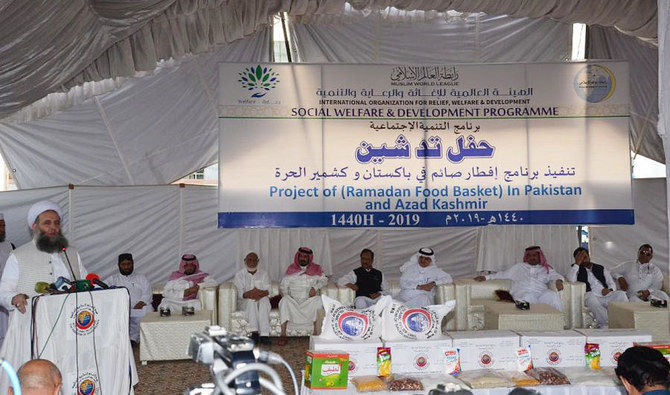
- The program consists of 4,700 food baskets for the benefit of thousands of people across Pakistan
Ramadan nights offer starry skywatching moments
- Astronomy enthusiasts in Saudi Arabia can expect several notable celestial displays, experts say
- Abouazza El-Mhamdi: The spiritual atmosphere of Ramadan this year is beautifully complemented by several astronomical phenomena
RIYADH: A series of astronomical events will coincide with Ramadan this year, offering skywatchers in Saudi Arabia several notable sights, including planetary alignments, a full moon and the spring equinox.
According to Majed Abu Zahra, director of the Jeddah Astronomy Society, the celestial displays began early in the month of Ramadan with a crescent moon appearing in a graceful arc near Saturn, Mercury and Venus, low on the western horizon after sunset.
Such alignments — known as conjunctions — are visual groupings caused by the planets appearing close together from Earth’s perspective.
He emphasized that observing the moon’s phases throughout the month provides an ideal opportunity to monitor lunar shadows and surface features, in addition to viewing variable stars and deep-sky objects through telescopes.
Abouazza El-Mhamdi, associate professor in the physics and astronomy department at King Saud University’s College of Science, told Arab News about the expected displays.
“The spiritual atmosphere of Ramadan this year is beautifully complemented by several astronomical phenomena, capturing the imagination of skywatchers and the general public alike.”
A lunar eclipse will occur on March 3 but will not be visible in Saudi Arabia. People in parts of Oman and the UAE are expected to see a penumbral eclipse, during which the moon passes through Earth’s outer shadow, causing subtle dimming rather than a dramatic darkening.
“As the holy month progresses, the full moon takes center stage,” he said.
“Known in various traditions as the ‘Lavender Moon,’ the name evokes the early blooming of spring flowers and the softening colors of the season. This year, the Lavender Moon coincides with a lunar eclipse.”
“Closer to Eid, we will welcome the vernal equinox,” El-Mhamdi added.
“This astronomical turning point, occurring when the sun passes directly above the equator, brings nearly equal hours of day and night, officially signaling the arrival of spring across the region.”
He said skywatchers may also observe passes of the International Space Station, visible to the naked eye at specific times, adding both scientific and aesthetic dimensions to Ramadan nights for astronomy enthusiasts.
Stargazers will also be treated to the rare sight of six planets aligned at once for one night this month. Taking place shortly after sunset on Saturday, Feb. 28, at least four of the six planets will be visible with the naked eye. Venus, Jupiter, Saturn and Mercury will be visible, while a telescope will be needed to see Uranus and Neptune.
While sometimes described as a “planetary parade,” such alignments are not rare events but periodic visual groupings along the ecliptic plane.
Tala Al-Hajouri, a member of the Misbar team which shares astronomy and space-related information, told Arab News it “effectively highlights the observational value of the upcoming planetary conjunctions.”
In particular, the observation of the “crescent alignment with Saturn, Mercury, and Venus, which will create a low-altitude post-sunset arc shaped by their ecliptic positions and solar elongation.”
Al-Hajouri added: “It would add scientific depth to briefly clarify the geometry of the March 3 lunar eclipse, especially the distinction between Earth’s umbra and penumbra.
“And to frame the March 20 equinox in terms of the Sun’s apparent crossing of the celestial equator — marking the shift in declination that defines seasonal transition in the Northern Hemisphere.”