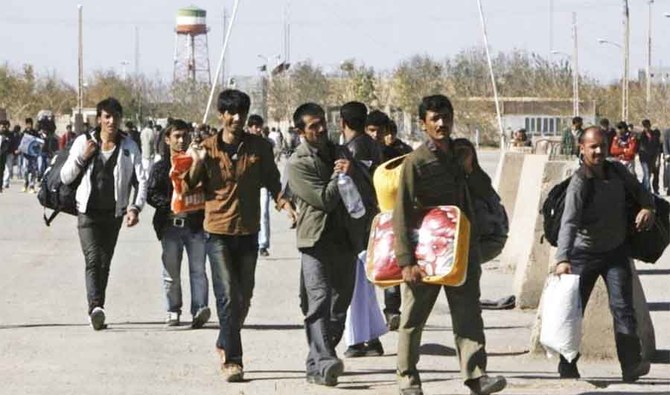

KABUL: Afghans expressed concern on Sunday about the implications of a move by neighboring Iran to deport nearly 3 million Afghan refugees from its soil if Washington toughens its sanctions against Tehran.
Faced by the threat of a new wave of US sanctions, Iran’s Deputy Foreign Minister Abbas Araqchi warned recently that if further sanctions were to be imposed — which would impair the export of Iran’s oil — then it would be forced to “request our Afghan brothers and sisters to leave Iran.”
Araqchi’s comments have created concern among government officials and locals in Afghanistan, where Washington’s sanctions last year pushed up prices and affected trade.
Sayed Hussain Alemi Balkhi, the Afghan minister for repatriation of refugees, said in comments posted on his Facebook page that Araqchi’s remarks were uncalculated, “provocative and in contradiction with international commitments.”
Sayed Abdul Basit Ansari, a spokesman for Balkhi, said Kabul “hoped that Iran will not resort to such a move despite the fact that ties between Iran and the US are not good and will possibly further deteriorate.”
“If such a thing happens, it is natural that it will be in direct violation of refugees laws,” Ansari told Arab News.
“When 3 million refugees come back all of a sudden, it is clear that there will be a crisis since they will need shelter, work and it will cause a big challenge for the government in terms of insecurity and poverty.”
He said Iran has not officially informed Afghanistan about any possible plan for expelling the refugees.
He said that Kabul would raise the matter with authorities in Tehran either by dispatch of a delegation or officially when and if the Islamic Republic officially announces that it will throw out the refugees.
He hoped Iran would not damage its historical and traditional ties with Afghanistan.
Hundreds of thousands of Afghan refugees living in Iran have access to jobs and some of them even send home some money for their families.
“My uncle has been living in Iran for 19 years now. His kids go to school there and he has a good job and settled well there,” said Barakat Ali, an Afghan in Kabul.
“If Iran implements the exodus policy, then it will be difficult for people like my uncle to find a job here and put up with other shortcomings here,” he told Arab News.
Imam Dad, a 40-year-old laborer in Kabul who has at least 20 relatives living in Iran said: “Afghanistan has no resources to address the needs of those who have returned from Pakistan and Iran in recent years, as well as the internally displaced people, and the possible exodus from Iran will mean a new wave of disaster for its people and government.”
Fazl Ahmad Orya, an analyst, told Arab News that Iran was using the “expulsion of refugees as a means of putting pressure on the Afghan government, so it encourages America not to further toughen the sanctions against Iran.”
But analyst Zubair Shafiqi disagreed, saying that ties between Washington and President Ashraf Ghani’s government were not smooth, and that Kabul no longer has the influence or leverage to persuade the US to avoid broadening sanctions.
Orya said the Afghan refugees living in Iran, who are mostly either Shiites or Hazaras, largely followers of the same sect, were “actually a good asset for Tehran for its war in Syria, Lebanon, Iraq and Yemen.”
“Iran is also possibly using the expulsion issue in order to gain funds from refugee agencies, but if Iran’s economy gets hurt by the sanctions, then the Afghans there will have no jobs either and will come home,” Orya said.
Shafiqi said Ghani’s government was “weak and inefficient, and the expulsion would cause catastrophe for society and the government. America neither listens to Ghani’s government and nor thinks about the fate of the Afghan refugees, it does what it wants,” he told Arab News.