

Cash crisis tops Sudan’s economic woes

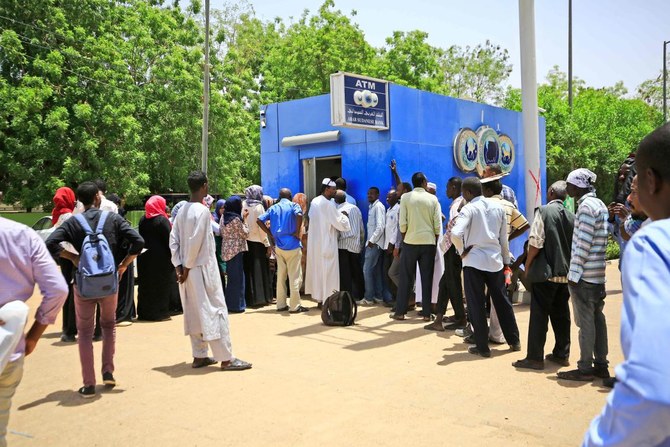
The search for cash has become a national sport in Sudan, where a deep economic crisis sparked months of protests that last month toppled veteran president Omar Al-Bashir. (AFP)
Updated 10 May 2019
Follow

Cash crisis tops Sudan’s economic woes

  • Bashir’s departure last month has done little to rescue the economy
  • The economic crisis far predates the protests against Bashir that broke out in December

KHARTOUM: Women queue for hours under scorching sun in the hope of withdrawing cash from an ATM in the Sudanese capital Khartoum. Sometimes it works, sometimes it doesn’t.
The hunt for cash has become a national sport in Sudan, where a deep economic crisis helped sparked months of protests against veteran president Omar Al-Bashir.
Bashir’s departure last month has done little to rescue the economy.
“I’ve been waiting on average two hours a day for the last eight days (to withdraw cash),” said Halima Souleiman as she waited in an ever-lengthening queue of women on a Khartoum street.
“Each time, the money in the machine has run out.”
Rumours had spread that an armored van had arrived to load the machine with cash, sparking a rush of customers.
“Today I’m hoping it will work,” said Halima, an unemployed biology graduate.
When she finally made it to the small cabin containing the ATM, she emerged smiling and brandishing a wad of banknotes.
Our iftar, the meal that ends the daytime fast observed by Muslims during Ramadan, “will be bigger tonight,” she said.

But with withdrawals limited to 2,000 Sudanese pounds (around $40, 36 euros) a day, the chronic cash shortage tops the list of Sudan’s economic woes.
It has been accompanied by persistent power cuts, fuel shortages and spiralling inflation.
Sudan is one of the poorest countries in the world — the United Nations last year ranked it 167th out of 189 on its Human Development Index.
The economic crisis far predates the protests against Bashir that broke out in December.
It was exacerbated by widespread corruption and huge spending on a military response to multiple regional rebellions under Bashir’s repressive rule.
In 2011, South Sudan won its independence, taking with it three quarters of the country’s oil receipts and dealing a heavy blow to public coffers.
Sudan has also endured two decades of US sanctions over human rights violations and alleged support for “terrorist” groups.
The sanctions were lifted in 2017, but the country remains on the State Department’s blacklist of state sponsors of terrorism.
The potential penalties have kept foreign investors away.
Inflation has reached nearly 70 percent and Khartoum’s foreign debt stands at more than $55 billion (49 billion euros).
The International Monetary Fund has forecast its GDP will shrink by 2.3 percent in 2019.
Four months of mass demonstrations have only added to its woes, disrupting supply chains and aggravating shortages that have set the price of basic goods skyrocketing.
The lack of liquidity has been fueled by the plummeting value of the Sudanese pound and the “lack of confidence in the banking system,” said Ibrahim Onour, a professor in finance and economics at the University of Khartoum.
The pound was devalued three times in 2018. At official rates, the dollar bought 6.75 pounds in 2017. It now buys more than 47.
On the black market, a dollar buys 55 pounds.
Some have started to withdraw pounds to convert them into other currencies.
That “has caused a rise in prices which in turn has led to more demand for liquidity,” Onour said.

Mondather Al-Rifai, a 30-year-old trader, showed AFP cheque books he said are now useless — nobody accepts cheques any more as the banks are reluctant to back them.
“I deposited my money in the bank but I can not withdraw it anymore, or only in tiny tranches,” he said.
Many shops and service providers have stopped accepting bank cards, preferring cash, an Asian restaurateur said on condition of anonymity, adding that business was down by half.
“Most suppliers no longer accept credit cards or cheques,” making it difficult for restaurants to accept them either, he said.
Those who do accept cheques sometimes demand a 20 percent mark-up, he added.
Some are placing their hopes on a three billion-dollar credit line pledged by Saudi Arabia and the United Arab Emirates to help provide liquidity and ease the chronic shortages of basic goods.
But Onour urged caution.
“This aid falls far short of the current needs of Sudan,” he said.


Israel bars Al-Aqsa imam from entering mosque in Ramadan

Updated 4 sec ago
Follow

Israel bars Al-Aqsa imam from entering mosque in Ramadan

  • ‘This ban is a grave matter for us as our soul is tied to Al-Aqsa, Al-Aqsa is our life’

JERUSALEM: A senior imam of the Al-Aqsa Mosque in East Jerusalem said on Tuesday that Israeli authorities had barred him from entering the compound, just days before the start of the holy month of Ramadan.

“I have been barred from the mosque for a week, and the order can be renewed,” Sheikh Muhammad Al-Abbasi said.
He said he was not informed of the reason for the ban, which came into effect from Monday.

FASTFACT

A Waqf source said 33 of its employees had been barred from entering the compound in the week leading up to Ramadan.

“I had only returned to Al-Aqsa a month ago after spending a year in the hospital following a serious car accident,” Abbasi said. “This ban is a grave matter for us, as our soul is tied to Al-Aqsa. Al-Aqsa is our life.”
On Monday, Israeli police said they had recommended issuing 10,000 permits for Palestinians from the occupied West Bank, who require special permission to enter Jerusalem.
Arad Braverman, a senior Israeli police officer in occupied Jerusalem, said forces would be deployed “day and night” across the compound.
He said thousands of police would also be on duty for Friday prayers, which draw the largest crowds of Muslim worshippers.
The Palestinian Jerusalem Governorate said it had been informed that permits would again be restricted to men over 55 and women over 50, mirroring last year’s criteria.
It added that Israeli authorities had prevented the Islamic Waqf — the Jordanian-run body that administers the site — from carrying out routine preparations, including installing shade structures and setting up temporary medical clinics.
A Waqf source said 33 of its employees had been barred from entering the compound in the week leading up to Ramadan.
Under long-standing arrangements, Jews may visit the Al-Aqsa compound —  but they are not permitted to pray there.
Palestinians fear the status quo it is being eroded.
In a separate development, Israeli NGOs have raised the alarm over a settlement plan signed by the government which they say would mark the first expansion of Jerusalem’s borders into the occupied West Bank since 1967. Palestinians view East Jerusalem as the capital of their future state.
The proposal, published in early February but reported by Israeli media only on Monday, comes as international outrage mounts over creeping measures aimed at strengthening Israeli control over the West Bank.
Critics say these actions by the Israeli authorities are aimed at the de facto annexation of the Palestinian territory.
The planned development, announced by Israel’s Ministry of Construction and Housing, is formally a westward expansion of the Geva Binyamin, or Adam, settlement situated northeast of Jerusalem in the West Bank.
In a statement, the ministry said the development agreement included the construction of around 2,780 housing units for the settlement, with an investment of roughly $38.7 million.
But the area to be developed lies on the Jerusalem side of the separation barrier built by Israel in the early 2000s, while Geva Binyamin sits on the West Bank side of the barrier, and the two are separated by a road.
Israeli settlement watchdog Peace Now said there would be no “territorial or functional connection” between the area to be developed and the settlement.
“The new neighborhood will be integral to the city of Jerusalem,” Lior Amihai, Peace Now’s executive director, said.
“What is unique about that one is that it will be connected directly to Jerusalem, but it will be beyond the annexed municipal border. So it will be in complete West Bank territory, but just adjacent to Jerusalem,” he said.
