Even the Taliban danced: Famous Pashto musician Takkar sings once again in Pakistan

1 / 7
This file photo shows Sardar Ali Takkar dedicating a song to Malala Yousafzai during Nobel Peace Prize ceremony in Oslo, Norway, on Dec.10, 2014. (Photo Courtesy: BBC Pashto/Screengrab)
2 / 7
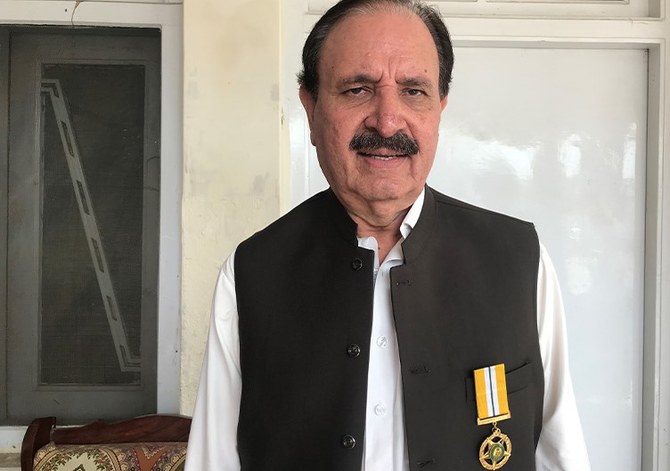
Sardar Ali Takkar at his guesthouse on April 04, 2019 in Peshawar in Pakistan's northwestern Khyber Pakhtunkhwa province. The 62-year-old singer came to Pakistan earlier this year to receive the country's highest civilian award, the Tamgha-e-Imtiaz, for services rendered for Pashto music. A decade ago, Takkar had migrated to Canada and the US with his family following a militant attack in 2009 in which his daughter was injured in Islamabad. (AN Photo)
3 / 7
Sardar Ali Takkar at his guesthouse on April 04, 2019 in Peshawar in Pakistan's northwestern Khyber Pakhtunkhwa province. The 62-year-old singer came to Pakistan earlier this year to receive the country's highest civilian award, the Tamgha-e-Imtiaz, for services rendered for Pashto music. A decade ago, Takkar had migrated to Canada and the US with his family following a militant attack in 2009 in which his daughter was injured in Islamabad. (AN Photo)
4 / 7
Sardar Ali Takkar at his guesthouse on April 04, 2019 in Peshawar in Pakistan's northwestern Khyber Pakhtunkhwa province. The 62-year-old singer came to Pakistan earlier this year to receive the country's highest civilian award, the Tamgha-e-Imtiaz, for services rendered for Pashto music. A decade ago, Takkar had migrated to Canada and the US with his family following a militant attack in 2009 in which his daughter was injured in Islamabad. (AN Photo)
5 / 7
Visitors come to see Sardar Ali Takkar, one of the greatest living Pashto singers, who was awarded Pakistan's highest civilian award, the Tamgha-e-Imtiaz, on March 23, 2019, for his services to Pashto music. Pictured here on April 04, 2019. (AN Photo)
6 / 7
Visitors come to see Sardar Ali Takkar, one of the greatest living Pashto singers, who was awarded Pakistan's highest civilian award, the Tamgha-e-Imtiaz, on March 23, 2019, for his services to Pashto music. Pictured here on April 04, 2019. (AN Photo)
7 / 7
A view Sardar Ali Takkar's house in Mardan, near Peshawar, in Pakistan's northwest, where hundreds of people come to visit the living legend of Pashto music on April 04, 2019. (AN Photo)
Updated 10 May 2019
Follow

Even the Taliban danced: Famous Pashto musician Takkar sings once again in Pakistan

  • Takkar moved to Canada and the US with his family following a militant attack in 2009 which injured his daughter
  • Came back earlier this year to receive the country’s highest civilian award for his services for Pashto music

PESHAWAR: Amid a crackdown on artists and musicians at the height of military ruler General Zia-ul-Haq’s regime in 80’s Pakistan, Sardar Ali Takkar sang lyrical poetry, called ghazals, to rooms packed full of ethnic Pashtun patrons in some of Peshawar city’s oldest mansions.
Earlier this year, the 62-year-old singer came to Pakistan to receive the country’s highest civilian award, the Tamgha-e-Imtiaz, for services rendered for Pashto music. It was a long overdue homecoming. A decade ago, Takkar had migrated to Canada and the US with his family following a militant attack in 2009 in which his daughter was injured in Islamabad.
“I thought to myself, if something bad happens to a single member of my family, they will ask me why I left them at the mercy of terrorists,” Takkar said during an interview last month with Arab News at a hujra, a traditionally all-male guesthouse in his hometown of Mardan near Peshawar in northwestern Pakistan, where men discuss social and political affairs through the day.
At least thirteen prominent artists, particularly women Pashtun singers, were killed by Pakistan’s indigenous Taliban between 2008 and 2017, the heyday of the insurgency, according to a report published by a major Pakistani newspaper, The News. Most of them were killed in or near Peshawar city, the capital of KP province near the Afghan border. 
In 2016, Amjad Sabri, one of Pakistan’s most famous singers, was gunned down by the Taliban in the southern city of Karachi. Although a non-Pashtun, he was a leading exponent of Sufi devotional music, known as Qawwali, and his message of tolerance was similar to Takker’s. Sufism, a tolerant, mystical form of Islam, has millions of followers in Pakistan but is opposed by the Taliban and militant factions as heretical. 
During the peak of violent militancy in Pakistan in 2010, a heartbroken Takkar left his home for Canada with his wife and three children. Soon, news of the famous Pashto singer’s arrival began making the rounds in Washington DC, where he was eventually offered a job with Voice of America’s Deewa Radio, a Pashto language service for which Takkar now hosts radio programs promoting music, tolerance and Sufi poetry. His audience are primarily Pashtuns living in the border areas between Pakistan and Afghanistan, who now hear his voice from half a world away, over the Internet.
“Music softens hearts,” Takkar said, quoting Imam Ghazali, one of Islam’s most influential philosophers, and added with a smile, that despite making music illegal in Afghanistan, even the Taliban would perform the traditional Attan folk dance to songs he had composed and sung. 
Trained as a mechanical engineer, Takker’s foray into Sufism and music began as a hobby. Ironically, his greatest hits came during the Zia regime of the 80’s and his ghazal, “Gila mai zaka okra,” (I make a complaint to you, O’ God), remains one of the most famous Pashto melodies of recent times.
Takkar often also sings the poetry of Khan Abdul Ghani Khan, a renowned Pashtun philosopher and poet of the 20th century, whose poetry declared clergymen as the culprits behind the spread of extremist Islamic ideology.
“He (Ghani) started writing poetry at the age of fifteen. Look at his vision,” Sher Alam Shinwari, a popular culture journalist from Khyber Pakhtunkhwa province, told Arab News, going on to quote some of Takkar’s most popular compositions of Ghani’s words.
“Che pe noor da Allah na ve ware daly,
No da Kaa’bay da shagu dak meenar bas a karham.”
“What really matters are the blessing of Allah Almighty, 
Without blessings, even the Holy Kaaba is a minaret of sands.”
At the hujra where Takkar stayed until his return to the US last month, hundreds of young people came every day to pay their respects to the native singer, many of them avid listeners of his radio shows.
“Look who are my visitors,” Takkar said proudly. “They are all young people under 30.”
Overcome with emotion at being back in Mardan among his own people, Takkar looked around him and told his guests: “Let’s give art and culture another chance. Let’s bury the past.” 
Then he sang for his audience a famous Sufi verse and the famed voice of one of Pashto’s most celebrated artists rose once more over a land he had fled ten years ago.


Pakistan’s finance chief says country shifting from aid to trade, investment with Gulf nations

Updated 5 sec ago
Follow

Pakistan’s finance chief says country shifting from aid to trade, investment with Gulf nations

  • Aurangzeb says remittances from the GCC topped $38 billion last fiscal year, projected at $42 billion this time
  • He tells an international media outlet discussions on a free trade agreement with the GCC are at an advanced stage

ISLAMABAD: Pakistan is no longer seeking aid-based support and is instead pivoting toward trade- and investment-led partnerships, Finance Minister Muhammad Aurangzeb said in an interview with an international media outlet circulated by the finance division on Monday, acknowledging longstanding economic backing from Gulf countries.

Aurangzeb spoke to CNN Business Arabia at a time when Pakistan seeks to consolidate macroeconomic stability after a prolonged crisis marked by soaring inflation, currency pressure and external financing gaps.

Aurangzeb said the government’s economic direction, articulated by Prime Minister Shehbaz Sharif, aims to replace reliance on external assistance with sustainable growth driven by investment and exports, particularly from partners in the Gulf Cooperation Council (GCC), which includes Saudi Arabia, the United Arab Emirates, Qatar, Kuwait, Oman and Bahrain.

“We are not looking for aid flows anymore,” he said. “For us, we are very clear ... that going forward is really trade and investment, which is going to bring sustainability and be win-win for our longstanding bilateral partners in GCC and for Pakistan.”

“This FDI [foreign direct investment] is going to help us in terms of GDP growth [and] more employment opportunities as we go forward,” he continued. “So, you know, all hands are on deck at this point in time to make this materialize.”

Aurangzeb said Pakistan’s shift was underpinned by improving macroeconomic indicators following an 18-month stabilization program.

He noted that inflation, which peaked at 38 percent in 2023, has fallen to single-digit levels, while the country has posted primary fiscal surpluses and kept the current account deficit within targeted limits, adding that foreign exchange reserves now cover about 2.5 months of imports.

The finance chief described recent international assessments as external validation of the government’s reform path.

“All three international credit rating agencies are now aligned in terms of their upgrades and outlook for Pakistan this year,” he said, adding that the successful completion of the second review under the International Monetary Fund’s loan program, approved by the lending agency’s executive board, reinforced confidence in Pakistan’s economic management.

The finance minister said reforms across taxation, energy, state-owned enterprises, public finance and privatization were central to consolidating stability and supporting growth.

He pointed out Pakistan’s tax-to-GDP ratio had risen to about 10.3 percent from 8.8 percent at the start of the reform program and is on track to reach 11 percent, driven by efforts to widen the tax base to include under-taxed sectors such as real estate, agriculture and wholesale and retail trade, while tightening compliance through technology-based monitoring.

Aurangzeb also highlighted the role of the GCC in supporting Pakistan’s external position, particularly through remittances.

He said inflows reached about $38 billion last fiscal year and are projected to rise to nearly $42 billion this time, with more than half originating from GCC states, reflecting the contribution of Pakistani nationals working in the region.

The finance chief said Pakistan was actively engaging Gulf partners to attract investment in sectors including energy, oil and gas, mining, artificial intelligence, digital infrastructure, pharmaceuticals and agriculture, while discussions on a free trade agreement with the GCC were at an advanced stage.