



DUBAI: “For Malala it is not about becoming prime minister of Pakistan but about what contribution she can make to society.”
Those are the words of Ziauddin Yousafzai, father of Malala, the young Pakistani activist, Taliban attack survivor and winner of the 2014 Nobel Peace Prize.
Now studying philosophy, politics and economics at Oxford University in the UK, Malala Yousafzai has said before that one day she hopes to become prime minister of Pakistan.
“I can say that she has the wisdom to focus on areas where she can contribute to the nation and to the world in general,” her father said. “But her objective is definitely not simply to have the title of a prime minister. It’s a good wish to have, but not the ultimate one.”
Yousafzai was speaking to Arab News during a visit to Dubai this week to launch his book “Let Her Fly,” which details his daughter’s achievements and ambitions.
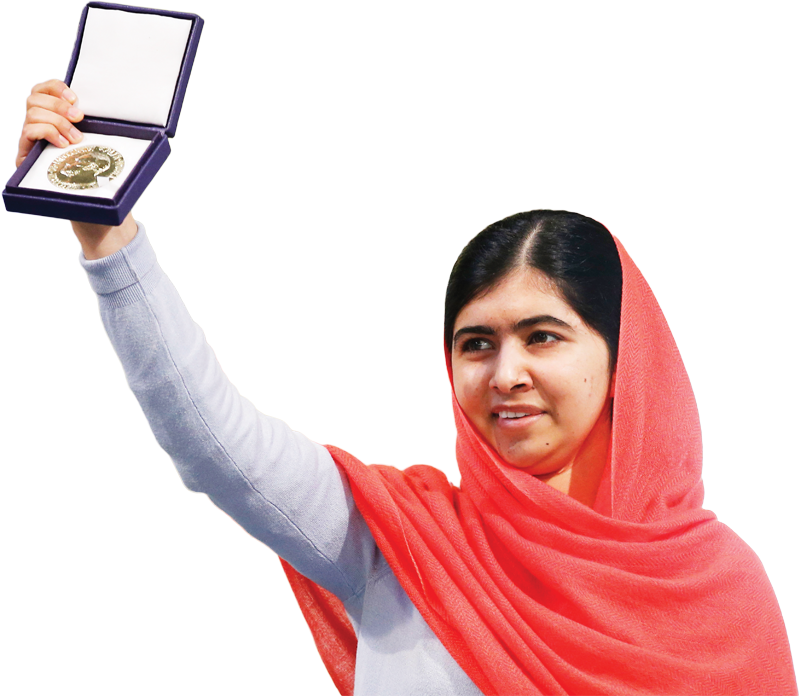
Malala receiving the Nobel Peace Prize in 2014 when she became the youngest-ever Nobel laureate. (AFP)
“Her entire struggle has been about equality and justice. She has stood for these values, and it is more important than just attaching a label to her name,” Yousafzai said.
“When Malala was growing up, I was her inspiration. Now I am among her millions of followers and I see her as my leader.”
Yousafzai is more than just the proud father of a young woman who became arguably the world’s most celebrated teenager when she survived an attack by Taliban gunmen in 2012. He has been an education activist in Pakistan all his life and is now helping the Malala Fund, which runs education projects around the world.
Yousafzai said that the security situation in Pakistan has improved considerably, but education still leaves much to be desired.
The Malala Fund has helped to set up modern schools in areas where underprivileged girls need better access to education.
“Things are moving in the right direction, but a lot still needs to be done when it comes to providing access to education for all segments of society,” he said.
According to UNESCO, about 262 million children and youth lacked access to education worldwide in 2017.
Recounting the horrific days when Malala battled for her life after the brutal Taliban attack, Yousafzai recalls the support of people around him and the government of Pakistan at the time.
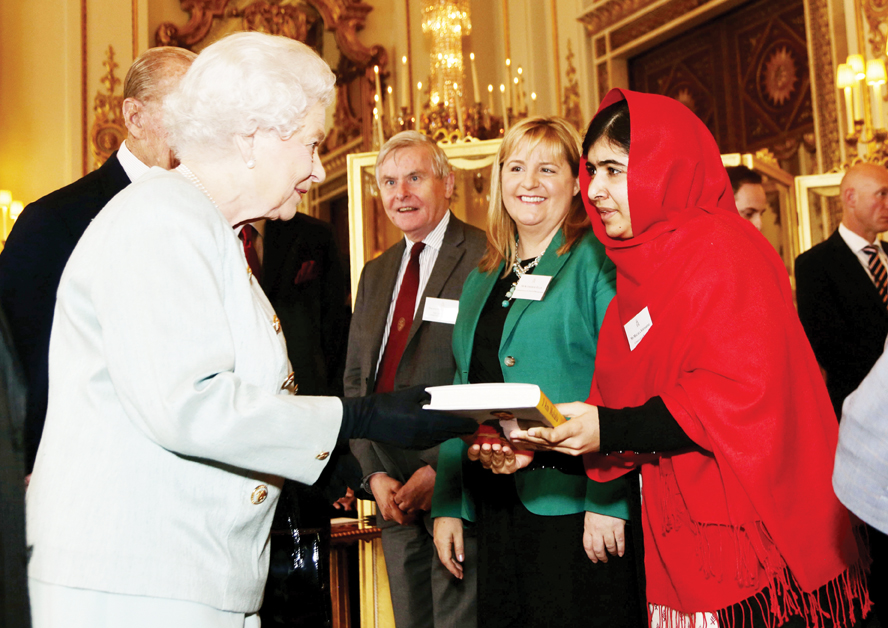
Malala presenting her autobiography to Queen Elizabeth in London. (AFP file photo)
“I was only saying yes to whatever people around me suggested, and I am extremely thankful that they collectively took the right decisions. I was then just the father of a critically injured daughter, and all I wanted was her life to be saved,” he said.
He is also indebted to those who decided to fly her to the UK for treatment — a decision taken after consultation between military doctors and the government. “She may have survived even if we stayed in Pakistan, but a lot of the reconstruction surgery wouldn’t be possible back home.”
Yousafzai said the family had lived happily in the Swat Valley until the terror attacks of 9/11 when the Taliban began to extend its influence, often attacking educational institutions.
“They had neither missiles nor suicide bombers at the time, so they started destroying girls’ schools. They banned women from going to the markets and started controlling the kind of clothes they wore, which was unacceptable,” he said.
The family decided to raise their voices against the violence and, almost by default, became Taliban targets. “They were silencing dissenters one by one, and it was only a matter of time before they attacked one of us.”
This marked the beginning of a struggle that has been detailed in Yousafzai’s book, which is subtitled “A Father’s Journey and the Fight for Equality.”
“Malala was the youngest of them all, but her voice was the loudest,” he said. “Maybe she was attacked because they looked for a soft target, but she was a star in her own right.
“Whenever she appeared on television, she had a certain charisma. She used to speak up for the girls whose rights had been taken away. She was speaking for the 50,000 girls who were being denied education by the Taliban,” he said.
For more than 20 years, Ziauddin Yousafzai has been fighting for equality — first for Malala, and then for young women around the world.
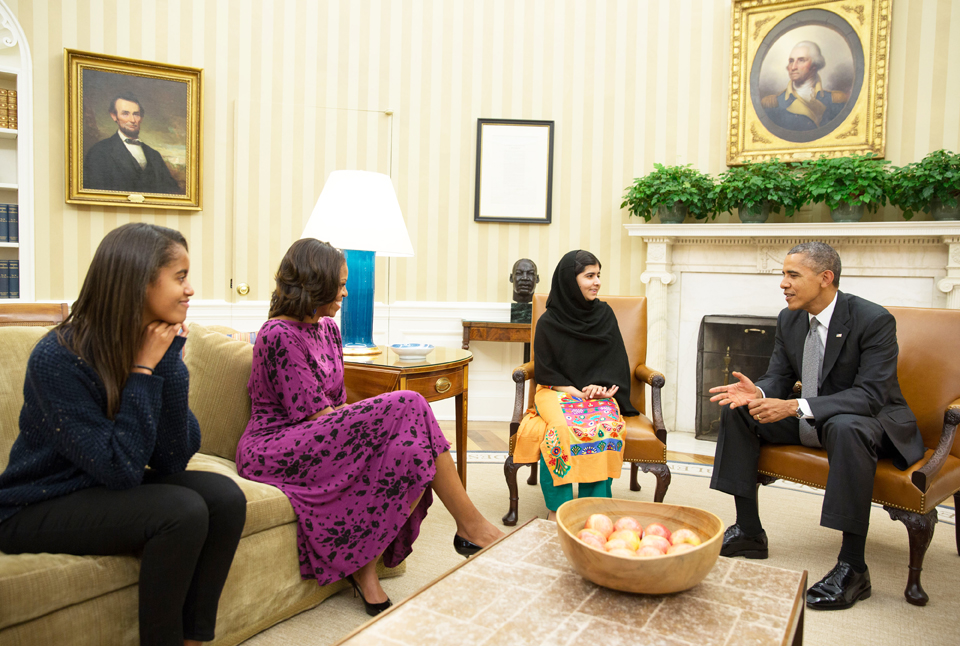
Malala meeting US President Barack Obama in 2013. (AFP)
________________
TIMELINE
1997 Malala Yousafzai born July 12, 1997, in Mingora in Pakistan’s Swat Valley.
2008 Eleven-year-old Malala gives her first speech — ‘How dare the Taliban take away my basic right to education?’ — to a press club in Peshawar.
2009 Writes for the BBC Urdu blog under the name Gul Makai.
2011 Fourteen-year-old Malala is nominated by South Africa’s Archbishop Desmond Tutu for the International Children’s Peace Prize. She is also awarded Pakistan’s first National Peace Award for Youth.
2012 Pakistani Taliban target Malala. A gunman fires four shots, hitting her and wounding two friends. She is flown to the UK for treatment.
2013 Addresses UN General Assembly, her first public speech since the shooting, and calls for free universal education. Speaks at Harvard University, meets Queen Elizabeth and US President Barack Obama, and is nominated again for the Nobel Peace Prize. Her autobiography, ‘I am Malala: The Girl Who Stood Up for Education and Was Shot by the Taliban,’ is published.
2014 Wins the Nobel Peace Prize, shared with Kailash Satyarthi, an Indian children’s rights activist. She becomes the youngest Nobel laureate and the only Pakistani winner of the peace prize.
2015 On her 18th birthday, Malala opens a school for Syrian refugees in Lebanon’s Bekaa Valley.


