

Macron says military equipment sales to ally Saudi Arabia part of 'war on terror'

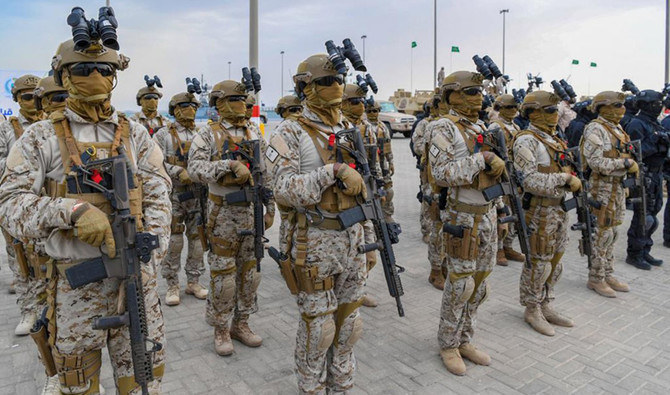
Saudi forces in joint military exercises last year. (SPA/File photo)
Updated 09 May 2019
Follow

Macron says military equipment sales to ally Saudi Arabia part of 'war on terror'

  • French president says Saudi Arabia and UAE are allies in the fight against terrorism

LONDON: French sales of military equipment to Saudi Arabia and the UAE are to support allies in the war against terrorism, Emmanuel Macron said Thursday.

“Saudi Arabia and the United Arab Emirates are allies of France and allies in the fight against terrorism,” the French president said as he arrived for a meeting of EU leaders in Romania.

“We need to be with our allies in these difficult times and the war against terrorism is a priority for us.”

A shipment of supplies is set to leave for the Gulf from the northern French port of Le Havre and the French president has faced pressure from critics at home over the deliveries.

Meanwhile, leading British defence firm BAE Systems said it was working with the UK government to deliver its contracts with Saudi Arabia after Germany in March extended its ban on exporting arms to the kingdom.

The move has been criticised by European allies since it put a question mark over billions of euros of military orders, including a multi-billion pound deal to sell 48 Eurofighter Typhoon jets to Riyadh that would be led by Britain's BAE Systems.

“Following the recent updates from the German Government regarding export licences, we are working closely with industry partners and the UK government to continue to fulfil our contractual support arrangements in Saudi Arabia on the key European collaboration programmes,” BAE said Thursday.

*With Reuters and AFP


Jordan, Lebanon sign 21 cooperation agreements across various fields

Updated 5 sec ago
Follow

Jordan, Lebanon sign 21 cooperation agreements across various fields

RIYADH: Jordan and Lebanon have sealed 21 cooperation agreements across various fields, including energy, electrical interconnection, and industry.

Jordanian Prime Minister Jafar Hassan and his Lebanese counterpart, Nawaf Salam, witnessed the signing of the deals between the two countries, following their chairing of the eighth session of the Jordanian-Lebanese Joint Higher Committee in Beirut, the Jordan News Agency, or Petra, reported.

Additional areas of cooperation included trade, investment, and tourism, as well as transport and several service sectors.

This reflects the ongoing trade relationship between the two countries. In 2023, Jordan exported $101 million worth of goods to Lebanon, while Lebanon exported $111 million to Jordan, according to data from the Observatory of Economic Complexity.

Petra stated: “In joint press statements after the signing of the agreements, Hassan said that Jordan will continue, as it always has, to support Lebanon and to stand by its security, stability and sovereignty.”

It added: “He stressed that supporting Lebanon is a firm Jordanian position under the continuous guidance of His Majesty King Abdullah II, who tasked him with working intensively to translate the historic relations between the two countries into comprehensive cooperation across all fields.”

The prime minister noted that despite the absence of a shared border between Jordan and Lebanon, the two nations are closely connected through long-standing ties of communication, cooperation, and integration at both official and public levels, extending across economic and cultural spheres.

He further stated that both countries are committed to reinforcing these ties and advancing their relationship, with the next phase expected to see broader institutional cooperation that serves the interests of Jordan and Lebanon.

Hassan underlined that the Joint Jordanian-Lebanese Higher Committee convened again, highlighting the two sides’ commitment to maintaining and regularly holding these meetings in line with the strong fraternal ties.

The prime minister added that both sides agreed to maintain ongoing communication and coordination among ministers, officials, and technical teams to ensure the implementation of the agreed accords and to explore future areas of cooperation in ways that serve the interests of both countries and their peoples.