ISLAMABAD: Pakistan is “absolutely” willing to send the popular Rooh Afza drink to neighboring India to make up for a shortage of the beverage in the Indian market, the foreign office said on Thursday, after Indian media reported that the preferred drink of Muslims in Ramadan had been unavailable for months.
Rooh Afza, a rose-flavored concentrate of herbs, fruits, and flowers, is popular throughout South Asia and is a staple of Ramadan in both Pakistan and India, particularly in summer when it is mixed in cold water or milk and served at sunrise Sehri and sunset Iftar meals.
This week, Indian news website The Print reported that Rooh Afza had been off the shelves for at least four months in India, calling it a “major Ramzan crisis for Indian Muslims.”
“Absolutely. [We] will send Rooh Afza if it helps quench thirst in India,” Foreign Office spokesman Dr. Muhammed Faisal said during a weekly press briefing in response to a question about whether Pakistan was willing to help out neighbor overcome the Rooh Afza shortage.
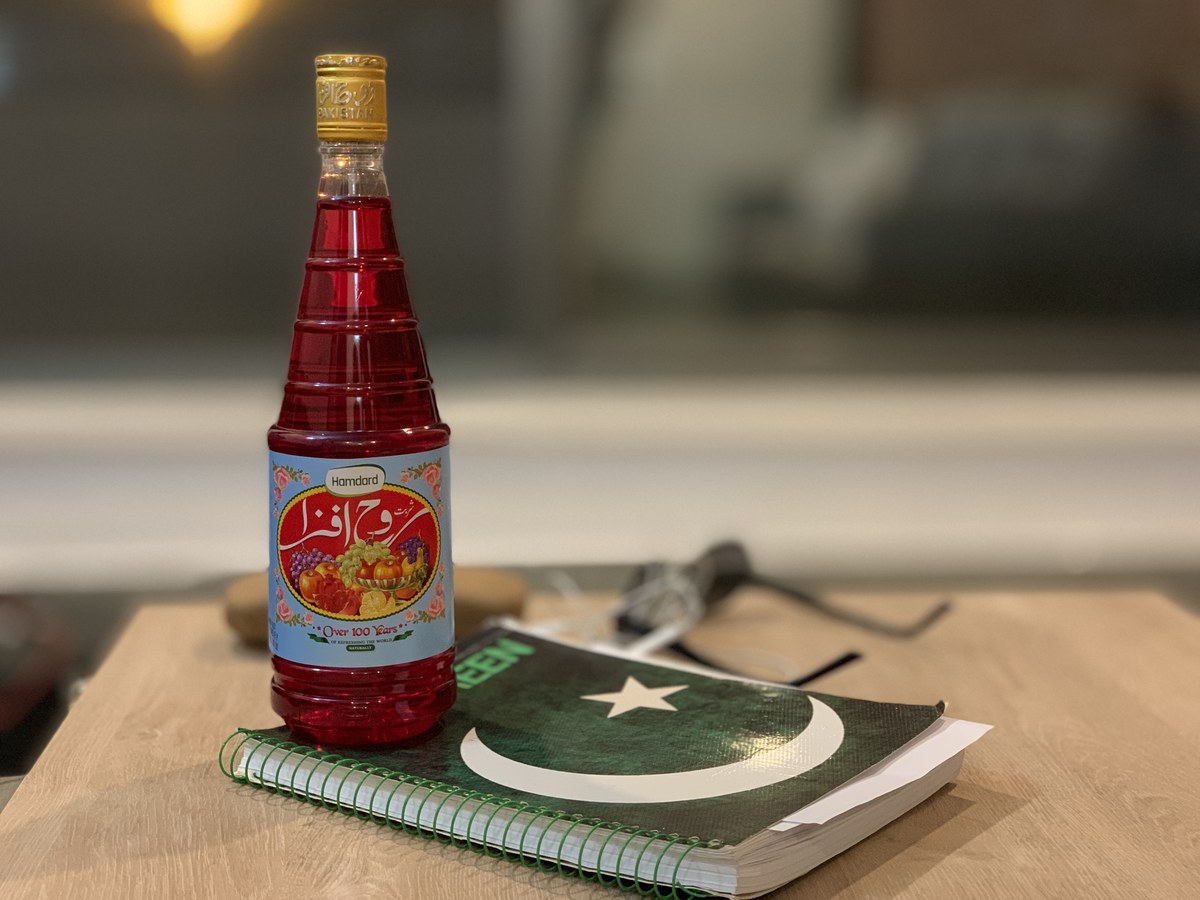
Rooh Afza, a rose-flavored concentrate of herbs, fruits, and flowers, is a staple of Ramadan in both Pakistan and India. In this photo taken on May 9, 2019, a bottle of Pakistani-produced Rooh Afza is seen on a table next to a notebook with a Pakistan flag cover. (AN Photo)
This ‘Rooh Afza diplomacy’ could inject much needed levity in relations between Pakistan and India who have fought three wars and have suspended all bilateral talks over a range of issues, including cross-border proxy wars that both sides deny. Firing also continues intermittently along the Line of Control (LoC) that divides the disputed Kashmir region between the two countries.
Rooh Afza is produced in Pakistan and India by Hamdard Laboratories which was founded in 1906 by physician Hakim Mohammed Kabiruddin in India. At the time of the partition of Indian in 1947, the business was split between two brothers who now operate separate ventures in the two countries.
Mansoor Ali, Chief Sales and Marketing Officer at Hamdard India, told Arab News that production of Rooh Afza had been affected by “supply constraints of certain herbal ingredients.”
“Now production is in full swing at our factories and Rooh Afza is available across markets,” he said. “The situation is getting better every day with distribution reaching far and wide. There has been unprecedented demand due to Ramadan and peak summer season coinciding. Full capacity production and a well-planned distribution infrastructure are ensuring it reaches all corners.”
However, a source at Hamdard who declined to be named said the product was still unavailable at 450,000 retail stories across India.
“We have been unable to cater to influx of customers demanding Rooh Afza,” Praveen Kumar at ELT, a retail outlet in a suburb of Delhi, told Arab News. “We have not received the supply of the drink for the last four months.”
Customers are not happy.
“Not to have a glass of Rooh Afza at the end of the day-long fast is pinching,” Ovais Sultan Khan, a Delhi-based social activist, told Arab News. “No other clone of the brand gives you the feel that Rooh Afza gives you.”
Neyaz Khan from Gaya, a town in the eastern Indian state of Bihar said he was “very disappointed” when his favorite Rooh Afza was not available in the market when he went to buy it two days ago.
Across the border, some Pakistanis have suggested the country help India overcome its shortage by sending Rooh Afza over the Wagah border crossing.
Hamdard Laboratories Pakistan could not be reached for official comment on whether they were willing to supply to India but Usama Qureshi, a former CEO of the company, made the offer in a Twitter post that went viral.
“Pakistan could easily provide Rooh Afza [to India],” he posted. “We can easily send trucks through Wagah border if permitted by Indian Government.”
When questioned about his tweet, which Qureshi has since deleted, he told Arab News he had written it in response to Indian media reports and not in any official capacity.
“We have Rooh Afza everywhere and I thought we could let India know that if need be we could help them out there,” Qureshi said. “If that happens then it would be a great diplomatic move.”