


What Souq-Amazon and Uber-Careem deals mean for Middle East’s online platforms

Updated 08 May 2019
Follow

What Souq-Amazon and Uber-Careem deals mean for Middle East’s online platforms

  • As local companies are being acquired by global giants, experts predict a healthy future for start-ups
  • Many say it’s actually a sign that homegrown companies know their markets best

DUBAI: A number of start-ups in the Middle East are being bought up by global giants, and while some might fear the loss of a home-grown identity, experts say the deals are recognition that local companies know their markets best.

It all started in 2009 with Yahoo!’s acquisition of Jordanian company Maktoob.com. The Amman-based online services company, founded in 1998, was known for being the first Arabic-English email service provider. It later became Yahoo!’s official arm in the Middle East and North Africa (MENA).

In 2017, Amazon purchased the e-commerce platform Souq.com for $580 million. In the UAE, the website was recently rebranded as Amazon.ae, although parts of the Middle East, such as Egypt and Saudi Arabia, were not included in the rebranding.

In April 2018, UAE-based online classifieds website Dubizzle was fully acquired by Naspers, a South Africa-based investor, through its subsidiary OLX Group, for $190 million, following its partial acquisition in 2013. The company was valued at $400 million. This year, global ride-hailing firm Uber Technologies acquired its regional rival Careem for $3.1 billion.
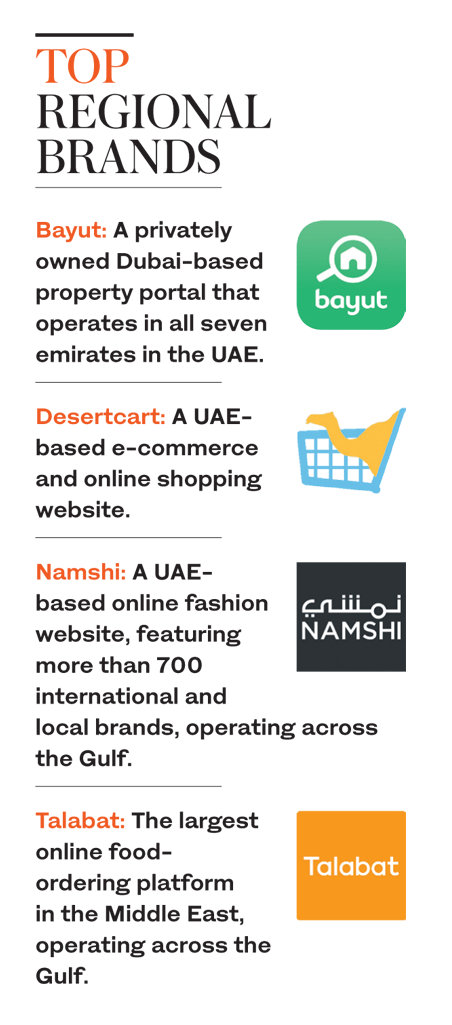
Experts speak of a growing trend in global companies buying smaller businesses in the region.

“As the start-up ecosystem in the region matures, and more venture-backed companies successfully scale across the region and internationally, it’s natural that they catch the eye of international players in similar domains that see an acquisition as a natural extension of their product offering to a new market,” said Philip Bahoshy, CEO and founder of MAGNiTT, a database for start-up information across MENA. “This is the case that we’ve seen in Souq, Careem and Maktoob to date.”

MAGNiTT has seen an acceleration in recent years of such acquisitions, with 12 registered in 2019 so far, compared to 17 in all of 2018.

“Founders have a feather in their hat for growing a company large enough and interesting enough for acquisition, (which allows them) to use this as a key success factor for future ventures,” Bahoshy said.

“In the cases of Careem, Souq and Maktoob, and all companies based in MENA, a key factor for their success is that they’ve found specific solutions that cater to the local or regional needs of their consumers, which are completely different to competitor firms based in the US, Europe or Asia.”

Careem CEO Mudassir Sheikha said one of the most prominent features of the Uber deal is that it allows Careem to stay independent. “We’ll remain a separate brand and organization, which means we get to keep our purpose, values and culture,” he said following the acquisition.

“We’ll continue to pursue our platform vision to go after the massive opportunity that still lies ahead of us, but do it faster with Uber’s resources and expertise.”

Sheikha called the deal a “lift-off moment” for MENA. “A transaction of this magnitude puts the region’s emerging technology ecosystem squarely on the map of regional and foreign investors,” he said. “It’ll radically and irreversibly enhance the support and funding opportunities for local entrepreneurs.”

For Souq and Amazon, the main element of change for customers was adding the Arabic language to both the mobile app and the website. Amazon.ae now features more than 30 million products from local and international businesses, including products previously available on Souq and 5 million products from Amazon US.

“Amazon.ae brings together Souq’s local know-how and Amazon’s global expertise, something we believe will be of significant benefit to UAE customers,” Ronaldo Mouchawar, co-founder of Souq and vice president of Amazon MENA, said last week.

Local companies that have not been acquired, such as Desertcart, believe such moves are good news for new start-ups in the region.

“I’ve lived in the UAE for a while, and we’ve always had a large number of international companies and brands around, so it’s not surprising to see the acquisitions happen,” said Desertcart founder Rahul Swaminathan.

Although he does not see much of a difference for customers either way, he said the acquired companies were fairly simple clones of existing businesses, and were planned from the start to be acquired. “It looks like both Uber and Amazon overlooked how much international growth there would be, and had to pay for their mistake with acquisitions,” he added.

“Uber has already lost in India, China and a few other countries, and Amazon got in really late in the game as well.” He said a lot of existing companies do not want to repeat the same mistake, so they are acquiring businesses in MENA and worldwide, especially when they have “lots of easy capital.”

But “existing start-ups have learnt their lessons, and new start-ups will learn their lesson from history,” he added.

“They’ll probably focus on expanding globally earlier on, and raise more money earlier to do it.”

Although Swaminathan believes that there is some advantage in having a local presence, he said the major cost of these start-ups is marketing, user acquisition and building software.

“Desertcart started as a local company, and the advantage that Dubai offers over the rest of MENA for business means we’ll always have our main offices here,” he added. “However, we’re also making sure we don’t miss out on international opportunity and expanding as fast as possible.”

Bahoshy said one of the cons of being acquired that is often mentioned is that it may lack aspiration, although the trend remains a very positive indication of growth for the MENA start-up scene. “As investors and founders continue to learn from the successful exits, they can gain confidence to go on and scale beyond the region, and once the process for start-ups in the region is made simpler and more start-up-friendly, you may see more companies listing on local markets,” he added.



Saudi Arabia sets global benchmark in AI modernization

Updated 15 January 2026
Follow

Saudi Arabia sets global benchmark in AI modernization

  • Executives hail the Kingdom’s robust infrastructure and strategic workforce programs

RIYADH: Saudi Arabia is emerging as a global leader in artificial intelligence, according to executives from OpenText, one of the world’s largest enterprise information management companies. 

With 22 years of international AI experience, Harald Adams, OpenText’s senior vice president of sales for international markets, said the Kingdom’s modernization efforts are now setting a global standard.

“From my perspective, Saudi Arabia is not only leading the modernization towards artificial intelligence in the Middle East, I think it is even not leading it only in the MENA region. I think it is leading it globally,” Adams told Arab News.

In an interview, Adams and George Schembri, vice president and general manager for the Middle East at OpenText, discussed the Kingdom’s significant investments in AI during the inauguration of OpenText’s new regional headquarters in Riyadh.

“So for us (OpenText), from our perspective, it was a strategic decision to move our MENA headquarters to Saudi Arabia because we believe that we will see here a lot of innovation coming out of the country, we can replicate not only to the MENA region, maybe even further to the global level,” Adams said.

The new headquarters, located in the King Abdullah Financial District, will serve as a central hub for OpenText customers and partners across the Middle East. Its opening reflects a broader trend of tech giants relocating to Riyadh, signaling the Kingdom’s rise as a hub for global AI innovation.

Adams attributed Saudi Arabia’s lead in AI modernization to a combination of substantial financial backing, a unified national strategy, and a remarkable pace of execution.

“I mean, a couple of things, because the ingredients in Saudi Arabia are of course, quite interesting. On the one hand side, Saudi Arabia has deep pockets and great ambitions. And they are, I mean, and they are executing fast, yeah,” he said.
“So from that perspective, at the moment, what we see is that there are, especially on the government side, I can’t see any other government organizations globally moving faster into that direction than it is happening in Saudi Arabia. Not in the region, not even on a global level, they are leading the game,” he underlined.

Schembri added, “Saudi’s AI vision is one of the most ambitious in the world, and AI on a national scale is not good without trusted, secured, and governed, and this is where OpenText helps to enable the Saudi organizations to be able to deliver on the 2030 Vision.”

“The Kingdom’s focus on AI and digital transformation creates a powerful opportunity for organizations to unlock value from their information,” Schembri stated.
“With OpenText on the ground in Riyadh, our customers gain direct access to trusted global expertise combined with local insight — enabling them to manage information securely, scale AI with confidence, and compete on a global stage,” he added.

DID YOU KNOW?

• Saudi Arabia ranks 5th globally and 1st in the region for AI growth under the 2025 Global AI Index.

• The Kingdom is also 3rd globally in advanced AI model development, trailing only the US and China.

• AI is projected to contribute $235.2 billion — or 12.4 percent — to Saudi Arabia’s GDP by 2030.

The inauguration of OpenText’s new regional headquarters was attended by Canada’s Minister of International Trade and Economic Development, Maninder Sidhu, and Jean-Philippe Linteau, Canada’s ambassador to Saudi Arabia. 

Sidhu emphasized the alignment of Saudi Vision 2030 with Canada’s economic and innovation goals.

“His Highness (Crown Prince Mohammed bin Salman) and Vision 2030, there is a lot of alignment with Canada, as you know, with the economic collaboration, with his vision around mining, around education, tourism, healthcare, you look at AI and tech, there’s a lot of alignment here at OpenText Grand opening their regional headquarters,” Sidhu told Arab News.

Saudi Arabia’s AI ambitions are projected to contribute $235.2 billion — or 12.4 percent — to its GDP by 2030, according to PwC. The Saudi Data and AI Authority, established by a royal decree in 2019, drives the Kingdom’s national data and AI strategy.

One flagship initiative, Humain, chaired by Crown Prince Mohammed bin Salman, was launched in May 2025 under the Public Investment Fund. It aims to build a full AI stack — from data centers and cloud infrastructure to models and applications — positioning Saudi Arabia as a globally competitive AI hub. The project plans to establish a data center capacity of 1.8 GW by 2030 and 100 GW of AI compute capacity by 2026.

Saudi Arabia is also expanding international partnerships. In May 2025, Humain signed a $5 billion agreement with Amazon Web Services to accelerate AI adoption domestically and globally, focusing on infrastructure, services, and talent development.

The Kingdom ranked fifth globally and first in the Arab region for AI sector growth under the 2025 Global AI Index, and third worldwide in advanced AI model development, behind only the US and China, according to the Stanford University AI Index 2025.

Education is another pillar of Saudi AI strategy. Starting in the 2025-26 academic year, AI will be taught as a core subject across all public school grades, reaching roughly 6.7 million students. The curriculum will cover algorithmic thinking, data literacy, and AI ethics.

OpenText executives emphasized their commitment to supporting Vision 2030 and the national AI strategy through workforce development.

“OpenText has put a lot of investment in the Kingdom, right. We brought cloud to the Kingdom, we’ve opened our headquarters in the Kingdom, we’ve basically hiring Saudis in the Kingdom, We basically building, if you like, an ecosystem to support the Kingdom. And on top of that, what we’re doing is we’re putting a plan together, if you like, a program to look at how we can educate, if you like, the students at universities,” Schembri said.
“So this is something that we are looking into, we are basically investigating and to see how we can support the Saudi nationals when they come into the workplace. And I’m really excited. I have Harry who is, our leadership who’s supporting this program.”
“It’s something that we are putting together. It’ll take some effort. So it’s still in play because we want to make sure what we put it basically delivers on what we're trying to achieve based on the vision of Saudi,” he added.

“The younger generation is sooner or later either working for us or maybe for a partner or for maybe for a customer. So that’s why we are to 100 percent committed to enable all of that,” Adams said.