
BEIRUT: Threats, interference and aid deliveries in jeopardy — relief workers say Daesh terrorists are adding to the huge challenges they face in violence-plagued northwest Syria where a fragile cease-fire is at risk.
The Idlib region, controlled by a former Al-Qaeda affiliate, is one of the last areas of the country that the Bashar Assad regime has yet to recapture.
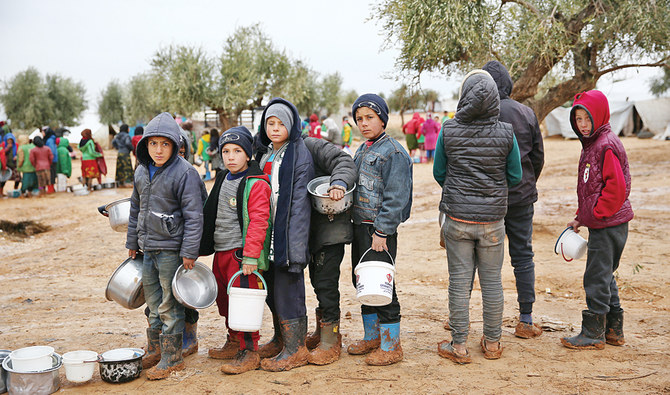
Around 2.7 million of its roughly 3 million residents need humanitarian assistance, according to the UN.
Most rely heavily on food, medicine and other aid brought across from Turkey by the UN and charity groups.
But efforts by the “de-facto authorities” in Idlib “to tamper with, impede or frustrate the delivery of humanitarian assistance including by undermining the safety of humanitarian workers, has been an unfortunate reality,” said Rachel Sider of the Norwegian Refugee Council (NRC).
The Hayat Tahrir Al-Sham (HTS) militant group and its civil wing — the so-called Salvation Government — cemented control over Idlib in the beginning of the year.
“The interference has increased since January,” said a humanitarian worker in Idlib, who wanted to remain anonymous for fear of retaliation.
“There is not a single aid organization that has been spared threats, arrests, or closure for very silly reasons,” he said, even as Idlib has come under increased bombardment by the regime and its ally Russia over the past month.
In April, Daesh militants threatened to detain him because he refused to provide them with food baskets his team was distributing at a camp for the displaced in southern Idlib, he added. “They told me I should give them aid,” said the 27-year-old.
He said HTS also detained him for four days seven months ago in Idlib city for photographing aid deliveries without their authorization.
Militants beat him, confiscated his laptop, and broke his camera, he said.
“They told me I should thank God I was being released alive.”
Paul Donohoe of the International Rescue Committee said “aid groups face interference from armed groups in Idlib, such as the restricting of access to vulnerable populations or attempting to influence beneficiary selection and the location of aid delivery.”
He declined to provide more detail but a second humanitarian worker in Idlib, who also asked to remain anonymous, said several projects by international aid agencies have been dropped in recent months because of such meddling.
A plan to provide bakeries in Idlib with free flour was scrapped because the Salvation Government insisted on limiting beneficiaries to bakeries it is affiliated with, the 29-year-old said.
“Our activities as an organization have become very modest since this happened to us,” he added.
The governing body is also trying to ensure its affiliates are among those who secure tenders with aid agencies, which attempt to avoid this through screening, he said. “They want a cut of any project implemented in the area,” he added. The encroachment has sparked concern that relief items and aid money may fall into the wrong hands.
Sider, of the NRC, said: “In this environment, aid agencies cannot completely eliminate the risk of diversion and we’d like donors to recognize this.”
The UN has said it is taking extra measures to combat diversion.
They include “additional screening from partners, suppliers, even workers, staff, and third party monitoring, including the use of modern technology — barcoding, establishing hotlines — to be able to be sure that aid reaches the right people,” the UN regional coordinator for Syria, Panos Moumtzis, told AFP.
There has yet to be any major decrease in humanitarian assistance but some donors have cut funding, said Ahmed Mahmoud, Syria director for the Islamic Relief charity.
“So far, five major hospitals have had to close entirely and seven other medical facilities — including hospitals focusing on paediatrics and obstetrics — severely cut back their operations due to funding cuts,” he said.
Though there could also be other reasons, “some donors may have concerns regarding the shifts in control in northwestern Syria, which may have affected their funding decisions.
“As one facility after another shuts its doors, the pressure only grows on those that remain,” he said.
For its part, the Salvation Government denies jeopardizing relief efforts.