



LAHORE: Former Pakistani prime minister Nawaz Sharif surrendered before prison authorities in the eastern city of Lahore on Wednesday as the six-week bail granted to him on medical grounds expired at midnight.
On May 3, the Supreme Court rejected an application by the three-time prime minister for an extension in bail granted on March 26. At midnight, as the day turned from Tuesday to Wednesday, Sharif was taken into custody by the Deputy Superintendent of the jail and shifted to a room specially prepared for him.
A team of Kot Lakhpat Jail officials arrived at the residence of the former prime minister in the afternoon and asked him to surrender but party leaders rejected the demand, saying the bail period technically expired on May 7.
“Sharif’s narrative is becoming popular and remains unchanged,” senior vice president of the party and the former prime minister of Pakistan, Shahid Khaqan Abbasi, told Arab News. “The masses have rejected the government version against Nawaz Sharif as they know the reality; that he is committed to the supremacy of institutions and is sacrificing for the better future of the nation.”
Earlier in the day, Attaullah Tarrar, PMLN deputy secretary general, told Arab News about the PMLN’s plans to escort Sharif to jail in a ‘solidarity rally.’
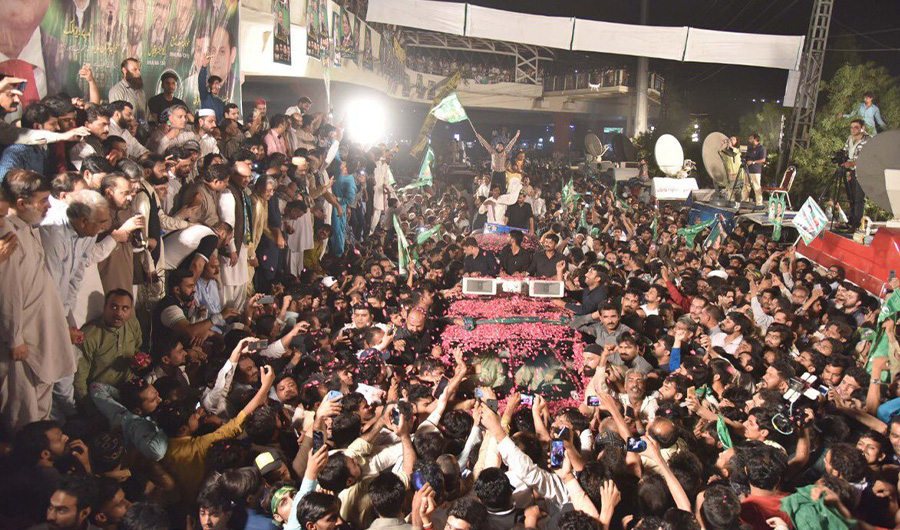
“Mian Sahib will leave for jail after iftar,” Tarrar said, referring to the sundown meal in which practicing Muslims break their fast in the month of Ramadan. The PML-N had set up ten welcome camps on the route to the jail and given a call to party workers and supporters to gather at the Sharif family’s residence to march toward the jail in solidarity with their leader, Tarrar said.
Sharif was handed a seven-year sentence last year for failing to reveal the source of income that allowed him to set up a steel factory in Saudi Arabia. He has appealed the sentence, which has also barred him for life from holding public office.
“I am thankful to the workers of my party who traveled with me till midnight,” Sharif told his supporters in a message recorded minutes before his surrender. “With the prayers of my workers the dark night of injustice will end soon. My workers know why I am being sent to jail.”
Sharif says all charges against him are politically motivated. In November last year, he returned to Pakistan from London to face trial in anti-corruption cases he calls political revenge but which opposition leaders have termed as accountability for the rich and powerful.
On Tuesday, Sharif party leaders and supporters gathered outside his Jati Umra residence and chanted slogans in his favor and against the government of Prime Minister Imran Khan. They then moved in the form of a ‘solidarity rally’ behind the car in which he was traveling with his daughter Maryam Nawaz Sharif, a vice president of the Pakistan Muslim League-Nawaz (PMLN) party.
The PML-N had requested Lahore authorities to make security arrangements for the rally but not received any response as yet, party leaders said, adding that would continue with plans for the rally.
In July 2017, the Supreme Court removed Sharif from office for not disclosing part of a salary drawn from his son’s company. He was later convicted in two separate cases of failing to disclose sources of income. In one of these cases revolving the ownership of upscale London properties, the high court suspended a 10-year sentence and granted bail last September until a final decision was made on his appeal application against the conviction. The appeal process in both cases is continuing.


