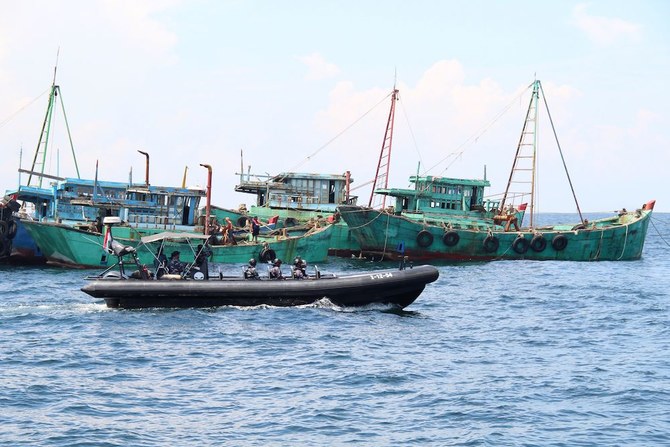
JAKARTA: Indonesian authorities resumed their tough stance against illegal fishing in the country’s waters by sinking 51 foreign ships Saturday, as the government ramps up efforts to exert greater control over its vast maritime territory.
The seized ships were sunk at five ports across the archipelago, which has some of the world’s richest fishing grounds, the Maritime and Fisheries Ministry said in a statement.
The seized vessels sunk included 38 Vietnamese-flagged ships, 6 Malaysian, 2 Chinese and 1 Filipino. The rest were foreign-owned ships using Indonesian flag.
Fisheries Minister Susi Pudjiastuti said in a speech that the illegal boats were a threat to the local fishing industry. Their operators are frequently perpetrators of modern day slavery.
“This crime of illegal fishing in our waters was out of mind,” Pudjiastuti said. “We can’t tolerate anymore.”
Saturday’s events were carried out in a low-key fashion compared with previous occasions, when boats were blown to pieces and their destruction broadcast live.
A video taken off Datuk island in West Kalimantan province and released by the ministry showed Pudjiastuti and other fishery officers scrambling to an adjacent boat from a sinking vessel that had been filled with sand and flooded. She clapped her hands when she saw several ships successfully sunk.
The move came a week after an Indonesian navy patrol ship was rammed by two Vietnamese coast guard ships after intercepting a boat it says was fishing illegally in its waters. The Vietnamese claimed that the area was Vietnamese waters.
Indonesia detained 12 Vietnamese fishermen from the boat, which sank in last Saturday’s clash, and they are being held at a naval base on Natuna island.
Indonesian government says it has sunk more than 500 illegal fishing vessels since October 2014, many with explosives.
Last year, the ministry sunk 125 mostly foreign vessels, included 86 Vietnamese-flagged ships, 20 Malaysian and 14 from the Philippines.
Indonesia, an archipelago of more than 17,000 islands, claims a huge exclusive economic zone, which is frequently penetrated by foreign fishing vessels. Its northerly reaches are regarded by China as its traditional fishing grounds despite their distance from the Chinese mainland.

Indonesia sinks 51 foreign boats to fight against poaching
Saudi ambassador becomes first foreign envoy to meet Bangladesh’s new PM
- Tarique Rahman took oath as PM last week after landslide election win
- Ambassador Abdullah bin Abiyah also meets Bangladesh’s new FM
Dhaka: Saudi Arabia’s ambassador to Dhaka became on Sunday the first foreign envoy to meet Bangladesh’s new Prime Minister Tarique Rahman since he assumed the country’s top office.
Rahman’s Bangladesh Nationalist Party made a landslide win in the Feb. 12 election, securing an absolute majority with 209 seats in the 300-seat parliament.
The son of former Prime Minister Khaleda Zia and former President and BNP founder Ziaur Rahman, he was sworn in as the prime minister last week.
The Saudi government congratulated Rahman on the day he took the oath of office, and the Kingdom’s Ambassador Abdullah bin Abiyah was received by the premier in the Bangladesh Secretariat, where he also met Bangladesh’s new foreign minister.
“Among the ambassadors stationed in Dhaka, this is the first ambassadorial visit with Prime Minister Tarique Rahman since he assumed office,” Saleh Shibli, the prime minister’s press secretary, told Arab News.
“The ambassador conveyed greetings and best wishes to Bangladesh’s prime minister from the king and crown prince of Saudi Arabia … They discussed bilateral matters and ways to strengthen the ties among Muslim countries.”
Rahman’s administration succeeded an interim government that oversaw preparations for the next election following the 2024 student-led uprising, which toppled former leader Sheikh Hasina and ended her Awami League party’s 15-year rule.
New Cabinet members were sworn in during the same ceremony as the prime minister last week.
Foreign Minister Khalilur Rahman is a former UN official who served as Bangladesh’s national security adviser during the interim government’s term.
He received Saudi Arabia’s ambassador after the envoy’s meeting with the prime minister.
“The foreign minister expressed appreciation for the Saudi leadership’s role in promoting peace and stability in the Middle East and across the Muslim Ummah. He also conveyed gratitude for hosting a large number of Bangladeshi workers in the Kingdom and underscored the significant potential for expanding cooperation across trade, investment, energy, and other priority sectors, leveraging the geostrategic positions of both countries,” the ministry said in a statement.
“The Saudi ambassador expressed his support to the present government and his intention to work with the government to enhance the current bilateral relationship to a comprehensive relationship.”
Around 3.5 million Bangladeshis live and work in Saudi Arabia. They have been joining the Saudi labor market since 1976, when work migration to the Kingdom was established during the rule of the new prime minister’s father.
Bangladeshis are the largest expat group in the Kingdom and the largest Bangladeshi community outside Bangladesh and send home more than $5 billion in remittances every year.