

Rohingya repatriation talks to resume in Myanmar

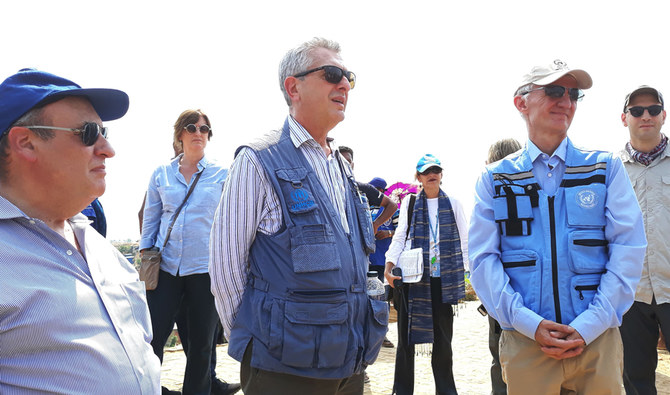
United Nations High Commissioner for Refugees (UNCHR) Filippo Grandi (C) look on next to other members of the delegation of United Nations organizations during their visit to a Rohingya camp in Ukhia, near Cox's Bazar in Bangladesh on April 26, 2019. (AFP)
Updated 03 May 2019
Follow

Rohingya repatriation talks to resume in Myanmar

  • ‘Difficult’ to deal with Myanmar, says Bangladesh official
  • Refugees fear violence and discrimination upon return

DHAKA: Bangladesh and Myanmar are to resume talks on Rohingya refugee repatriation on Friday, after a lull of more than five months.

A 16-member Bangladeshi team is already in the capital city of Myanmar to attend the Joint Working Group's (JWG) fourth meeting.

The two nations established the JWG in November 2017 to expedite the refugee repatriation process, following a massive number of Rohingya Muslims fleeing a brutal military crackdown in Myanmar’s Rakhine state and entering neighboring Bangladesh in search of refuge.

They agreed to initiate repatriation within two months of signing a deal at the time. But there has been little to no progress since.

Bangladesh will try to exert pressure on its neighbor to ensure a conducive environment in Rakhine for the repatriation process to begin as soon as possible, said a member of the Bangladeshi delegation requesting anonymity.

“We will inquire about the physical developments on the ground which were decided to be implemented by Myanmar during the first two JWG meetings,” the official told Arab News.

“It is very difficult to deal with a party like Myanmar since they don't stick to their promises. Although we are hopeful to have some concrete outcome of the meeting, the situation in Rakhine is still very problematic. But we have no other option except to engage them in talks.”

Last November an attempt to repatriate Rohingya refugees living in Cox's Bazar failed when no volunteers came forward. Refugees also voiced their concern about the discrimination and violence that awaited them, saying the environment was not right for their return.  

Last month the UN’s humanitarian chief Mark Lowcock said there had been “no progress” in dealing with the reasons why more than 700,000 Rohingya Muslims had fled to Bangladesh.

Myanmar had failed “to put in place confidence-building measures that would persuade people it’s safe to go back,” Associated Press reported Lowcock as saying.

Experts who spoke to Arab News said Bangladesh should be bold at the negotiating table.

“We should make it clear to them (Myanmar) that if there is no outcome on ground, then there is no point in having these meetings time and again,” Professor Imtiaz Ahmed, an international relations expert at Dhaka University, told Arab News. "As an immediate step of their willingness, Myanmar should take some visible steps to change their law which should ensure right of citizenship for the Rohingyas.”

Buddhist-majority Myanmar considers the Rohingya to be ‘Bengalis’ from Bangladesh even though their families have lived in the country for generations. Nearly all have been denied citizenship since 1982, effectively making them stateless. They are also denied freedom of movement and other basic rights.

Humayun Kabir, Bangladesh's former ambassador to the US, said that Myanmar should exhibit “sincerity” for the repatriation process to invoke “a sense of reliability” among the refugees.

“We need a sustainable solution to the Rohingya crisis, which Bangladesh wants to achieve through diplomatic means,” he told Arab News.

He said that Bangladesh could also seek diplomatic assistance from neighboring countries. Singapore could play a crucial role in putting pressure on Myanmar as the two have strong economic ties and are ASEAN member states.


Russia strikes power plant, kills four in Ukraine barrage

Updated 13 January 2026
Follow

Russia strikes power plant, kills four in Ukraine barrage

KHARKIV: Russia battered Ukraine with more than two dozen missiles and hundreds of drones early Tuesday, killing four people and pummelling another power plant, piling more pressure on Ukraine’s brittle energy system.
An AFP journalist in the eastern Kharkiv region, where four people were killed, saw firefighters battling a fire at a postal hub and rescue workers helping survivors by lamp light in freezing temperatures.
Ukrainian President Volodymyr Zelensky said “several hundred thousand” households near Kyiv were without power after the strikes, and again called on allies to bolster his country’s air defense systems.
“The world can respond to this Russian terror with new assistance packages for Ukraine,” President Volodymyr Zelensky wrote on social media.
“Russia must come to learn that cold will not help it win the war,” he added.
Authorities in Kyiv and the surrounding region rolled out emergency power cuts in the hours after the attack, saying freezing temperatures were complicating their work.
DTEK, Ukraine’s largest energy provider, said Russian forces had struck one of its power plants, saying it was the eighth such attack since October.
The operator did not reveal which of its plants was struck, but said Russia had attacked its power plants over 220 times since Moscow invaded Ukraine in 2022.
Daily attacks
Moscow has pummelled Ukraine with daily drone and missile barrages in recent months, targeting energy infrastructure and cutting power and heating in the frigid height of winter.
The Ukrainian air force said that Tuesday’s bombardment included 25 missiles and 247 drones.
The Kharkiv governor gave the death toll and added that six people were wounded in the overnight hit outside the region’s main city, also called Kharkiv.
White helmeted emergency workers could be seen clambering through the still-smoking wreckage of a building occupied by postal company Nova Poshta, in a video posted by the regional prosecutor’s office.
Within Ukraine’s second city, Kharkiv Mayor Igor Terekhov said a Russian long-range drone struck a medical facility for children, causing a fire. No casualties were reported.
The overnight strikes hit other regions as well, including southern city Odesa.
Residential buildings, a hospital and a kindergarten were damaged, with at least five people wounded in two waves of attacks, regional governor Sergiy Lysak said.
Russia’s use last week of a nuclear-capable Oreshnik ballistic missile on Ukraine sparked condemnation from Kyiv’s allies, including Washington, which called it a “dangerous and inexplicable escalation of this war.”
Moscow on Monday said the missile hit an aviation repair factory in the Lviv region and that it was fired in response to Ukraine’s attempt to strike one of Russian President Vladimir Putin’s residences — a claim Kyiv denies and that Washington has said it does not believe happened.