UNITED NATIONS: The UN humanitarian chief said Monday there has been “no progress” in dealing with the reasons why more than 700,000 Rohingya Muslims fled to Bangladesh from western Myanmar’s Rakhine state.
Mark Lowcock, who just returned from a visit to Bangladesh, said Myanmar has failed “to put in place confidence-building measures that would persuade people it’s safe to go back.”
He said all the refugees he spoke to didn’t think it was safe to return, and want to be assured of things like freedom of movement and access to education, jobs and services.
Buddhist-majority Myanmar has long considered the Rohingya to be “Bengalis” from Bangladesh even though their families have lived in the country for generations. Nearly all have been denied citizenship since 1982, effectively rendering them stateless, and they are also denied freedom of movement and other basic rights.
The latest crisis began with attacks by an underground Rohingya insurgent group on Myanmar security personnel in August 2017 in northern Rakhine. Myanmar’s military responded with a brutal campaign and is accused of mass rape, killings and the burning of thousands of homes that critics have described as ethnic cleansing, or even genocide.
Lowcock told a small group of reporters he is “extremely worried” that the UN appeal for $962 million to provide for the Rohingya refugees and their host communities in Bangladesh this year is only 17% funded.
“I think the world may be losing interest,” he said. “Last year, we got 70% what we asked for. We’re running way behind.”
He warned that “if we don’t get financed, the consequences will be serious” for the provision of such things as food rations and health services.
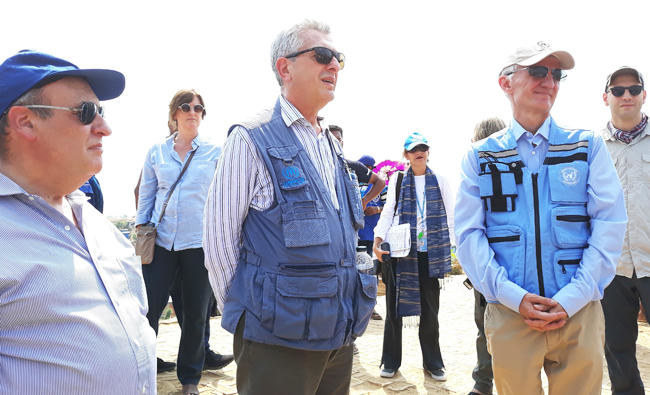
Lowcock visited Bangladesh with UN refugee chief Filippo Grandi and Antonio Vitorino, head of the International Office for Migration. In a joint statement, they stressed the need to sustain support for the Rohingya refugees and to keep working for “safe and sustainable solutions” so they can return home.
They noted that almost half the 540,000 refugee children under age 12 are missing out on education and the rest are only getting very limited schooling.
“I think the world ought to worry about what this very large group of people will be like in 10 years’ time if they don’t get an opportunity to access education and a chance to develop a livelihood and have a normal life,” Lowcock told reporters.
While the best solution would be for the refugees to return home, he said, “in any event it’s a bad idea to run the risk of a very aggrieved, disaffected large group of young people, especially young men.”
Lowcock said Bangladesh’s government expressed concern to the three UN officials during the trip about criminal activity among refugees in the Cox’s Bazaar area.
“There are well-known concerns about the drugs industry trying to use populations in Cox’s Bazaar to support their malign activities,” Lowcock said, adding that there are also concerns about possible radicalization of refugees.

No progress so Rohingya can return to Myanmar: UN aid chief
- There are well-known concerns about the drugs industry trying to use populations in Cox’s Bazaar to support their malign activities
EU leaders to reassess US ties despite Trump U-turn on Greenland
- Diplomats stressed that, although Thursday’s emergency EU talks in Brussels would now lose some of their urgency, the longer-term issue of how to handle the relationship with the US remained
BRUSSELS: EU leaders will rethink their ties with the US at an emergency summit on Thursday after Donald Trump’s threat of tariffs and even military action to acquire Greenland badly shook confidence in the transatlantic relationship, diplomats said.
Trump abruptly stepped back on Wednesday from his threat of tariffs on eight European nations, ruled out using force to take Greenland, a semi-autonomous territory of NATO ally Denmark, and suggested a deal was in sight to end the dispute.
German Chancellor Friedrich Merz, welcoming Trump’s U-turn on Greenland, urged Europeans not to be too quick to write off the transatlantic partnership.
But EU governments remain wary of another change of mind by a mercurial president who is increasingly seen as a bully that Europe will have to stand up to, and they are focused on coming up with a longer-term plan on how to deal with the United States under this administration and possibly its successors too.
“Trump crossed the Rubicon. He might do it again. There is no going back to what it was. And leaders will discuss it,” one EU diplomat said, adding that the bloc needed to move away from its heavy reliance on the US in many areas.
“We need to try to keep him (Trump) close while working on becoming more independent from the US It is a process, probably a long one,” the diplomat said.
EU RELIANCE ON US
After decades of relying on the United States for defense within the NATO alliance, the EU lacks the needed intelligence, transport, missile defense and production capabilities to defend itself against a possible Russian attack. This gives the US substantial leverage.
The US is also Europe’s biggest trading partner, making the EU vulnerable to Trump’s policies of imposing tariffs to reduce Washington’s trade deficit in goods, and, as in the case of Greenland, to achieve other goals.
“We need to discuss where the red lines are, how we deal with this bully across the Atlantic, where our strengths are,” a second EU diplomat said.
“Trump says no tariffs today, but does that mean also no tariffs tomorrow, or will he again quickly change his mind? We need to discuss what to do then,” the second diplomat said.
The EU had been considering a package of retaliatory tariffs on 93 billion euros ($108.74 billion) on US imports or anti-coercive measures if Trump had gone ahead with his own tariffs, while knowing such a step would harm Europe’s economy as well as the United States.
WHAT’S THE GREENLAND DEAL?
Several diplomats noted there were still few details of the new plan for Greenland, agreed between Trump and NATO Secretary General Mark Rutte late on Wednesday on the sidelines of the World Economic Forum in Davos, Switzerland.
“Nothing much changed. We still need to see details of the Greenland deal. We are a bit fed up with all the bullying. And we need to act on a few things: more resiliency, unity, get our things together on internal market, competitiveness. And no more accepting tariff bullying,” a third diplomat said.
Rutte told Reuters in an interview in Davos on Thursday that under the framework deal he reached with Trump the Western allies would have to step up their presence in the Arctic.
He also said talks would continue between Denmark, Greenland and the US on specific issues.
Diplomats stressed that, although Thursday’s emergency EU talks in Brussels would now lose some of their urgency, the longer-term issue of how to handle the relationship with the US remained.
“The approach of a united front in solidarity with Denmark and Greenland while focusing on de-escalation and finding an off-ramp has worked,” a fourth EU diplomat said.
“At the same time it would be good to reflect on the state of the relationship and how we want to shape this going forward, given the experiences of the past week (and year),” he said.


