

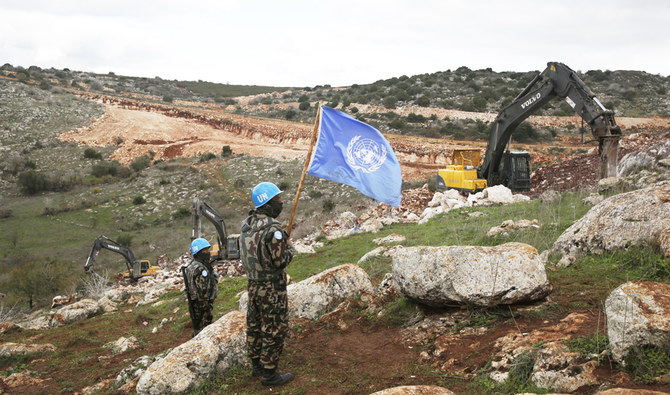

BEIRUT: A UN peacekeeping force in Lebanon on Thursday said a tunnel discovered earlier this year by Israel had crossed the Lebanese-Israeli border, in the third such breach of a cease-fire resolution.
Israel in January accused Lebanese movement Hezbollah of having dug what it described as the deepest, “longest and most detailed” tunnel it had discovered.
The Israeli army said the tunnel from the Lebanese town of Ramyeh — just 800 meters from the border — reached a few dozen meters into Israel, and descended to 55 meters underground.
UN Interim Force In Lebanon (UNIFIL) on Thursday said the tunnel was the third to have crossed the “blue line,” a demarcation line drawn by the UN to mark Israel’s withdrawal from southern Lebanon in 2000.
“UNIFIL’s independent assessment confirms that this tunnel crosses the blue line in violation of resolution 1701,” which ended the 2006 war between Israel and Hezbollah, it said.
“UNIFIL has informed the Lebanese authorities about the violation and has requested urgent follow-up actions,” the UN force said in a statement.
Lebanon and Israel are still technically at war. Israel is currently building a wall along the 130 km frontier to block Hezbollah attempts to infiltrate.
Since early December, Israel has said it discovered six tunnels, destroying them either with explosives or by filling them with a cement-like material.
Five have been confirmed to exist by UNIFIL.
“Of these, three tunnels have been found to be crossing the blue line,” the peacekeeping force said.
Israel alleges Hezbollah had planned to use the tunnels to kidnap or kill its civilians or soldiers, and to seize Israeli territory in the event of any hostilities.
On Jan. 26, Hezbollah leader Hassan Nasrallah said it had taken Israel “years” to discover some of the tunnels, but did not specify who had constructed them.
Hezbollah is the only side not to have disarmed after Lebanon’s 1975-1990 civil war.
In recent years, Israel has repeatedly carried out airstrikes against what it says are Hezbollah weapons convoys in war-torn Syria next door, where the group is backing regime forces.
The US has designated Hezbollah a “terrorist” group since 1997, while the EU blacklisted its military arm in 2013.
But it also functions as a political party, with posts in the current Cabinet.
The US on Monday offered a $10 million reward for information that would disrupt the group’s finances.


