



JEDDAH: Russian and Syrian-regime forces have intensified airstrikes and shelling in opposition-held northwestern Syria, residents, medics and UN workers said on Thursday. It is the heaviest assault, they added, since the area was declared a demilitarized zone.
The targeted villages and towns, in northern Hama and southern Idlib, fall within a buffer zone agreed last September by Russia and Turkey as part of a deal that averted a major offensive. Schools, health facilities and residential areas have been hit, according to Panos Moumtzis, a UN regional humanitarian coordinator.
Regime helicopters dropped barrel bombs, which are drums or cylinders packed with explosives and shrapnel that cause indiscriminate destruction. At least 15 civilians have been killed and dozens injured, rescuers in Idlib province said.
“The barrel bombing is the worst we have seen for at least 15 months,” Moumtzis said, adding that 300,000 people live in the affected area.
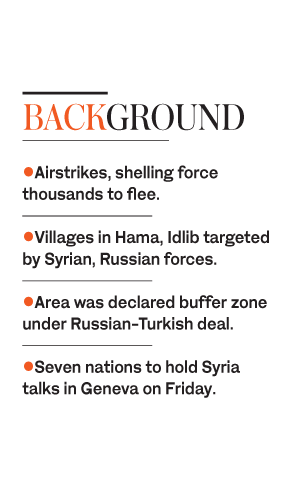 The military escalation is expected to be a focus of talks in Geneva on Friday between envoys from seven countries, including US Ambassador James Jeffrey and UN Special Envoy for Syria Geir Pedersen.
At that meeting, Moscow will have to accept what is decided or risk becoming an international pariah, like Assad’s regime and Iran, Syrian opposition spokesman Yahya Al-Aridi, told Arab News. Russia has no choice “but to stop this madness if it wants to be part of the political process,” he added.
“Any attempt to give the political process a chance is blocked by all sorts of pretexts,” said Al-Aridi. “The regime found itself cornered because the political process might be seriously starting.
“Russia repeats the regime’s narrative when it says the opposition is the one hindering the political process, namely the formation of the constitutional committee.”
Since Tuesday, the attacks have forced thousands of civilians to flee to camps to the north, along the Turkish border, and damaged four medical facilities.
Turkey is one of the main destinations for Syrians trying to flee the fighting.
The country already hosts about 3.6 million refugees and there are concerns about whether it will accept more or restrict entry. It has set up 12 observation points in Idlib but they do little to protect civilians from the bombing.
“The role of these checkpoints is only to count violations, without providing any real support for the protection of civilians,” Ammar Hamou, a Syrian journalist based in Jordan, told Arab News. “The Syrian regime threatens a hot summer in Idlib.”


