

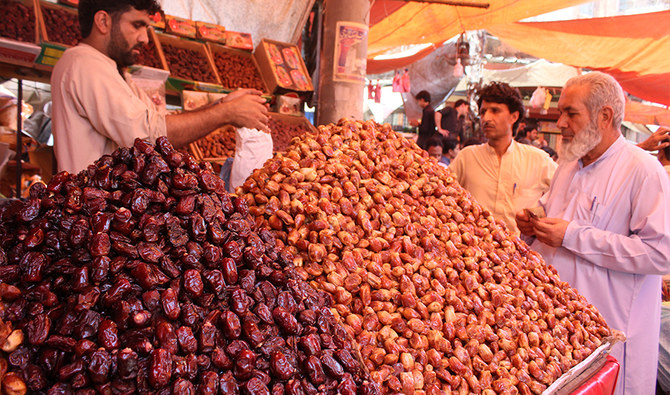
Pakistan’s dates market witnesses huge demand ahead of Ramadan

1 / 5
Pakistan meets half of country’s dates Ramadan demand from imports. (AN photo)
2 / 5
Trading activities picks up ahead of Ramadan in the Karachi’s Khajoor market. (AN photo)
3 / 5
Prices of dates have increased due to Pak Rupee devaluation against US dollar. (AN photo)
4 / 5
: Almost all varieties of dates are available in the market for Ramadan festivities. (AN photo)
5 / 5
Income of small venders rises by almost 900 percent during Ramadan. (AN photo)
Updated 03 May 2019
Follow

Pakistan’s dates market witnesses huge demand ahead of Ramadan

  • Rupee devaluation leads to sizable increase in prices of dry fruit, sellers says
  • Country fulfills 50% need by importing product from Saudi Arabia, Iraq, and Iran

KARACHI: Remaining almost lackluster for most of the months, Pakistan’s oldest market for kHajjoor (dates) springs into life ahead of Ramadan, even as most buyers said that the increased prices of the fruit, due to a devalued rupee, were making the experience less sweet.

Located in Karachi’s Lyari area, the KHajjoor market – which was established prior to the formation of Pakistan in 1947 – caters to the supply of datesand other related products for the entire country, especially during Ramadan when demand for the commodity jumps to more than 100 percent. The fruit is a quintessential part of the iftar (end of the fast) meal and is the first thing which is eaten after a Muslim ends his/her fast for the day. The dates serve as a good source of energy and provide essential vitamins.
“Several people, including wholesalers and retailers, rush to buy the commodity before Ramadan. The trading increases by more than 100 percent,” Muhammad Sabir, president of the KHajjoor Merchants’ Association, told Arab News.
 “This year, the trading activity has also picked up in the traditional manner, but the prices of dates have increased manifold,” Hanif Baloch, General Secretary of the market association said, adding that the “price spiral is because of the devaluation of the Pakistani currency”.
Pakistan meets around 50 percent of its peak demand of dates through imports which are mostly from Iran, Iraq, Saudi Arabia, and other gulf countries.
Pakistan has devalued its currency by 34 percent to PKR 141 against the US dollar since December 2017 mainly for boosting exports and curtailing imports.
“Due to devaluation (Pak Rupee), the prices of imported dates have increased from PKR 6000-7000 per maund of last year to PKR 12000-13000 per maund. Besides, less crop of dates this year in Iran also played role in price hike,” Sabir said.
Buyers, for their part, complained about the “very expensive dates” this year. “They are selling kHajjoor very expensive. The variety which was sold at PKR 80 per kilogram last year is now gone up to PKR 180 per kg,” Abdul Hameed, a daily wager, said while scouring the market for cheaper options.
“Rates are much higher this year. Even they are selling low quality dates for PKR 150 per kg,” Abdullah, who has retired from work, said.
As the business gains momentum, the number of vendors in the area – who set up makeshift shops and kiosks, some of which run into hundreds – have also multiplied.
“Though big shop owners draw major chunk of business but small vendors’ sales also sees major jump. A small vendor who sells from PKR 10,000 worth of dates in other months earns around PKR 100,000 in Ramadan,” Khizar, one of the vendors, said.
Shopkeepers said the demand is for the imported varieties of dates, such as Zahidi, Muzafati and Rabai while locally, the Aseel variety – which is mostly produced in Sukkar, Sindh – is the most sought after in Ramadan.


Pakistan says $50 million meat export deal with Tajikistan nearing finalization

Updated 09 December 2025
Follow

Pakistan says $50 million meat export deal with Tajikistan nearing finalization

  • Islamabad expects to finalize agreement soon after Dushanbe signals demand for 100,000 tons
  • Pakistan is seeking to expand agricultural trade beyond rice, citrus and mango exports

ISLAMABAD: Tajikistan has expressed interest in importing 100,000 tons of Pakistani meat worth more than $50 million, with both governments expected to finalize a supply agreement soon, Pakistan’s food security ministry said on Tuesday.

Pakistan is trying to grow agriculture-based exports as it seeks regional markets for livestock and food commodities, while Tajikistan, a landlocked Central Asian state, has been expanding food imports to support domestic demand. Pakistan currently exports rice, citrus and mangoes to Dushanbe, though volumes remain small compared to national production, according to official figures.

The development came during a meeting in Islamabad between Pakistan’s Federal Minister for National Food Security and Research Rana Tanveer Hussain and Ambassador of Tajikistan Yusuf Sharifzoda, where agricultural trade, livestock supply and food-security cooperation were discussed.

“Tajikistan intends to purchase 100,000 tons of meat from Pakistan, an import valued at over USD 50 million,” the ambassador said, according to the ministry’s statement, assuring full facilitation and that Islamabad was prepared to meet the demand.

The statement said the two sides agreed to expand cooperation in meat and livestock, fresh fruit, vegetables, staple crops, agricultural research, pest management and standards compliance. Pakistan also proposed strengthening coordination on phytosanitary rules and establishing pest-free production zones to support long-term exports.

Pakistan and Tajikistan have long maintained political ties but bilateral food trade remains below potential: Pakistan produces 1.8 million tons of mangoes annually but exported just 0.7 metric tons to Tajikistan in 2024, while rice exports amounted to only 240 metric tons in 2022 out of national output of 9.3 million tons. Pakistan imports mainly ginned cotton from Tajikistan.