Iraq says Daesh leader Baghdadi filmed video in 'remote area'

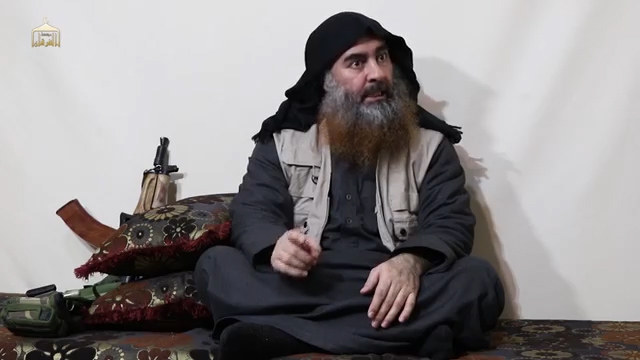
Baghdadi's appearence in a video released Monday was the first time he had been seen in 5 years. (AFP)
Updated 30 April 2019
Follow

Iraq says Daesh leader Baghdadi filmed video in 'remote area'

BAGHDAD: Daesh remains a potent threat around the world despite reduced capabilities, Iraqi Prime Minister Adel Abdul Mahdi said on Tuesday, adding its leader Abu Bakr Al-Baghdadi had made his latest video appearance in a "remote area."

Abdul Mahdi did not say which country that area was in.
A video released late on Monday by Daesh's propaganda wing showed a man it said was Al-Baghdadi in what would be his first appearance since he declared the extremists' now-defunct "caliphate" five years ago.
The authenticity and date of the recording could not be independently verified.
Abdul Mahdi said Baghdadi's appearance was an attempt to boost militants and that Daesh would attempt to carry out more attacks.
"Regarding the location of Baghdadi, we can't give intelligence information right now but it's clear from the video that he's in a remote area," Abdul Mahdi said at a news conference on a visit to Berlin.
Al-Baghdadi, an Iraqi, is believed to be hiding out in an isolated area of either Iraq or Syria, part of vast desert regions Daesh once held and from where it is thought the extremists are now waging regular insurgent-style attacks against security forces in both countries.
Hisham Al-Hashemi, a security adviser to the Iraqi government, said officials had narrowed his whereabouts from 17 to a possible four locations.
"These are in the desert of Iraq's Anbar (province) or in the (eastern) desert of Homs in Syria," he said.
Abdul Mahdi said Daesh's capabilities had "greatly reduced" but that the group still posed a threat.
"Daesh is not just a small organisation, it's widespread and will try to put confidence back in its militants and carry out acts such as those in Sri Lanka," he said, referring to the Easter Sunday attacks claimed by the group which killed more than 250 people.
In the 18-minute video, a bearded man with Al-Baghdadi's appearance says the bombings in Sri Lanka were Daesh's response to losses in its last territorial stronghold of Baghouz in Syria.
The video would be the first from Al-Baghdadi since he was filmed in the Iraqi city of Mosul in 2014. More recent speeches have been released as audio recordings.
A US-backed campaign ended Daesh's control of territory in Iraq in late 2017 and in Syria last month, nearly five years after the group took over vast areas in both countries.


Lebanon close to completing disarmament of Hezbollah south of Litani River, says PM

Updated 2 sec ago
Follow

Lebanon close to completing disarmament of Hezbollah south of Litani River, says PM

BEIRUT: Lebanon is close to completing the disarmament of Hezbollah south of the Litani River, Prime Minister Nawaf Salam said on Saturday, as the country ​races to fulfil a key demand of its ceasefire with Israel before a year-end deadline.
The US-backed ceasefire, agreed in November 2024, ended more than a year of fighting between Israel and Hezbollah and required the disarmament of the Iran-aligned militant group, starting in areas south of the river adjacent to Israel.
Lebanese authorities, ‌led by President ‌Joseph Aoun and Salam,
tasked
the US-backed Lebanese ‌army ⁠on ​August ‌5 with devising a plan to establish a state monopoly on arms by the end of the year.
“Prime Minister Salam affirmed that the first phase of the weapons consolidation plan related to the area south of the Litani River is only days away from completion,” a statement from his ⁠office said.
“The state is ready to move on to the second ‌phase — namely (confiscating weapons) north of the ‍Litani River — based on the ‍plan prepared by the Lebanese army pursuant to ‍a mandate from the government,” Salam added.
The statement came after Salam held talks with Simon Karam, Lebanon’s top civilian negotiator on a committee overseeing the Hezbollah-Israel truce.
Since the ceasefire, the sides ​have regularly accused each other of violations, with Israel questioning the Lebanese army’s efforts to disarm Hezbollah. ⁠Israeli warplanes have increasingly targeted Hezbollah in southern Lebanon and even in the capital.
Hezbollah, a Shiite Muslim group, has tried to resist the pressure — from its mainly Christian and Sunni Muslim opponents in Lebanon as well as from the US and Saudi Arabia — to disarm, saying it would be a mistake while Israel continues its air strikes on the country.
Israel has publicly urged Lebanese authorities to fulfil the conditions of the truce, saying it will act “as ‌necessary” if Lebanon fails to take steps against Hezbollah.