ISLAMABAD: Pakistan’s army called on India on Monday to heed its message of peace in order to resolve all outstanding issues through dialogue, warning that it was ready to use its capabilities to defend its territory against any form of aggression.
The statement follows months of border tensions between the arch-rival neighbors which peaked in February this year when Pakistan Air Force (PAF) shot down two Indian fighter jets for violating its airspace and arrested Wing Commander Abhinandan, who was released a few days later as a goodwill gesture on part of Prime Minister Imran Khan.
“Don’t test our resolve. The army with the support of 207 million Pakistanis will respond to any aggression with full force,” Major General Asif Ghafoor, Director-General of Inter-Services Public Relations (ISPR) – media wing of the armed forces – said in a wide-ranging press conference.
Commenting on the recent threat of use of nuclear weapons as suggested by Indian Prime Minister Narendra Modi, he said: “Nuclear weapons are not a threat, they are a weapon of deterrence that should not be mentioned lightly.”
Ghafoor also took a jibe at India for its “repeated lies” against Pakistan following the February 14 attack in the Pulwama district of Indian-administered Kashmir which resulted in the deaths of nearly 40 Indian paramilitary troops.
The Indian Air Force, on February 26, conducted an airstrike inside Pakistani territory, claiming that it had targeted a Jaish-e-Mohammad – a proscribed outfit that claimed responsibility for the Pulwama incident – facility and killed militants in the process.
“Two months have passed since and India has told countless lies on the matter. We have not responded to the lies, not because we can’t, but because we don’t want to retaliate,” he said.
The PAF, on February 27, shot down two Indian fighter jets and “the whole world saw their debris,” the DG ISPR said, “we have not talked much about it because we want to find the appropriate time to honor our pilots whose skills had been used to down the Indian planes.”
Talking about Pakistan’s education system, he regretted the fact that more than 25 million children were out of schools in the country. “These children then go to madrassas, 30,000 of which exist in Pakistan at the moment. Out of these, less than 100 were found to be the kind that were pushing children toward extremism,” he said.
He said that children studying in the Islamic seminaries should have the same job opportunities as those enrolled in mainstream schools. “That’s why we have decided to mainstream all these madrassas where children will be taught contemporary subjects,” he said.
Ghafoor said that both PM Khan and army chief General Qamar Javed Bajwa have taken on board the views of clerics from all schools of thoughts and that the process would be completed in three different phases.
“Initially two billion rupees will be required to run this program and then one billion rupees will be required each year for the program’s upkeep,” he said, adding that new teachers will be employed in these madrassas to provide equal opportunities of education and careers to all children.
About the growing protests by Pashtun ethnic protest movement, Pashtun Tahaffuz Movement (PTM), he warned leaders of the group not to cross the red line. “Their time is up. You have taken the liberty that you wanted,” he said while hinting at initiating legal proceedings against the PTM leaders for their inflammatory speeches against the state and the armed forces.
He also questioned their sources of funding for holding public gatherings in different cities of the country. “Nobody can fight the state. It is not a difficult job to deal with you,” he said, adding that the state has made significant progress on all three demands of the PTM which included clearance of mines from tribal districts, abolition of check posts, and recovery of missing persons.
“The three demands put forward by PTM are not theirs. This is not their pain. The people don’t even live in areas where the war occurred,” he said.
The DG ISPR said that the overall security situation has improved in the country due to 1,237 kinetic operations carried out by the armed forces to flush out militants. “We can say with confidence that no organized structure of any terrorist network, including the Daesh, exists in Pakistan today,” he added.


![]()

“Don’t test our resolve” Pakistan army warns India
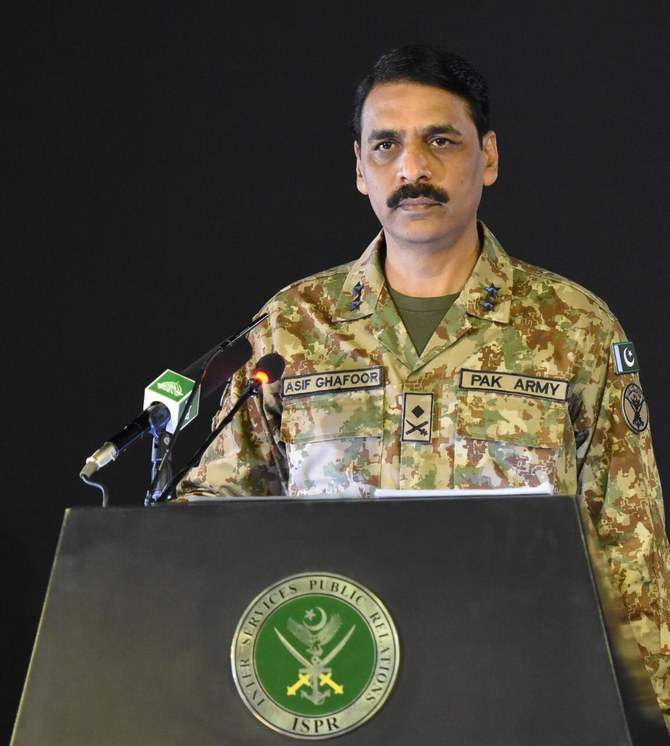
“Don’t test our resolve” Pakistan army warns India
- Slams New Delhi for nuclear saber-rattling
- Says no organized structure of any terrorist network, including Daesh, exists in Pakistan
Latest updates


© 2026 SAUDI RESEARCH & PUBLISHING COMPANY, All Rights Reserved And subject to Terms of Use Agreement.