

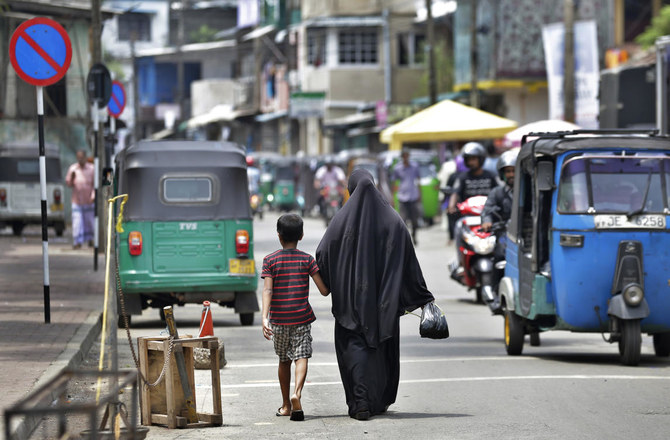

COLOMBO: The Sri Lankan government has introduced measures banning women from covering their faces in public.
The move was imposed by President Maithripala Sirisena on Monday, following a series of deadly bomb blasts in the country last week.
It will mean religious wear like the niqab (full face veil) cannot be worn, and will apply to female citizens and visitors
Several Sri Lankans, including those from the Sinhalese, Tamil and Muslim communities, welcomed the government’s decision after 268 people, including 40 foreign tourists, were killed in attacks on churches and hotels in Colombo last week.
Muslim women from all walks of life were in agreement with the new rule, saying that in times of national emergency, women should contribute toward maintaining law and order.
Rozmin Farhard, a schoolteacher from Colombo, told Arab News that only a small number of Muslim women in the country would be affected.
“They will not like to expose themselves following the rule, those working may relinquish their jobs and would prefer to stay indoors to exposing their faces since it is very sensitive to them,” she said.
The directive claims all forms of face covers, which may hinder people from being clearly identified, are a threat to national security and public safety. Sirisena tweeted on Monday that the security measures were being put in place to maintain order and stability.
Western Province Gov. Azath Salley said that under the rule, even motorbike riders would be banned from wearing fully covered helmets on the roads. “It is a rule to enable the law enforcement officers to identify people easily at a glance.”
All-Ceylon Jamiyaathul Ulema President Shaikh Rizwie Mufthi claimed the government has no alternative but to introduce the law to eradicate extremism and terrorism from the country, whilst the Sri Lankan Muslim Council president, N. M. Amin, said that as a community Muslims had to accept the president’s decision for the sake of national unity and security.
Police spokesman Ruwan Gunasekera, meanwhile, said that the government had intensified its search operations across the island, and had apprehended the wife and brother of Zahran Hashmi, the suspected mastermind of the attacks.
The attacks have also instigated a number of senior changes in Sri Lanka’s judiciary and in high-level defense roles.
The former head of the army, Gen. S. H. S Kottegoda (Rtd) has been made secretary of defense in place of Hemasiri Fernando, who submitted his resignation on Friday.
The former Inspector General of Police (IGP) N.K. Illangakoon has been appointed as an adviser to the Ministry of Defense, whilst Senior Deputy Inspector C. D Wickramaratne has been made acting IGP after incumbent IGP Pujith Jayasundara was placed on compulsory leave over the attacks.
Meanwhile, Attorney General (AG) Jayantha Jayasuriya was sworn in as Sri Lanka’s new chief justice on Monday morning, while Solicitor General Dappula de Livera was made acting AG.


