ANKARA: Turkish President Recep Tayyip Erdogan upped his war of words on Saturday with French counterpart Emmanuel Macron for creating a day of remembrance for the 1915 Armenian “genocide.”
Macron decided in February to formally to mark the mass killings and forced deportations of Armenians by troops from the Ottoman Empire — which preceded modern-day Turkey and sided with German and Austro-Hungary in World War I.
France on Wednesday held its first “national day of commemoration of the Armenian genocide.”
It was the first major European country to recognize the massacres as genocide in 2001 and Macron has said his decision on a commemoration is designed to show Paris “knows how to look history in the face.”
But Erdogan, who has urged “political novice” Macron to “focus on massacres committed by French troops during the colonial era” on Saturday again denounced the idea.
“Delivering a message to 700,000 Armenians who live in France will not save you, Monsieur Macron,” Erdogan told a gathering of his ruling party in Kizilcahamam, north of Ankara.
“Learn first to be honest in politics — if you are not you cannot win,” said Erdogan, adding he had told Macron his views several times face to face.
Turkish officials have indicated France should look first at its own record, notably in Algeria and its role in the 1994 Rwandan genocide.
Rwanda’s current government accuses Paris of being complicit in the atrocities committed by the majority Hutu community on minority Tutsis.
France has always denied the allegations and Macron announced the creation of a panel of historians and researchers earlier in April which will be tasked with investigating France’s role.
Some 30 countries and a number of historians recognize the 1915 massacre of between 1.2 and 1.5 million Armenians as genocide.

Macron’s ‘Armenia genocide’ remembrance irks Erdogan
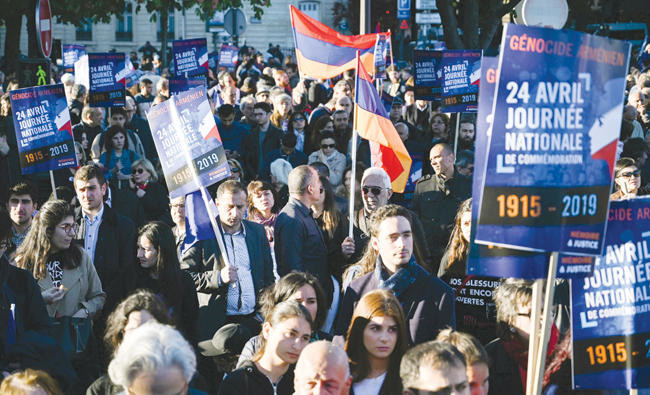
- Some 30 countries and a number of historians recognize the 1915 massacre of between 1.2 and 1.5 million Armenians as genocide
As Iran conflict spills over, Iraq’s Kurds say ‘this war is not mine’
- The Kurds, an ethnic minority with a distinct culture and language, are rooted in the mountainous region spread across Turkiye, Syria, Iraq and Iran
- American bases there have come under fire, as have positions held by Iranian Kurdish parties — the same ones US President Donald Trump said it would be “wonderful” to see storm Iran
SORAN, Iraq: On a deserted road not too far from the border between Iran and Iraqi Kurdistan, Satar Barsirini looked up at the sky, now streaked with jets and drones.
Iraq’s Kurdish region has found itself caught in the crossfire of a regional war triggered by US and Israeli attacks on the Islamic republic.
Dressed like the Kurdish fighters he once served alongside, Barsirini still wears the khaki shalwar, fitted jacket and scarf wrapped around his waist.
Though recently retired, he refuses to give up his peshmerga uniform as he tills his small plot of land.
The rumble of jets and hum of drones “come from everywhere. Especially at night,” he told AFP in the hamlet of Barsirini, dozens of kilometers from the border.
He described the “shiver in our flesh” as the drones hit the ground outside.
“I feel bad for the people, because we have paid a lot in blood to liberate Kurdistan... We just want to live.”
Irbil, the autonomous region’s capital, and the valleys leading to the border have been targeted by Tehran and the Iraqi armed groups it supports.
American bases there have come under fire, as have positions held by Iranian Kurdish parties — the same ones US President Donald Trump said it would be “wonderful” to see storm Iran.
But Iran warned on Friday it would target facilities in Iraqi Kurdistan if fighters crossed into its territory.
“This isn’t my war,” said 58-year-old Barsirini.
He recalled the brutal repression and flight into the snowy mountains after the 1991 Kurdish uprising that followed the first Gulf War.
- ‘Dangerous people’ -
The uprising was repressed, leading to an exodus of two million Kurds to Iran and Turkiye.
“When we fled the cities for our lives, we went to Iran. They helped us, they gave us shelter and food,” he said.
The Kurds would not forget that, Barsirini stressed, adding that they could not just “turn against them” now to support the US and Israel.
“I don’t trust (Americans). They are dangerous people,” he said.
The Kurds, an ethnic minority with a distinct culture and language, are rooted in the mountainous region spread across Turkiye, Syria, Iraq and Iran.
They have long fought for their own homeland, but for decades suffered defeats on the battlefield and massacres in their hometowns.
They make up one of Iran’s most important non-Persian ethnic minority groups.
A week of war has gripped daily life in Iraqi Kurdistan, residents told AFP.
“People are afraid,” said Nasr Al-Din, a 42-year-old policeman who, as a child, lived through the 1991 exodus — “thrown on a donkey’s back with my sister.”
“This generation is different from the older ones” that have seen “seen fighting.”
Now, he said, you could be “sitting down in your home... and all of a sudden a drone hits your house.”
“We may have to go into town or somewhere safer,” said Issa Diayri, 31, a truck driver waiting in a roadside garage, his lorry idle for lack of deliveries from Iran.
- ‘Shouldn’t get involved’ -
Soran, a small town of 3,000 people about 65 kilometers (40 miles) from the border, was hit Thursday by a drone that fell in the middle of a street.
There, baker Yussef Ramazan, 42, and his three apprentices, hurriedly made bread before breaking their fast.
But, living so close to the Iranian border, he said “people are afraid to come and buy it.”
He told AFP he did not think it was a good idea “for the Kurdish region to get involved in this war.”
“We are not even an independent country yet. We would like to become one, but we are nothing for now, so we shouldn’t get involved in these situations.”
Across the street, Hajji watched from his empty dry cleaning shop as the road cleared.
Before the war, the town was crowded as evening fell, he said, declining to give his full name.
“But after the drone explosion, no one was here. In five minutes, everyone left the street and no one was out.”