KIEV: A Ukrainian computer game that brings to life a town abandoned after the Chernobyl nuclear disaster may not sound like everyone’s idea of fun but has attracted 60,000 people globally since its launch in October.
Players of “Isotopium: Chernobyl” drive tanks around the ghost town of Prypyat near Chernobyl, knocking out competitors as they search for an energy source called isotopium and collecting points every time they find some.
While the game takes its theme from the nuclear disaster at Chernobyl in northern Ukraine, which marked its 33rd anniversary on Friday, it was also inspired by the 2009 science fiction film “Avatar.”
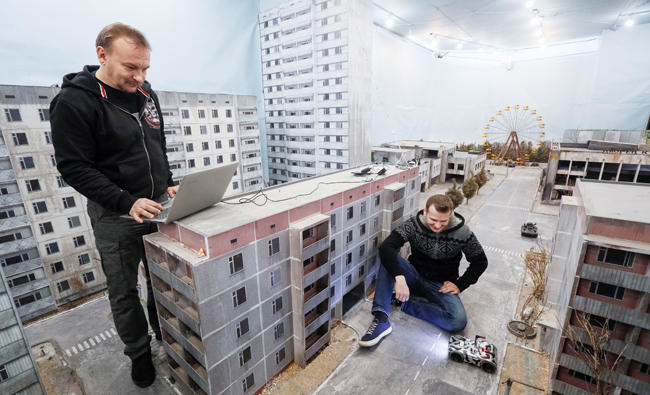
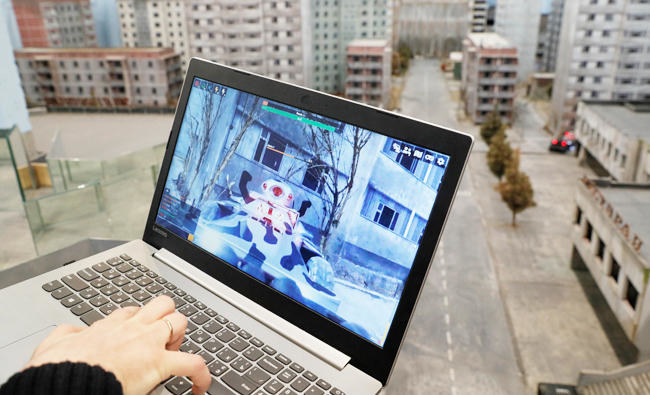
Newcomers to the game think they have entered a virtual world when in fact they are controlling a real robot, equipped with a camera and computer, which makes its way around a model of the town rendered down to the tiniest detail.
“When playing our game, for the first 5-10 minutes many players don’t understand that it is not fictional,” said the game’s co-founder Sergey Beskrestnov. “They message us saying: ‘You have cool texture, you have good graphics, your designer is good, well done. You have a cool operating system.’
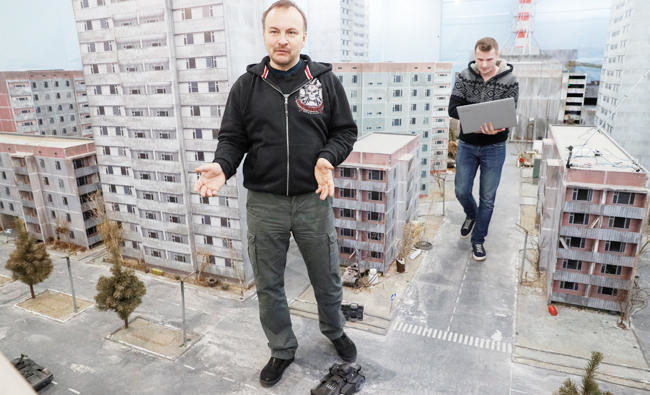
“People then reply: ‘It is not an operating system, it is real,’ and the player can’t believe it is real,” said Beskrestnov, speaking mid-game from Prypyat city square as he towers over surrounding five-story buildings.
Kiev-born Beskrestnov was just 12 years old when on April 26, 1986 a botched test at the nuclear plant in the then Soviet Union sent clouds of smoldering nuclear material across large swathes of Europe, forced over 50,000 people, including Beskrestnov’s family, to evacuate and poisoned unknown numbers of workers involved in its clean-up.
Beskrestnov and his partner Alexey Fateyev used Google maps and hundreds of pictures from the Chernobyl area to recreate Prypyat landmarks, including residential buildings, a hotel, concert hall, amusement park and a stadium.
The game’s real-scale model occupies a 180 square meter (1,938 sq. ft) basement of a residential building in the Ukraine city of Brovary, just 150 km (93 miles) from the Chernobyl Exclusion Zone and 30 km east of Kiev.
Miniature radioactivity warning signs, graffiti on the walls of abandoned buildings and tables and chairs left scattered inside a small cafe all add to the creepy atmosphere of a once lively town.
“It’s a really neat concept ...,” Shaun Prescott wrote in a review of the game published by PC Gamer magazine in January. “Controlling the tanks is kinda cumbersome, but they are tanks, after all.”
An attentive player will notice at least one inaccuracy – the real Chernobyl nuclear power plant is not located in town as it is in the game.
It costs $9 to immerse in the atmosphere of a post-apocalyptic town for an hour but only 20 people at a time can play simultaneously. Beskrestnov’s company, Remote Games, said 62,615 people around the world have registered to play the game, including around 15,000 in France and 10,000 in the United States.
A camera fixed on top of a moving tank broadcasts high quality signal in real time, allowing players from as far apart as Australia and Canada enjoy the game without facing any time delay in delivering video signals.
Its creators next ambition is to devise a game featuring the colonization of Mars in which 1,000 people will be able to simultaneously control robots on different missions involved in the operation.
“Many people advise us to contact Elon Musk directly because it resonates his dreams and ideas,” Beskrestnov jokes.

Chernobyl comes back to life in Ukrainian computer game
- An attentive player will notice at least one inaccuracy – the real Chernobyl nuclear power plant is not located in town as it is in the game
How TV shows like ‘Mo’ and ‘Muslim Matchmaker’ allow Arab and Muslim Americans to tell their stories
- In addition to “Mo,” shows like “Muslim Matchmaker,” hosted by matchmakers Hoda Abrahim and Yasmin Elhady, connect Muslim Americans from around the country with the goal of finding a spouse
COLUMBUS, Ohio: Whether it’s stand-up comedy specials or a dramedy series, when Muslim American Mo Amer sets out to create, he writes what he knows.
The comedian, writer and actor of Palestinian descent has received critical acclaim for it, too. The second season of Amer’s “Mo” documents Mo Najjar and his family’s tumultuous journey reaching asylum in the United States as Palestinian refugees.
Amer’s show is part of an ongoing wave of television from Arab American and Muslim American creators who are telling nuanced, complicated stories about identity without falling into stereotypes that Western media has historically portrayed.
“Whenever you want to make a grounded show that feels very real and authentic to the story and their cultural background, you write to that,” Amer told The Associated Press. “And once you do that, it just feels very natural, and when you accomplish that, other people can see themselves very easily.”
At the start of its second season, viewers find Najjar running a falafel taco stand in Mexico after he was locked in a van transporting stolen olive trees across the US-Mexico border. Najjar was trying to retrieve the olive trees and return them to the farm where he, his mother and brother are attempting to build an olive oil business.
Both seasons of “Mo” were smash hits on Netflix. The first season was awarded a Peabody. His third comedy special on Netflix, “Mo Amer: Wild World,” premiered in October.
Narratively, the second season ends before the Hamas attack in Israel on Oct. 7, 2023, but the series itself doesn’t shy away from addressing Israeli-Palestinian relations, the ongoing conflict in Gaza or what it’s like for asylum seekers detained in US Immigration and Customs Enforcement detention centers.
In addition to “Mo,” shows like “Muslim Matchmaker,” hosted by matchmakers Hoda Abrahim and Yasmin Elhady, connect Muslim Americans from around the country with the goal of finding a spouse.
The animated series, “#1 Happy Family USA,” created by Ramy Youssef, who worked with Amer to create “Mo,” and Pam Brady, follows an Egyptian American Muslim family navigating life in New Jersey after the 9/11 terrorists attack in New York.
Current events have an influence
The key to understanding the ways in which Arab or Muslim Americans have been represented on screen is to be aware of the “historical, political, cultural and social contexts” in which the content was created, said Sahar Mohamed Khamis, a University of Maryland professor who studies Arab and Muslim representation in media.
After the 9/11 attacks, Arabs and Muslims became the villains in many American films and TV shows. The ethnic background of Arabs and the religion of Islam were portrayed as synonymous, too, Khamis said. The villain, Khamis said, is often a man with brown skin with an Arab-sounding name.
A show like “Muslim Matchmaker” flips this narrative on its head, Elhady said, by showing the ethnic diversity of Muslim Americans.
“It’s really important to have shows that show us as everyday Americans,” said Elhady, who is Egyptian and Libyan American, “but also as people that live in different places and have kind of sometimes dual realities and a foot in the East and a foot in the West and the reality of really negotiating that context.”
Before 9/11, people living in the Middle East were often portrayed to Western audiences as exotic beings, living in tents in the desert and riding camels. Women often had little to no agency in these media depictions and were “confined to the harem” — a secluded location for women in a traditional Muslim home.
This idea, Khamis said, harkens back to the term “orientalism,” which Palestinian American academic, political activist and literary critic Edward Said coined in his 1978 book of the same name.
Khamis said, pointing to countries like Britain and France, the portrayal in media of people from the region was “created and manufactured, not by the people themselves, but through the gaze of an outsider. The outsiders in this case, he said, were the colonial/imperialist powers that were actually controlling these lands for long periods of time.”
Among those who study the ways Arabs have been depicted on Western television, a common critique is that the characters are “bombers, billionaires or belly dancers,” she said.
The limits of representation
Sanaz Alesafar, executive director of Storyline Partners and an Iranian American, said she has seen some “wins” with regard to Arab representation in Hollywood, noting the success of “Mo,” “Muslim Matchmaker” and “#1 Happy Family USA.” Storyline Partners helps writers, showrunners, executives and creators check the historical and cultural backgrounds of their characters and narratives to assure they’re represented fairly and that one creator’s ideas don’t infringe upon another’s.
Alesafar argues there is still a need for diverse stories told about people living in the Middle East and the English-speaking diaspora, written and produced by people from those backgrounds.
“In the popular imagination and popular culture, we’re still siloed in really harmful ways,” she said. “Yes, we’re having these wins and these are incredible, but that decision-making and centers of power still are relegating us to these tropes and these stereotypes.”
Deana Nassar, an Egyptian American who is head of creative talent at film production company Alamiya Filmed Entertainment, said it’s important for her children to see themselves reflected on screen “for their own self image.” Nassar said she would like to see a diverse group of people in decision-making roles in Hollywood. Without that, it’s “a clear indication that representation is just not going to get us all the way there,” she said.
Representation can impact audiences’ opinions on public policy, too, according to a recent study by the Institute for Social Policy and Understanding. Results showed that the participants who witnessed positive representation of Muslims were less likely to support anti-democratic and anti-Muslim policies compared to those who viewed negative representations.
For Amer, limitations to representation come from the decision-makers who greenlight projects, not from creators. He said the success of shows like his and others are a “start,” but he wants to see more industry recognition for his work and the work of others like him.
“That’s the thing, like just keep writing, that’s all it’s about,” he said. “Just keep creating and keep making and thankfully I have a really deep well for that, so I’m very excited about the next things,” he said.