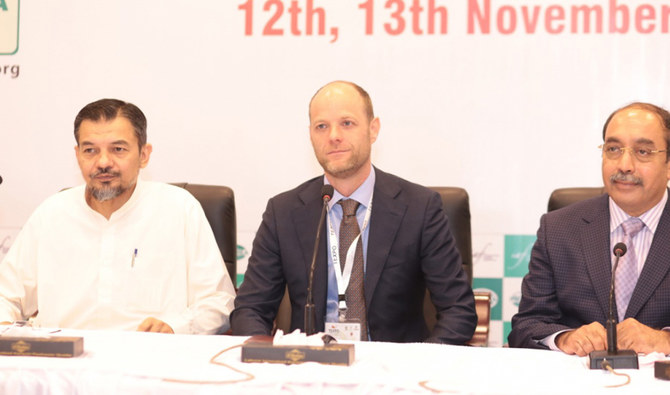
ISLAMABAD: The International Apparel Federation’s Thirty-fifty World Fashion Convention (WFC) will be held in Pakistan in November this year, the chief coordinator for the event said on Thursday, the first time the South Asian nation will host the prestigious apparel summit.
The International Apparel Federation (IAF) represents 150,000 companies and apparel associations from 60 countries. This year’s convention is expected to host delegates from more than 45 countries.
The Pakistan government asked the Pakistan Readymade Garments Manufacturers and Exporters Association last year to put in a bid to host the event, Ijaz Khokhar, a former PRGMEA chairman and the chief coordinator for this year’s convention, told Arab News.
He said the government had pushed for the convention to be held in Pakistan “so that our country and our countrymen can show a softer image of Pakistan around the globe.”
The convention, whose membership registration opens in June, is a multi-day event featuring panel discussions, lectures and workshops about the textile and garment industry attended by well-known fashion designers, buyers, brands and fashion houses and influencers from around the world.
It moves each year to a different country and is coming to Pakistan a year after the IAF opened a regional office in Sialkot.
“The IAF Convention caters to apparel industry leaders from across the supply chain, from all continents. This convention is a unique opportunity to gain the insights necessary to understand where our industry is heading,” the IAF said on its website.
“Top speakers from across the globe cover the width of the supply chain, from raw materials to apparel sourcing and from production to retail trends. On top of that, the convention provides an excellent opportunity to meet the global industry in one location in a few days time.”
Khokhar said the visiting delegates, many of whom would be coming to Pakistan for the first time, “will see physically with their own eyes the products of Pakistan, the standard of our textile and garment companies.”
The delegates will tour Pakistani garment and textile factories and also be able to view a ‘small products showcase’ at the hall where the convention will be held, he said. International designers and companies will also speak at sessions.
Among this year’s attendees will be Li & Fung Limited, Khokhar confirmed, the Hong Kong-based supply chain giant primarily for US and EU brands, department stores, hypermarkets, specialty stores, catalogue-led companies, and e-commerce sites.
“Li and Fung’s chief operating officer was here to discuss the plan,” Khokhar said. “He will be one of our speakers, plus he will be trying to bring Chinese companies from Hong Kong to come and join this session.”
Khokhar described the event as a large scale “social networking opportunity” for both foreigners and locals.
“The main focus is to send a soft image of Pakistan, to give [attendees] knowledge about what we produce, and to allow interaction between our people and their community,” the chief coordinator said, adding that the convention went “beyond business”: “It’s about establishing friendships, connections, exchanging business cards and ideas … which can make individual relationships grow stronger with the countries and their people.”
“For example someone coming from Brazil, when they go back they will bring a message to the Brazilian companies that Pakistan is a suitable place for their products,” Khokhar said.
The coordinator said he was in talks with President Dr. Arif Alvi to inaugurate the event: “I already spoke to him and he is very much willing to conduct the opening ceremony as well as start the inaugural session.” The president’s office could not be reached for comment.
However, Khokhar said, the convention was a purely private sector initiative with the government merely supporting it from the sidelines.


![]()
![]()
![]()

Pakistan to host World Fashion Convention in November


Pakistan to host World Fashion Convention in November
- Event seeks to present ‘softer image’ of Pakistan abroad, convention coordinator says
- This year’s summit is expected to host delegates from over 45 countries
Latest updates


Recommended


© 2026 SAUDI RESEARCH & PUBLISHING COMPANY, All Rights Reserved And subject to Terms of Use Agreement.