

Sri Lanka churches halt public services over security fears

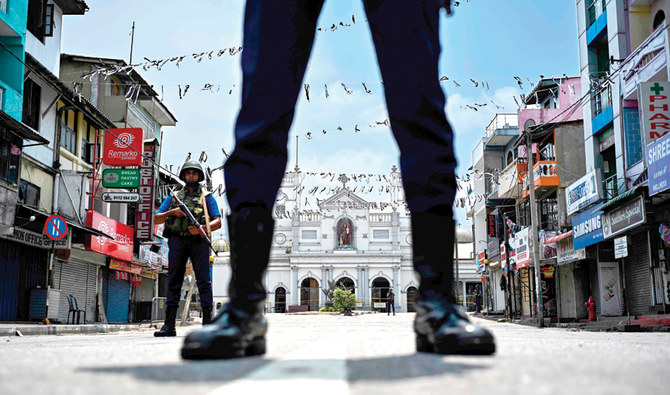
Soldiers stand guard on Thursday outside St. Anthony’s Shrine in Colombo that was attacked on Sunday. (AFP)
Updated 26 April 2019
Follow

Sri Lanka churches halt public services over security fears

  • Potential bombers ‘at large’ as death toll lowered to 253
  • Muslims asked to shun Friday prayer

COLOMBO: Sri Lanka’s Catholic churches suspended all public services over security fears on Thursday, as thousands of troops joined the hunt for suspects in deadly Easter bombings.

A senior priest said that all public services were being suspended and all churches closed “on the advice of security forces.”

Authorities revised the death toll down to 253, from the previous figure of 359, explaining that some of the badly mutilated bodies had been double-counted.

The father of two of the suspected bombers has been arrested on suspicion of aiding his sons.

Sri Lanka’s Prime Minister Ranil Wickremesinghe said suspects remained at large and could have access to explosives. Some of the suspects “may go out for a suicide attack,” Wickremesinghe said.

Hundreds of Ahmadi refugees in western Sri Lanka have taken refuge in mosques and a police station after facing intimidation following the bombings. Scores of Ahmadis who settled in Negombo after fleeing persecution in their home countries have been thrown out of their accommodation by landlords.

Sri Lanka’s Defense Secretary Hemasiri Fernando resigned on Thursday over security failures. He submitted a letter of resignation to President Maithripala Sirisena.

Britain’s Foreign Office advised against all but essential travel to Sri Lanka.

“The horrific attack is a demonstration of how tactics, techniques and procedures (TTPs) that originated in this island nation several decades ago returned to haunt a shocked and broken government thanks to a complete collapse of counterterrorism capability or capacity,” Dr. Theodore Karasik, a security expert, writes in an opinion piece.

Hate preacher Zahran Hashim, head of the National Thowheeth Jama’ath group that is being blamed for the attacks, developed a reputation as a preacher who “copied” Daesh propaganda videos to enhance his posts via the pro-Daesh Al-Ghuraba media channel, which used Facebook and YouTube as its primary platforms, Karasik says. 

Sri Lanka’s Islamic affairs minister, M. H. M. Haleem, asked all Muslims to avoid prayers on Friday for security reasons. He also said it would be a mark of respect for those who perished in the nation’s worst violence in years.

Politician and Western Province Gov. Azath Salley told Arab News that the blasts were orchestrated by a handful of extremists and that the island’s Muslim population could not be held responsible for their “deviant” actions. 


Duterte killed thousands, ICC prosecutors say

Updated 3 sec ago
Follow

Duterte killed thousands, ICC prosecutors say

  • His defense team countered that Duterte had murdered no one and that the prosecution’s argument was based on “hearsay” and “conjecture“
  • “He’s proud of his killings. He wants to be remembered for them,” said Julian Nicholls, summing up for the prosecution

THE HAGUE: Rodrigo Duterte killed thousands during his anti-drug campaign, an International Criminal Court prosecutor alleged Friday, as the crimes against humanity hearing against the former Philippines president wrapped up.
His defense team countered that Duterte had murdered no one and that the prosecution’s argument was based on “hearsay” and “conjecture,” falling far short of the bar needed to confirm the charges against him.
“He’s proud of his killings. He wants to be remembered for them,” said Julian Nicholls, summing up for the prosecution.
“Decades of murdering his own people, murdering the children of the Philippines, and he claims that he did it all for his country. He doesn’t deny it.
“He ran a death squad in Davao (city) that he created. He ran it for over 20 years before he became president. His promise was to kill thousands and he did.”
Throughout the week, a panel of three judges has heard from the prosecution, defense, and victims’ representatives as they weigh whether to proceed to a full trial.
Duterte has not been in the courtroom. The defense says he is too ill to attend. Victims say he does not want to face the loved ones of those he killed.
He faces three counts of crimes against humanity over his so-called “war on drugs” when he was mayor of Davao City and then as president of the Philippines.
The prosecution has put forward 76 cases of alleged murder, which they say is an “emblematic fraction” of those killed, which rights groups say number thousands.
Duterte’s defense lawyer Nicholas Kaufman, summing up his case, said that if his client could be faulted for anything, it was his “inappropriate choice of language.”
“But he murdered nobody,” Kaufman told the court.
He urged the judges not to confirm the charges and to free Duterte to “live out the rest of his days in peace” in the Philippines.
He said that during a visit to explain proceedings to his client, he “lost the desire to follow me within a minute.”
However, he cited the former leader as asking how the prosecutors could prove that he murdered anyone, again denying the charges against him.
Gilbert Andres, a lawyer representing victims, summed up by saying that his clients experienced defense rebuttals “like their murdered loved-ones are being murdered again.”
He called on the court to confirm the charges so that the victims can be “reintegrated into their communities.”
Following the hearing, judges will have up to 60 days to issue a written verdict.
They can confirm all of the charges and proceed to trial, throw out some of the charges, or reject the case outright, in which case Duterte would walk free.