

Turkey’s election board rejects objection for ‘dismissed voters’

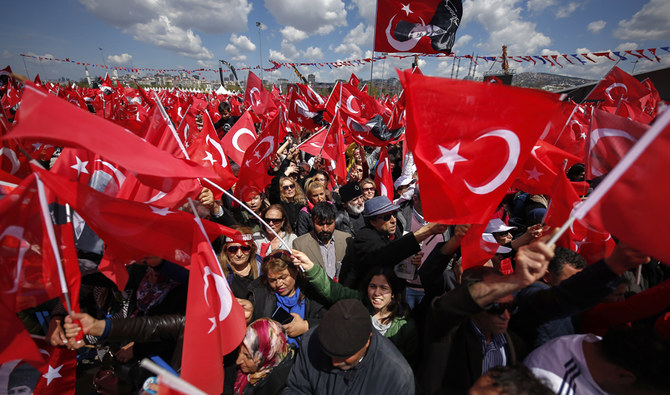
Supporters listen to Ekrem Imamoglu, the new mayor of the city of Istanbul, during a rally in Istanbul on April 21, 2019. (AP)
Updated 23 April 2019
Follow

Turkey’s election board rejects objection for ‘dismissed voters’

  • Based on initial results and a series of recounts, the main opposition Republican People’s Party (CHP) won the mayoralty in Istanbul

ISTANBUL: Turkey’s high election board has rejected part of an effort by President Tayyip Erdogan’s ruling party to have a rerun of elections in Istanbul, dismissing an appeal regarding voters who were dismissed by decrees from government jobs after an attempted coup in 2016, state news agency Anadolu said.

In a petition submitted to cancel and rerun the city elections that it lost three weeks ago, Erdogan’s AK Party cited thousands of ballots cast by people it said were ineligible to vote due to previous government decrees.

Based on initial results and a series of recounts, the main opposition Republican People’s Party (CHP) won the mayoralty in Istanbul, Turkey’s largest city, with a margin of some 13,000 votes.

The new CHP mayor, Ekrem Imamoglu, took office on Wednesday, despite a formal request submitted a day earlier by the AK Party to annul and repeat the mayoral elections over what it said were irregularities.

The high election board, the YSK, has not yet ruled on the appeal to annul and rerun the elections due to voting irregularities including faulty entering of voting data, a wider issue that has been described by the AK Party as organized fraud.

The YSK also ruled to investigate the status of 41,132 voters, including people who according to the AK Party were dead, ineligible or voted twice, and to look into some ballot box council attendants.

Iran FM criticizes Israel for ‘doctrine of domination’

Updated 58 min 7 sec ago
Follow

Iran FM criticizes Israel for ‘doctrine of domination’

  • Doctrine allows Israel to expand its military arsenal while pressuring other countries in the region to disarm
  • His remarks came a day after renewed nuclear talks with Washington in Oman

DOHA: Iran’s Foreign Minister Abbas Araghchi on Saturday criticized what he said was a “doctrine of domination” that allows Israel to expand its military arsenal while pressuring other countries in the region to disarm.
His remarks came a day after renewed nuclear talks with Washington, with previous talks collapsing when Israel launched an unprecedented bombing campaign against Iran last June that triggered a 12-day war.
Araghchi was speaking at the Al Jazeera Forum conference in Qatar but made no reference to Friday’s talks with the United States.
“Israel’s expansionist project requires that neighboring countries be weakened: militarily, technologically, economically and socially,” Araghchi said.
“Under this project Israel is free to expand its military arsenal without limits ... Yet other countries are demanded to disarm. Others are pressured to reduce defensive capacity. Others are punished for scientific progress,” he added.
“This is a doctrine of domination.”
During the 12-day war Israel targeted senior Iranian military officials, nuclear scientists and sites as well as residential areas, with the US later launching its own attacks on key nuclear facilities.
Iran responded at the time with drone and missile attacks on Israel, as well as by targeting the largest US military base in the Middle East, located in Qatar.
On Friday, Araghchi led the Iranian delegation in indirect nuclear talks with US Middle East envoy Steve Witkoff in Muscat.
The top Iranian diplomat later described the atmosphere as having been “very positive,” while US President Donald Trump said the talks were “very good,” with both sides agreeing to proceed with further negotiations.
The talks followed threats from Washington and its recent deployment of an aircraft carrier group to the region following Iran’s deadly crackdown on anti-government protests last month.
The United States has sought to address Iran’s ballistic missile program and its support for militant groups in the region — issues which Israel has pushed to include in the talks, according to media reports.
Tehran has repeatedly rejected expanding the scope of negotiations beyond the nuclear issue.