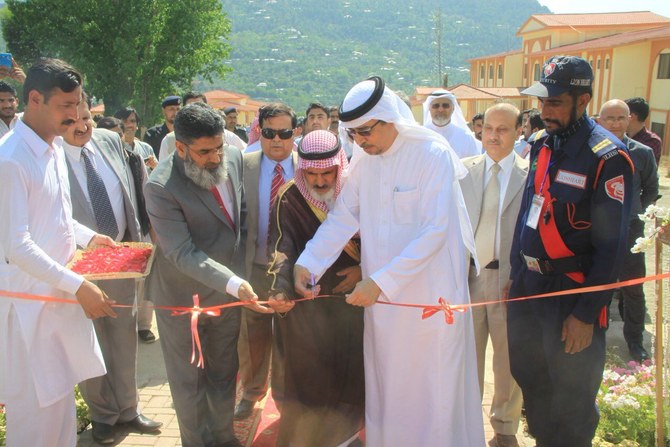
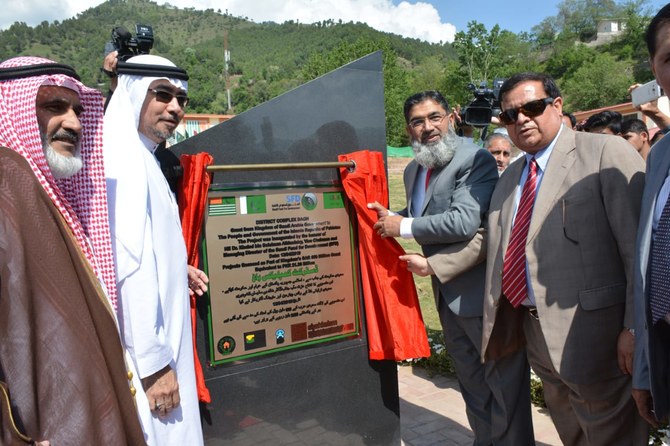
ISLAMABAD: Pakistan’s Earthquake Reconstruction and Rehabilitation Authority (ERRA) and the Saudi Fund for Development (SFD) completed a complex to house government offices in Rawalakot city in Pakistan-administered Kashmir, a spokesperson for ERRA said on Tuesday.
Rawalakot was among the areas hit by a devastating 7.6 magnitude earthquake on Oct. 8, 2005, which wrought widespread death and destruction in Kashmir and parts of Pakistan’s northwestern Khyber Pakhtunkhwa (KP) province.
The death toll from the 2005 quake was more than 75,000 while tens and thousands of buildings, including schools, hospitals, and other state infrastructure, were damaged.
The Saudi-funded complex, inaugurated on Monday, has 25 blocks and will house district government offices, the ERRA official said.
“Government and people of Pakistan highly value the timely contribution of our brotherly country to alleviate miseries of earthquake affected Pakistani people,” the Acting Deputy Chairman of ERRA, Brig Muhammad Latif, said in a statement.
A high-level delegation from SFD, ERRA, officials from the Economic Affair Division, and the Azad Kashmir government were present at the inauguration ceremony of the complex.
“It was the professional commitment and dedication of Adviser Engineer Abdullah M. Al-Shoaibi, Yasir Al Bakri Project Manager Engineer SFD, and Faisal Al Yahya, engineer operation department SFD, that led to the successful completion of the projects,” Latif said.
Saudi Arabia has been an active partner of ERRA in the reconstruction and rehabilitation of earthquake affected areas after October 2005.
“SFD provided a grant of US $160 Million for the construction of educational and health facilities in Kashmir and KP, while at present out of 6 mega projects, 5 mega projects have been successfully completed in governance and education sectors in Kashmir,” ERRA said in a statement.
Saudi Arabia is also funding the King Abdullah University in Muzaffarabad, the capital of Pakistan-administered Kashmir, which is currently under construction and slated to be completed by June 2019, according to Latif.
ERRA’s acting deputy chairman thanked the guests, including the Deputy Head of Mission Habeeb Ullah Al Bokhari, for their support.
According to a UN Financial Tracking Service report released in October last year, Saudi Arabia is ranked fourth among the world’s major donors of humanitarian aid.
In Pakistan itself, the Kingdom has provided assistance amounting to $107.3 million, used in the implementation of 85 projects for displaced people affected by floods and earthquakes between 2005 and 2018, the report said.
In April 2018, Saudi Ambassador to Pakistan Nawaf Saeed Al-Maliki inaugurated the King Abdullah Teaching Hospital in Mansehra, another earthquake-hit district of KP province.


Saudi-funded office block inaugurated in quake-hit Rawalakot city

Saudi-funded office block inaugurated in quake-hit Rawalakot city

- Complex opened in Rawalakot on Monday, has 25 blocks for district government offices
- Saudi Arabia major partner in reconstruction efforts since devastating October 2005 quake in Pakistan

Pakistani students stuck in Afghanistan permitted to go home
- The border between the countries has been shut since Oct. 12
- Worries remain for students about return after the winter break
JALALABAD: After three months, some Pakistani university students who were stuck in Afghanistan due to deadly clashes between the neighboring countries were “permitted to go back home,” Afghan border police said Monday.
“The students from Khyber Pakhtunkhwa (northwest Pakistan) who were stuck on this side of the border, only they were permitted to cross and go to their homes,” said Abdullah Farooqi, Afghan border police spokesman.
The border has “not reopened” for other people, he said.
The land border has been shut since October 12, leaving many people with no affordable option of making it home.
“I am happy with the steps the Afghan government has taken to open the road for us, so that my friends and I will be able to return to our homes” during the winter break, Anees Afridi, a Pakistani medical student in eastern Afghanistan’s Nangarhar province, told AFP.
However, worries remain for the hundreds of students about returning to Afghanistan after the break ends.
“If the road is still closed from that side (Pakistan), we will be forced to return to Afghanistan for our studies by air.”
Flights are prohibitively expensive for most, and smuggling routes also come at great risk.
Anees hopes that by the time they return for their studies “the road will be open on both sides through talks between the two governments.”


