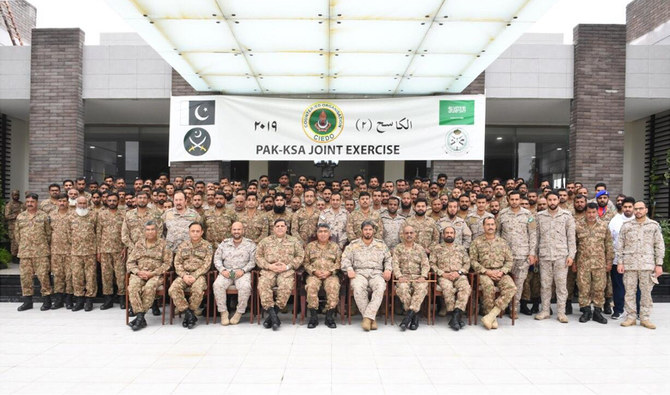
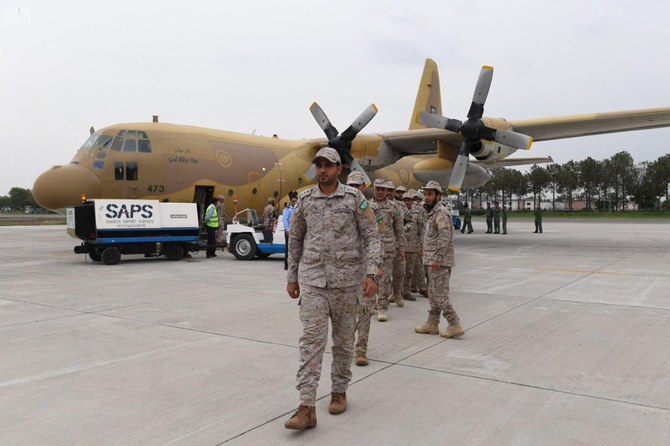
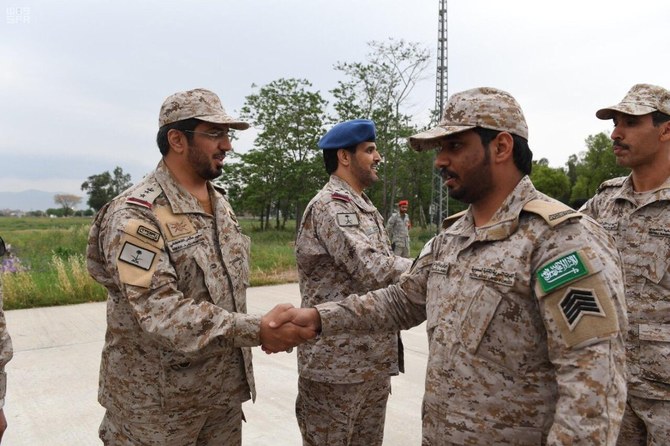
ISLAMABAD: Saudi Arabia and Pakistan launched a joint military exercise this week in the northern Pakistani city of Risalpur in Khyber Pakhtunkhwa, the Pakistan army’s media wing said on Friday, part of a longstanding defense cooperation deal between the two countries.
Royal Saudi land forces arrived in Pakistan on Wednesday and the exercise is expected to conclude on May 3, according to the Saudi Press Agency. The Pakistan army’s media wing said a detailed press statement would be issued once the military exercise was completed.
The exercise, called Kaseh 2, took place at Pakistan’s military college of engineering and is the second phase of a joint 2017 military drill held in the Tabuk region in northwestern Saudi Arabia.
Director General of the Pakistan army’s department of engineering, Maj. Gen. Muhammad Ajmal Iqbal, welcomed Saudi Arabia’s participation and said he looked forward to more joint exercises in the future.
Commander of the Saudi army’s Engineers Battalion 7th brigade, Col. Saeed bin Ayed Al-Qahtani, thanked the Pakistani side for their hospitality and said the exercise aimed to improve combat capabilities of both countries.
“Everyone seeks to make this exercise a success and use every opportunity to achieve the aspirations of the military leaderships,” he said.
Joint military relations between the two countries expanded with the mutual cooperation program of 1967 under which Pakistan provides large-scale combined military training to Saudi armed forces. A 1982 protocol agreement widened the scope of military cooperation to include cooperation in defense production and science and technology.
Since then, both Saudi Arabia and Pakistan have continued sharing military and intelligence data under a number of joint drills between their armies, navies and airforces.

Pakistan, Saudi Arabia team up for ‘Kaseh 2’ military exercise

- Exercise is the second phase of a 2017 drill held in Saudi Arabia
- Saudi Arabia and Pakistan signed a mutual defense cooperation pact in 1967
Pakistan mulls 'Super App' for public services, document verification in major technology push
- Pakistan has been urging technology adoption in public, private sectors as it seeks to become a key tech player globally
- The country this month launched the Indus AI Week to harness technology for productivity, skills development and innovation
KARACHI: Pakistan is planning to launch a “Super App” to deliver public services and enable digital document verification, the country's information technology (IT) minister said on Sunday, amid a major push for technology adoption in public and private sectors.
Pakistan, a country of 240 million people, seeks to become a key participant in the global tech economy, amid growing interest from governments in the Global South to harness advanced technologies for productivity, skills development and innovation.
The country's information and communications technology (ICT) exports hit a record $437 million in Dec. last year, according to IT Minister Shaza Fatima Khawaja. This constituted a 23% increase month on month and a 26% increase year on year.
Pakistan's technology sector is also advancing in artificial intelligence (AI) and cloud computing, marked by the launch of Pakistan’s first sovereign AI cloud in November, designed to keep sensitive data domestic and support growth in the broader digital ecosystem.
“In developed countries, citizens can access all government services from a mobile phone,” Fatima said, announcing plans for the Super App at an event in Karachi where more than 7,000 students had gathered for an AI training entrance test as part of the ‘Indus AI Week.’
“We will strive to provide similar facilities in the coming years.”
Khawaja said the app will reduce the need for in-person visits to government offices such as the National Database and Registration Authority (NADRA) and the Higher Education Commission (HEC).
The Indus AI Week initiative, which ran from Feb. 9 till Feb. 15. was aimed at positioning Pakistan as a key future participant in the global AI revolution, according to the IT minister.
At the opening of the weeklong initiative, Prime Minister Shehbaz Sharif announced that Pakistan would invest $1 billion in AI by 2030 to modernize the South Asian nation’s digital economy.
“These initiatives aim to strengthen national AI infrastructure and make the best use of our human resource,” Khawaja said, urging young Pakistanis to become creators, inventors and innovators rather than just being the consumers of technology.