BANGKOK: Thai authorities have raided a floating home in the Andaman Sea belonging to an American man and his Thai partner who sought to be pioneers in the “seasteading” movement, which promotes living in international waters to be free of any nation’s laws.
Thailand’s navy said Chad Elwartowski and Supranee Thepdet endangered national sovereignty, an offense punishable by life imprisonment or death.
It filed a complaint against them with police on the southern resort island of Phuket. Thai authorities said they have revoked Elwartowski’s visa.
Elwartowski said in an email Thursday that he believes he and Supranee — also known as Nadia Summergirl — did nothing wrong.
“This is ridiculous,” he said in an earlier statement posted online. “We lived on a floating house boat for a few weeks and now Thailand wants us killed.”
The couple, who have gone into hiding, had been living part-time on a small structure they said was anchored outside Thailand’s territorial waters, just over 12 nautical miles from shore. They were not there when the navy carried out their raid on Saturday.
The Thai deputy naval commander responsible for the area said the project was a challenge to the country’s authorities.
“This affects our national security and cannot be allowed,” Rear Adm. Wintharat Kotchaseni told Thai media on Tuesday. He said the floating house also posed a safety threat to navigation if it broke loose because the area is considered a shipping lane.
Seasteading has had a revival in recent years as libertarian ideas of living free from state interference — such as by using crypto-currency including Bitcoin — have become more popular, including among influential Silicon Valley figures such as entrepreneur Peter Thiel. Elwartowski, an IT specialist, has been involved in Bitcoin since 2010.
Several larger-scale projects are under development, but some in the seasteading community have credited the Andaman Sea house with being the first modern implementation of seasteading.
“The first thing to do is whatever I can to help Chad & Nadia, because living on a weird self-built structure and dreaming of future sovereignty should be considered harmless eccentricities, not major crimes,” Patri Friedman, a former Google engineer who heads The Seasteading Institute, said on his Facebook page.
The floating two-story octagonal house at the center of the controversy had been profiled and promoted online by a group called Ocean Builders, which touted it as a pilot project and sought to sell additional units.
The group describes itself as “a team of engineering focused entrepreneurs who have a passion for seasteading and are willing to put the hard work and effort forward to see that it happens.”
In online statements, both Elwartowski and Ocean Builders said the couple merely promoted and lived on the structure, and did not fund, design, build or set the location for it.
“I was volunteering for the project promoting it with the desire to be able to be the first seasteader and continue promoting it while living on the platform,” Elwartowski told The Associated Press.
“Being a foreigner in a foreign land, seeing the news that they want to give me the death penalty for just living on a floating house had me quite scared,” Elwartowski said. “We are still quite scared for our lives. We seriously did not think we were doing anything wrong and thought this would be a huge benefit for Thailand in so many ways.”
Asked his next step, he was more optimistic.
“I believe my lawyer can come to an amicable agreement with the Thai government,” he said.

Thailand says US man’s seasteading home violates sovereignty
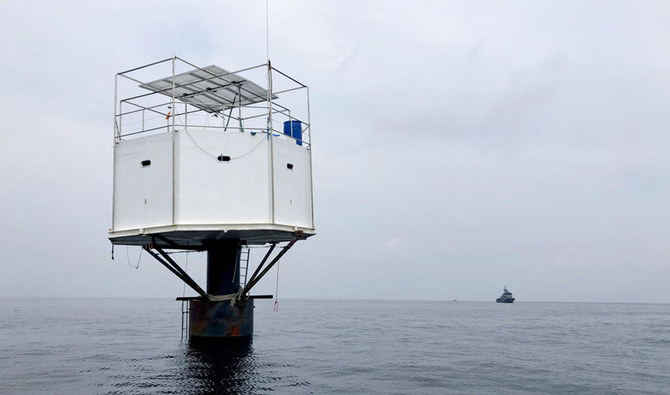
- Seasteading has had a revival in recent years as libertarian ideas of living free from state interference have become more popular
- Thailand’s navy said Chad Elwartowski and Supranee Thepdet endangered national sovereignty
UK cyclists to ride 550km in Saudi Arabia to save children with heart defects
- The H&K Cycle Club was the first team to take the Hejaz route, and their endeavour has since 2022 inspired hundreds of other cyclists to follow suit
- The cyclists expect to face scorching heat, brutal headwinds, sandstorms, and long no-U-turn stretches of roads, along with physical and mental exhaustion
LONDON: A cycling team from London set out on Sunday on a 550km journey from Makkah to Madinah in Saudi Arabia to raise funds for children in developing countries with congenital heart defects.
This is the fifth year that Shamsul Abdin, the head of the H&K Cycle Club, and 40 riders aged between 18 and 65, are taking on the challenge through the Hejaz region.
Abdin told Arab News that the “Hijrah Ride” was a replication of the journey made by Prophet Muhammad over 1,400 years ago, when he migrated from Makkah to Madinah, where he established the first city-state of Islam. This migration, known as Hijrah, also marked the beginning of the Islamic Hijri calendar.
The H&K Cycle Club has expanded from just six riders 14 years ago to more than 40 members from various cities across the UK, including London, Manchester, Oxford, and Birmingham. In November, they began their training in the freezing temperatures of the UK, aiming to cycle over 100 kilometers each day within 6 to 7 hours for a 4-day ride in Saudi Arabia. On Wednesday, they are expected to arrive in Madinah.
They have cycled throughout the UK and parts of Europe, riding from London to Istanbul to raise funds for various causes through Muntada Aid, a charity that works on projects in developing countries and organizes the “Hijrah Ride”.
They were also the first cycling team to take the Hejaz route, and their endeavour has since inspired hundreds of other cyclists to follow suit. Abdin has seen Saudi Arabia become more bike-friendly over the past five years, with cycling lanes integrated into city development, while drivers, locals, and authorities are now more aware of cyclists on the roads.
The cyclists expect to face scorching heat, brutal headwinds, sandstorms, and long no-U-turn stretches of roads, along with physical and mental exhaustion. For many riders, this will be their fifth ride in Hejaz. Some of them include Uber and bus drivers, business analysts, and even entrepreneurs, according to Abdin.
“The headwind feels like climbing a mountain; it’s a constant resistance. To overcome this challenge, we ride in a peloton, taking turns at the front. One person heads into the wind while the others line up behind, shielded from the gusts. After a while, we rotate, allowing everyone a chance to lead,” Abdin explained.
Almost £923,000 has been raised by the “Hijrah Ride” since its inception, to reach a target of one million pounds this year. Some of the money went into emergency aid programs in Gaza and Sudan. Muntada Aid aims to raise about £250,000 for its flagship project, “Little Hearts,” which will fund 150 surgeries for children with congenital heart defects in Pakistan and Bangladesh this year.
“I fell in love with this project, which gives children the opportunity to live up to their potential as adults, truly,” said Abdin, who was awarded the MBE (Member of the Order of the British Empire) in December for his contribution to charitable fundraising.
The riders will be escorted by two vehicles, one in front and one in the rear, carrying paramedics and media staff, along with food and water. They will split into two groups based on their cycling powers. Along the route, they will pass several locations, including Jeddah on the Red Sea, King Abdullah Economic City, Rabigh, Masturah, and Badr, before reaching the elevated roads of Madinah, where their journey, which started with performing Umrah in Makkah, will end.
Muntada Aid is a part of Al-Muntada Trust, which was founded in 1986 by a group of Middle Eastern students, including individuals from Qatar and Saudi Arabia, to address the famine crisis in Ethiopia. Since then, the organization has assisted children in 17 countries, including Somalia, Sudan, Chad, Kosovo, Bosnia, Bangladesh, Pakistan, Mali, and Niger. They focus on developing infrastructure in education, health, water and sanitation sectors.
Nasrun Mir, the marketing director of Muntada Aid, told Arab News that they support “Hijrah Ride” with financial backing and logistics, and that they have obtained permits through communication with the Saudi Ministry of Transport, the Ministry of Foreign Affairs, the Saudi embassy in London, and the British Consulate in Jeddah.
Mir, who is joining the journey as part of the media team this week, said that the reception in Saudi Arabia could not be friendlier.
“People offer us free food and drinks. They want to have conversations with us. They want to know what we do. In the Middle East, there is still no concept of using sports as a tool for charity. The general idea is that if I want to give money to the charity, I’ll give it to them. You don’t need to run. You don’t need to cycle,” Mir said.
In one incident, a local community prevented the riders from passing through their village unless they disembarked and sat down to eat with them. In particular sections of the road near Madinah, a Saudi police vehicle has escorted the riders for a few kilometers, he added.
“There have been incidents where people have stopped us from eating our own food during the break. They literally took our food and said, ‘No, you come to our village; you cannot eat your food. You have to have food, which we will prepare.’ This delayed ride for a couple of hours,” Mir said.


