India’s Jet Airways suspends all operations

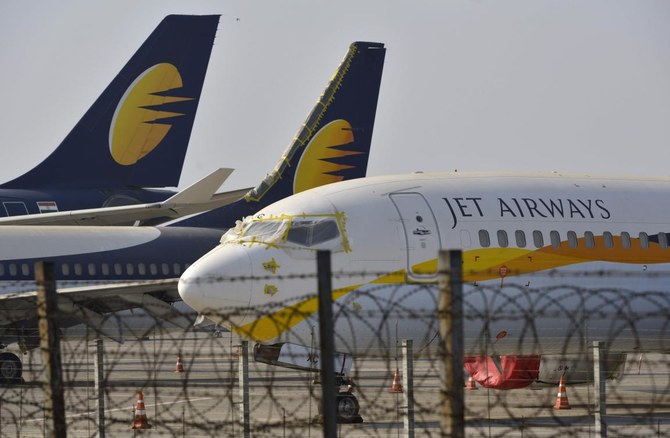
Jet Airways aircraft parked on the tarmac at Chattrapati Shivaji International Airport in Mumbai. The Indian airline has grounded all of its operations after failing to secure emergency funding. (AFP)
Updated 17 April 2019
Follow

India’s Jet Airways suspends all operations

  • Jet had asked a consortium of lenders led by the State Bank of India to urgently provide four billion rupees ($57.5 million) but said that this had not been forthcoming
  • The airline was once India’s second-biggest by market share but is on the brink of collapse with debts of more than $1 billion

MUMBAI: India’s debt-stricken Jet Airways grounded all of its operations Wednesday after failing to secure emergency funding from lenders, the carrier said in a statement.
“Jet Airways is compelled to cancel all its international and domestic flights. The last flight will operate today,” it said, adding that the decision would take “immediate effect.”
Jet had asked a consortium of lenders led by the State Bank of India to urgently provide four billion rupees ($57.5 million) but said that this had not been forthcoming.
“This has been a very difficult decision but without interim funding, the airline is simply unable to conduct flight operations in a manner that delivers to the very reasonable expectations of its guests, employees, partners and service providers,” it added.
The airline was once India’s second-biggest by market share but is on the brink of collapse with debts of more than $1 billion.
Jet was operating just five planes on Wednesday because it could not pay its bills, down from a fleet of more than 120 at its peak.
The carrier has canceled hundreds of flights in recent weeks, stranding thousands of passengers.
It has repeatedly defaulted on loans and failed to pay staff in recent months.
The consortium took control of Jet in March, pledging to give $218 million in “immediate funding support” as part of a debt resolution plan.
But they have failed to release most of the money and the banks also failed to agree after a meeting of several hours on Monday on how to proceed.
The SBI-led consortium is looking for a buyer for Jet and a deadline passed on Friday for prospective bidders to express an interest in acquiring a 75 percent stake in the carrier.
The SBI is yet to announce a shortlist of prospective bidders but Indian media said four were in the running including Etihad Airways, which already owns a 24 percent stake.
“Jet Airways will now await the bid finalization process by SBI and the consortium of Indian Lenders,” the airline said, adding that it hoped to resume services “as soon as possible.”
Bad investments, competition from several low-cost carriers, high oil prices and a weak rupee have led to Jet’s current financial predicament, analysts say.
A collapse of Jet, and the loss of more than 20,000 jobs, would deal a blow to Prime Minister Narendra Modi’s pro-business reputation as he seeks a second term in ongoing national elections.


Saudi minister at Davos urges collaboration on minerals

Global collaboration on minerals essential to ease geopolitical tensions and secure supply, WEF hears. (Supplied)
Updated 20 January 2026
Follow

Saudi minister at Davos urges collaboration on minerals

  • The reason of the tension of geopolitics is actually the criticality of the minerals

LONDON: Countries need to collaborate on mining and resources to help avoid geopolitical tensions, Saudi Arabia’s minister of industry and mineral resources told the World Economic Forum on Tuesday.

“The reason of the tension of geopolitics is actually the criticality of the minerals, the concentration in different areas of the world,” Bandar Alkhorayef told a panel discussion on the geopolitics of materials.

“The rational thing to do is to collaborate, and that’s what we are doing,” he added. “We are creating a platform of collaboration in Saudi Arabia.”

Bandar Alkhorayef, Saudi Minister of Industry and Mineral Resources 

The Kingdom last week hosted the Future Minerals Forum in Riyadh. Alkhorayef said the platform was launched by the government in 2022 as a contribution to the global community. “It’s very important to have a global movement, and that’s why we launched the Future Minerals Forum,” he said. “It is the most important platform of global mining leaders.”

The Kingdom has made mining one of the key pillars of its economy, rapidly expanding the sector under the Vision 2030 reform program with an eye on diversification. Saudi Arabia has an estimated $2.5 trillion in mineral wealth and the ramping up of extraction comes at a time of intense global competition for resources to drive technological development in areas like AI and renewables.

“We realized that unlocking the value that we have in our natural resources, of the different minerals that we have, will definitely help our economy to grow to diversify,” Alkhorayef said. The Kingdom has worked to reduce the timelines required to set up mines while also protecting local communities, he added. Obtaining mining permits in Saudi Arabia has been reduced to just 30 to 90 days compared to the many years required in other countries, Alkhorayef said.

“We learned very, very early that permitting is a bottleneck in the system,” he added. “We all know, and we have to be very, very frank about this, that mining doesn’t have a good reputation globally.

“We are trying to change this and cutting down the licensing process doesn’t only solve it. You need also to show the communities the impact of the mining on their lives.”

Saudi Arabia’s new mining investment laws have placed great emphasis on the development of society and local communities, along with protecting the environment and incorporating new technologies, Alkhorayef said. “We want to build the future mines; we don’t want to build old mines.”