

UN weighs measure demanding immediate cease-fire in Libya

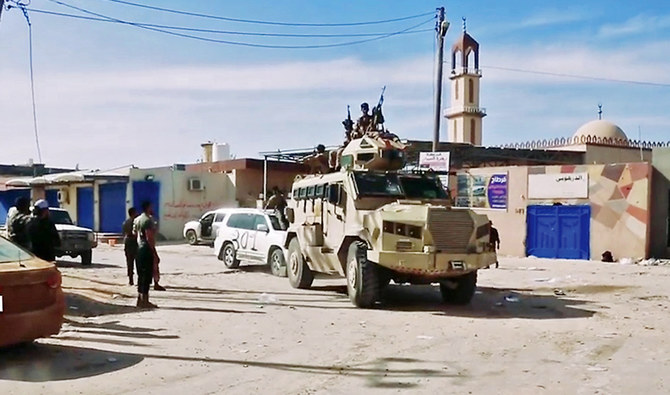
A video grab shows fighters riding atop an armored vehicle in Tripoli on Tuesday. (AFP)
Updated 17 April 2019
Follow

UN weighs measure demanding immediate cease-fire in Libya

  • Council ‘demands that all parties in Libya immediately de-escalate the situation’

NEW YORK: Britain has presented a draft resolution to the UN Security Council demanding an immediate cease-fire in Libya after forces loyal to Khalifa Haftar launched an offensive on Tripoli, according to the text obtained by AFP on Tuesday.

The proposed measure said the offensive by Haftar’s Libyan National Army (LNA) “threatens the stability of Libya and prospects for a United Nations-facilitated political dialogue and a comprehensive political solution to the crisis.”

The council “demands that all parties in Libya immediately de-escalate the situation, commit to a cease-fire, and engage with the United Nations to ensure a full and comprehensive cessation of hostilities throughout Libya,” the draft says.

Dozens of people have been killed and more than 18,000 displaced since fighting broke out on April 4.

Britain circulated the text late Monday and a first round of negotiations is to be held immediately, diplomats said.

Britain hopes to bring the measure to a vote at the council before Friday, but diplomats said it remained unclear whether negotiations on the measure would wrap up that quickly.

Resolutions adopted by the council are legally binding.

The proposed measure echoed a call for a cease-fire by UN Secretary-General Antonio Guterres, who was in Libya to personally advance prospects for a political solution when the offensive was launched.

Haftar has declared he wants to seize the capital, now controlled by a UN-recognized government and an array of militias.

Haftar backs a rival administration based in eastern Libya that is refusing to recognize the authority of the Tripoli government.

The draft resolution calls on all sides in Libya “immediately to re-commit” to UN peace efforts and urges all member-states “to use their influence over the parties” to see that the resolution is respected.

Diplomats have long complained that foreign powers backing rival sides in Libya threatened to turn the conflict into a proxy war.

Russia and France, two permanent council members, have praised Haftar’s battlefield successes in defeating Libyan armed groups aligned with Daesh in the south of the country.

Haftar’s offensive on the capital forced the UN to postpone a national conference that was to draw up a roadmap to elections, meant to turn the page on years of chaos since the 2011 ouster of Muammar Qaddafi.

Guterres has said that serious negotiations on Libya’s future cannot resume without a cease-fire.

Meanwhile, traumatized men, women and children are living in cramped huts at a shut-down factory in the Libyan capital that used to house workers but are now makeshift shelter for civilians uprooted by conflict.

More than 18,000 people have been displaced, according to the UN.

Many been unable to leave the southern districts of Tripoli, trapped by non-stop shelling and gunbattles where the advance has been stopped for now by Tripoli forces.

Streets have been changing hands as both sides have been unable to gain significant ground, leaving families trapped near the frontline seeking shelter with neighbors.

Among those who got out was 19-year-old Ali, who fled with his family and is now living in a hut built for men making truck trailers at the now defunct factory.

“We were evacuated from our home after three days of clashes,” Ali said. “This shirt I’m wearing is the only item of clothing I have.”

He is a former fighter for one of the myriad of armed groups that have dominated life in Libya since the overthrow of Muammar Qaddafi in 2011, filling the political and security vacuum.

Wounded in fighting last summer, he quit the group.

“They paid me 100 dinars ($70) a day ... now I’m broke but this is better than fighting,” he said.

Some 47 families are housed in the camp with up to six individuals to each small room.

The factory itself if a victim of the chaos that has reigned in Libya as foreign firms pulled out since 2011 and workplaces closed.

One mother at the factory was away on a pilgrimage in Saudi Arabia when the latest fighting broke out. She came straight from Tripoli airport to the shelter to be with the rest of her family who had fled their home.

“My family managed to bring the family papers but not my jewelry,” she said, sitting next to her daughter on a mattress on the floor, her head in her hands.

Her father, suffering from Parkinson’s, only muttered: “What can we do?“

In another hut, 34-year-old housewife Nabila Ayad Al-Ammari prayed for the friends she had left behind.


UN nuclear watchdog says it’s unable to verify whether Iran has suspended all uranium enrichment

Updated 3 sec ago
Follow

UN nuclear watchdog says it’s unable to verify whether Iran has suspended all uranium enrichment

VIENNA: Iran has not allowed the United Nations nuclear watchdog to access nuclear facilities affected by the 12-day war in June, according to a confidential report by the watchdog circulated to member states and seen Friday by The Associated Press.
The report from the International Atomic Energy Agency stressed that therefore it “cannot verify whether Iran has suspended all enrichment-related activities,” or the “size of Iran’s uranium stockpile at the affected nuclear facilities.”
The IAEA report on Friday warned that due to the continued lack of access to any of Iran’s four declared enrichment facilities, the agency “cannot provide any information on the current size, composition or whereabouts of the stockpile of enriched uranium in Iran.”
The report stressed that the “loss of continuity of knowledge over all previously declared nuclear material at affected facilities in Iran needs to be addressed with the utmost urgency.”
Iran long has insisted its program is peaceful, but the IAEA and Western nations say Tehran had an organized nuclear weapons program up until 2003.
Highly enriched material should be verified regularly
According to the IAEA, Iran maintains a stockpile of 440.9 kilograms (972 pounds) of uranium enriched up to 60 percent purity — a short, technical step away from weapons-grade levels of 90 percent.
That stockpile could allow Iran to build as many as 10 nuclear bombs, should it decide to weaponize its program, IAEA director general Rafael Grossi warned in a recent interview with the AP. He added that it doesn’t mean that Iran has such a weapon.
Such highly enriched nuclear material should normally be verified every month, according to the IAEA’s guidelines.
The IAEA also reported that it had observed, through the analysis of commercially available satellite imagery, “regular vehicular activity around the entrance to the tunnel complex at Isfahan.”
The facility in Isfahan, some 350 kilometers (215 miles) southeast of Tehran, was mainly known for producing the uranium gas that is fed into centrifuges to be spun and purified.
Israel has struck buildings at the Isfahan nuclear site, among them a uranium conversion facility. The US also struck Isfahan with missiles during the war last June.
The IAEA also reported that through the analysis of commercially available satellite imagery, it has observed “activities being conducted at some of the affected nuclear facilities, including the enrichment facilities at Natanz and Fordow,” but it added that “without access to these facilities it is not possible for the Agency to confirm the nature and the purpose of the activities.”
The confidential IAEA report also said Friday that Iran did provide access to IAEA inspectors “to each of the unaffected nuclear facilities at least once since the military attacks of June 2025, with the exception of Karun Nuclear Power Plan, which is in the early stages of construction and does not contain nuclear material.”
IAEA joined Geneva talks between Iran and US
The IAEA reported on Friday that Grossi attended negotiations between the US and Iran on Feb. 17 and Feb. 26 in Geneva at which he “provided advice on issues relevant to the verification of Iran’s nuclear program.” The report said that those negotiations are “ongoing.”
The Trump administration has held three rounds of nuclear talks this year with Iran under Omani mediation. Thursday’s round of talks in Geneva ended without a deal, leaving the danger of another Mideast war on the table as the US has gathered a massive fleet of aircraft and warships in the region.
Oman’s Foreign Minister Badr Al-Busaidi said technical talks involving lower-level representatives would continue next week in Vienna, the home of the IAEA. The agency is likely to be critical in any deal.
The US is seeking a deal to limit Iran’s nuclear program and ensure it does not develop nuclear weapons.
Iran says it is not pursuing weapons and has so far resisted demands that it halt uranium enrichment on its soil or hand over its stockpile of highly enriched uranium.
Similar talks last year between the US and Iran about Iran’s nuclear program broke down after Israel launched what became a 12-day war on Iran, that included the US bombing Iranian nuclear sites.
Before the June war, Iran had been enriching uranium up to 60 percent purity.