

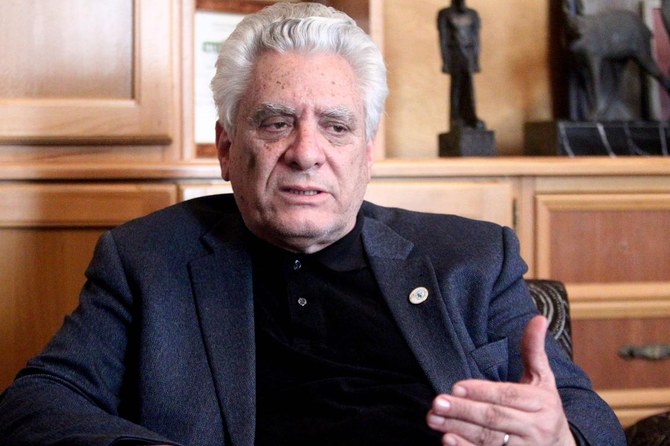
Algerian rights lawyer Mustapha Bouchachi, a leading voice for change

Algerian lawyer Mostefa Bouchachi speaks during an interview in Algiers on April 14, 2019. (AFP)
Updated 16 April 2019
Follow

Algerian rights lawyer Mustapha Bouchachi, a leading voice for change

  • Bouchachi found himself labelled a “lawyer of the Islamists” for defending victims of torture and arbitrary arrests during Algeria’s civil war of 1992-2002
  • He was recognized as a mentor to demonstrators who have mobilized against “the system” and forced long-time ruler Bouteflika to step down

ALGIERS: Emotion filled the voice of Mustapha Bouchachi as the Algerian veteran lawyer and human rights activist recalled the peaceful mass protests that swept aside President Abdelaziz Bouteflika.
The young protesters “are finishing what my generation failed to do,” said the man who became a mentor to demonstrators who have mobilized against “the system.”
Bouchachi, in his mid-60s, has been careful not to try to “seize” the youth-driven movement even as he helped formulate its demands, notably in Facebook video clips that exceeded 200,000 views.
Whether speaking in his old-fashioned Algiers office or addressing university students, he has been tireless in explaining the goals of what he calls the “revolution of smiles.”
“I am proud that many Algerians trust me, but this is the demonstration of young people,” he told AFP, refusing the status of spokesman for the activists who ended Bouteflika’s two-decade reign on April 2.
“We can accompany and give advice, but we must not steal” their movement, he said.
Bouchachi’s eyes filled with tears as he recalled his amazement when crowds of Algerians began to peacefully take to the streets on February 22.
“I was so afraid that there would be no-one, that we would just be a few thousand, isolated, like in 2011,” he said, referring to the Arab Spring uprisings that started in Tunisia but largely bypassed Algeria.
This time around, he admitted, “I cried with joy,” his grave face transforming into a deep smile.
He pointed to Algeria’s 1962 independence from French colonial rule and said: “I told myself that it is these young people who will finish liberating the country, because our fathers liberated the land of Algeria but the people were not free.”
Bouchachi was seven years old when his father was killed fighting in the independence war.
When asked whether he has a political bias, Bouchachi replied without hesitation: “democracy.”
“You can’t have politics in a totalitarian regime,” he said. “All politicians must campaign for the rule of law, this is the priority. Only after that we can have debates between left and right.”
Bouchachi studied law in Britain on a scholarship and graduated at the age of 25.
After defending victims of torture and arbitrary arrests during Algeria’s civil war of 1992-2002, he found himself labelled a “lawyer of the Islamists.”
But he stressed that he is “not selective in the fight against human rights violations,” adding that “now I am being labelled a secular leftist.”


Mustapha Bouchachi, a rights activist and lawyer, marches with others during a protest to demand the immediate resignation of President Abdelaziz Bouteflika, in Algiers, Algeria on March 23, 2019. (REUTERS/Ramzi Boudina/File Photo)


From 2007 to 2012, he was president of the Algerian League for Human Rights, at a time when the regime was using a mix of repression and social measures to pre-empt street protests.
He was elected to parliament in 2012 for the Front of Socialist Forces, on the promise of having “a forum to question ministers.”
But when he found his questions remained unanswered, Bouchachi left the legislature in 2014 to go back to his legal practice.
In recent weeks he returned to the political scene where, backed by his four student children, he has been hammering home the message of non-violence.
“Our only weapon is the peaceful nature of the demonstrations,” he told students.
Bouchachi has also urged young people to resist the temptation of wanting to sweep away all politicians and officials, including those in the opposition.
“You have to aim at the heads of the system,” he said. “When they are gone, then we can get organized.”
He now hopes for “nine months or a year of transition,” a process he said must include youth who took the lead in the street protests as well as opposition parties, civil society and political leaders from the pre-Bouteflika era.
As for the army, he said, “you have to be pragmatic. It’s a strong institution, we need them for the transition. But they must accompany, not interfere in, the people’s affairs.”


How Israeli land grabs are redrawing the map of Palestine’s Jordan Valley

Updated 18 December 2025
Follow

How Israeli land grabs are redrawing the map of Palestine’s Jordan Valley

  • A major incursion in Tubas caused damage and displacement, but residents say a planned 22-km barrier poses bigger threat
  • Israel calls the “Scarlet Thread” wall a security measure; activists say it’s a land grab severing the Jordan Valley

LONDON: Israeli raids are not new to Tubas, a Palestinian governorate in the northern West Bank’s western Jordan Valley. But fears of de-facto annexation have intensified since November, after land confiscation orders were issued for a planned barrier dubbed the “Scarlet Thread.”

On Nov. 26, Israeli security forces, backed by a helicopter that reportedly opened fire, sealed off the governorate and raided Tubas City and nearby towns, including Tammun, Aqqaba, Tayasir and Wadi Al-Fara — home to more than 58,000 people.

The operation involved drones, aircraft, bulldozers and curfews, according to the UN Office for the Coordination of Humanitarian Affairs, OCHA.

At least 160 Palestinians were injured, OCHA said, while homes and infrastructure sustained extensive damage. The raids also displaced residents and disrupted essential services, including water supplies.

A man stands okn the ruins of a Palestinian building destroyed on the day of an Israeli raid in Tammoun, near Tubas, in the Israeli-occupied West Bank, on May 15, 2025. (REUTERS)

In Al-Fara refugee camp, OCHA noted, Israeli forces seized at least 10 residential buildings, forcing at least 20 families to flee, and detained and interrogated dozens of Palestinians before withdrawing.

The Palestinian Detainees’ Affairs Society said 29 young men were detained in the camp and later released, with the exception of one.

Israeli military and internal security officials described the operation as part of a broad “counterterrorism” campaign.

Locally, however, concerns have grown not only over the scale of the assault but also its timing, which coincided with new land confiscation orders in the Jordan Valley.

Ahmed Al-Asaad, the Tubas governor, said the Israeli military has issued nine land confiscation orders to carve out a 22-kilometer settlement road that would isolate large areas of the Jordan Valley and extend to within 12 kilometers of the Jordanian border.

Israeli soldiers take part in an operation in Tubas, in the Israeli-occupied West Bank, on November 26, 2025. (REUTERS/Mohamad Torokman)

Although the orders were signed in August, Al-Asaad told Arab News that Palestinian landowners were not notified until Nov. 21, nearly three months later, and were given insufficient time to appeal.

An Arabic-language notice obtained by Arab News via WhatsApp from Mutaz Bisharat, a Palestinian official overseeing Jordan Valley affairs in Tubas, stated that the Israeli military ordered the confiscation of Palestinian land “for military purposes.”

Signed by Avi Bluth, head of the Israeli military in the West Bank, on Aug. 28, the order took effect “on the date of its signing” and remains in force until Dec. 31, 2027.

It instructed those “in possession of the lands” to remove all equipment and vegetation within seven days. It also said objections could be filed within seven days of the notice’s publication date through Israeli liaison offices.

Al-Asaad said landowners were given “only one week” to file objections, noting that two days fell on a weekend, while four days coincided with curfews during the first raid and two more during a second large-scale incursion.

“As a result, residents were unable to prepare land ownership documents,” he said.

Opinion

This section contains relevant reference points, placed in (Opinion field)

Palestinian landowners were invited on Dec. 3 to tour the land earmarked for confiscation. The seven-day appeal window, Al-Asaad said, was counted from the day of that tour.

But on Dec. 1, Israeli forces launched another large-scale operation, a day after withdrawing from the nearby Tammun. The three-day raid imposed an open-ended curfew on Tubas City and surrounding towns, according to OCHA.

During the operation, forces blocked five main roads with earth mounds, three in Tubas City and two in Aqqaba, as well as several secondary roads, severely restricting movement for about 30,000 Palestinians.

At least eight residential buildings were converted into military posts, forcibly displacing at least 11 families, OCHA said in a Dec. 4 situation update.

The land earmarked for confiscation under the “Scarlet Thread” project covers about 1,160 dunams, 85 percent of which is privately owned by residents of Tubas and Tammun, The Times of Israel reported, citing an X post by Israeli civil rights activist Dror Etkes.

Dunam is a unit of land area equal to 1,000 square meters or 0.1 hectares.

The Israeli military told the newspaper that the project was introduced based on a “clear military need” to prevent arms smuggling and “terror attacks.”

Etkes rejected that justification, saying the real aim was to “ethnically cleanse” the land between the proposed barrier and what Israel calls the Allon Road to the east, an area of about 45,000 dunams, with residents ultimately forced out.

On Dec. 1, the Israeli newspaper Haaretz reported that the army was preparing to build a new separation wall deep inside the occupied West Bank, in the heart of the Jordan Valley. The wall would stretch 22 kilometers and span 50 meters in width, cutting Palestinians off from tens of thousands of dunams of land.

According to the report, the project would require demolishing homes, agricultural buildings, wells, water lines and trees along the route.

It would also encircle the herding community of Khirbet Yarza, isolating about 70 residents who depend on several thousand sheep for their livelihood, and separate agricultural and pastoral communities from their lands, similar to what the separation barrier in the western West Bank has done.

Palestinians say the plan, if implemented, amounts to annexation of the northern West Bank.

“New notices have been issued, pursuant to the military orders, for the seizure of citizens’ lands in the areas of Tubas and Tammun, for the purpose of removing homes and agricultural projects, including greenhouses, sheds, and sheep pens,” Bisharat told Arab News.

He said authorities also ordered the removal of a 5-kilometer water pipeline.

“This decision will effectively end the Palestinian presence and agriculture on more than 22,000 dunams of cultivated land and lead to the displacement of more than 60 families,” he added.

While the Israeli military says the land is being seized for a road and barrier, Bisharat argues the true objective is annexation.

“These notices are issued under the pretext of opening a road and constructing the separation wall in Buqeia and the Jordan Valley,” he said. “But through these notices, the (Israeli) occupation is waging a war against the Palestinian presence in all residential communities, and against all farmers and agricultural projects.”

He added that Israel’s plan involves a “50-meter-wide corridor, along with a wall, gates and an earthen trench,” measures he described as “a new border demarcation” that would separate the Jordan Valley from the rest of the governorate.

“This is an annexation process,” he said. “As a result, we will be left without borders, without water, and without Palestine’s food basket, and will lose approximately 190,000 dunams of land.”

Al-Asaad echoed those warnings, saying Israel’s plans amount to de-facto annexation.

“The new settlement plan, under which the occupation forces intend to establish an apartheid separation wall, will separate the Jordan Valley from Tubas governorate and confiscate areas estimated at hundreds of thousands of dunams,” he said. “This constitutes a plan to annex the Jordan Valley.”

He warned the project would inflict severe political, economic and agricultural losses, undermine prospects for a Palestinian state and isolate Tubas from its eastern border with Jordan under 12 km of Israeli control.

By Dec. 12, around 1,000 dunams of Palestinian land have been reportedly confiscated. The UN Human Rights Office described Israel’s military road project as “another step towards the progressive fragmentation of the West Bank.”

“This is the most fertile land in the West Bank and the road is likely going to separate Palestinian communities from each other and the Palestinian farmers in Tubas from … land they own on the other side of the planned barrier,” said Ajith Sunghay, head of the OHCHR’s office in the Occupied Palestinian Territory.

Immediately after the seizure orders were issued, Al-Asaad said, local authorities submitted an initial objection through the Northern Jordan Valley file and the Colonization and Wall Resistance Commission, collected powers of attorney and land deeds, and coordinated with land departments to document ownership.

“We continue to work on submitting objections through attorney Tawfiq Jabarin,” he added, reiterating that curfews and military operations severely limited their ability to complete the legal file.

Etkes, however, dismissed the objection process as meaningless, saying Israel’s judiciary would reject the appeals.

Still, Tubas residents say they will continue to resist. Al-Asaad said officials plan to internationalize the issue, urging the Palestinian Foreign Ministry to organize tours for diplomats and raise the case in international forums.

“We will mobilize local and international media to expose the danger of a plan that would seize half the governorate’s land and destroy the two-state solution,” he said.

IN NUMBERS:

188 Palestinians killed in occupation-related violence in the West Bank since January 2025.

45 Children accounted for nearly a quarter of the above-mentioned victims.

(Source: UNRWA)

Jabarin, a Palestinian lawyer and human rights activist representing landowners, submitted an initial objection in late November, according to the Al-Quds Al-Arabi newspaper.

He argued that Jordan already shares a secure border with the Jordan Valley and that an internal wall would not prevent arms smuggling.

He said Palestinian communities are the ones who need protection from repeated settler attacks.

The developments in Tubas come amid a broader West Bank escalation following the Hamas-led Oct. 7, 2023, attack on southern Israel from Gaza and the devastating Israeli military retaliation.

Israel has sharply restricted movement, erecting new checkpoints and sealing off communities.

Since January, Israeli forces have intensified operations, killing dozens and displacing tens of thousands. The campaign began in Jenin refugee camp on Jan. 21, dubbed “Operation Iron Wall,” and expanded to Tulkarem and Nur Shams, displacing at least 32,000 people in January and February alone, according to UN figures.

Human Rights Watch said on Nov. 20 that Israel’s forced expulsions in West Bank refugee camps amount to war crimes and crimes against humanity — allegations Israel denies.

The UN says large-scale operations in Jenin and Tubas governorates affected more than 95,000 Palestinians between Nov. 25 and Dec. 1.

All of this has unfolded alongside accelerated settlement expansion and rising settler violence.

So far this year, OCHA has documented 1,680 settler attacks across more than 270 communities — an average of five per day — with the olive harvest season marked by widespread assaults on farmers, trees, and agricultural infrastructure.

In a landmark decision in July 2024, the International Court of Justice ruled that Israel’s occupation of the Palestinian territories is unlawful.

The Court also ruled that Israel must “immediately and completely cease all new settlement activities, evacuate all settlers, stop the forcible transfer of the Palestinian population, and prevent and punish attacks by its security forces and settlers.”

UN experts in 2025 referred to this advisory opinion to criticize ongoing settlement expansions and military operations as violations of international law.