KARACHI: Counterterrorism police in Pakistan’s Sindh province said on Monday they had arrested six suspected militants that were part of a terror network suspected of ties to a neighboring Muslim country and allegedly carrying out sectarian attacks in the port city of Karachi since 2003.
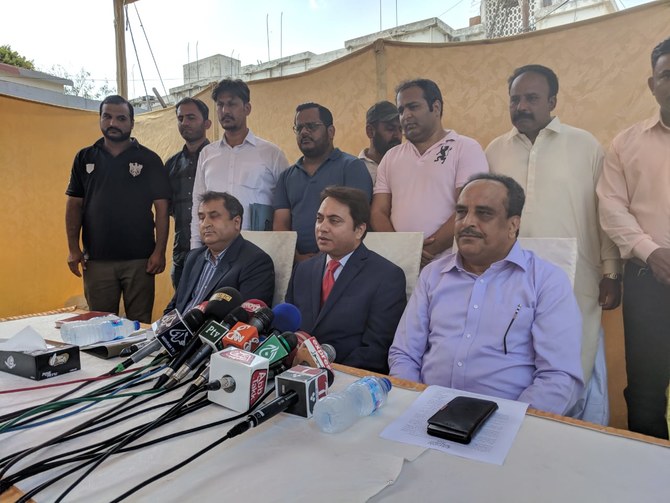
Abdullah Shaikh, Deputy Inspector General of the Counter Terrorism Department, told reporters six people had been arrested, one of them a police constable. The suspects were linked to 31 sectarian attacks in which at least 50 people had been killed, Shaikh said, and had been hiding in, and receiving financial help from, a neighboring Muslim country since 2003.
Shaikh did not specify which country he was referring to but in response to reporters’ questions, he ruled out that it was Afghanistan, leading to speculation that the country in question was Iran.
“The arrested terrorists would hide in a neighboring Islamic country after killing people in Karachi on sectarian grounds,” Shaikh said. “They are highly qualified and are trained in a foreign country from where they would also get financial help.”
He said they had disclosed details of future targets but did not share the details with reporters.
Raja Umar Khattab, another senior official at the Counter Terrorism Department, said police had raided a building in Karachi’s Ahsanabad area on March 29 after receiving a tip that militants linked to banned sectarian outfits, Tehrik-e-Jafaria Pakistan and Sipaha-e-Muhammad Pakistan, were hiding there. The suspects managed to flee then.
“We continued the chase and today morning arrested six terrorists from Business Recorder Road,” Khattab said, adding that three of the suspects were already on Sindh Police’s “red-book of hardened terrorists.”
He said the arrested suspects were involved in attacks that killed 50 people, including four policemen and two private guards.
“A joint interrogation team has been formed, which will further interrogate the arrested terrorists,” Khattab said.
In a separate incident, Karachi police arrested five militants allegedly linked to the international Daesh group and using social media to recruit new members for the organization.


![]()
![]()
![]()

Pakistan says six militants linked to ‘Islamic neighboring country’ arrested


Pakistan says six militants linked to ‘Islamic neighboring country’ arrested
- Police officials decline to name which country but rule out Afghanistan
- Arrested suspects linked to 31 sectarian attacks in which 50 people killed
Latest updates


Recommended


© 2026 SAUDI RESEARCH & PUBLISHING COMPANY, All Rights Reserved And subject to Terms of Use Agreement.